With the help of a $28,400 grant from the Lower Colorado River Authority, the city of Burnet will make high-tech improvements to its water metering infrastructure that should reduce water waste and save customers money.
The grant, provided through LCRA’s Firm Water Conservation Cost-Share Program, will help the city install new cellular water meters as part of an “advanced metering infrastructure system,” according to an Aug. 8 media release from the LCRA. The system will include an online portal where customers can track their water use in real time, helping them spot potential leaks, increase conservation, and avoid costly bills.
Burnet City Engineer Eric Belaj said testing has shown that roughly 17 percent of the existing meters in the city fail to accurately read water usage. In addition, meter readings are collected only once a month, so residential and business customers sometimes discover leaks only when their monthly bills arrive.
“One of the challenges we face right now is that many of our existing meters aren’t sensitive enough to detect small flows, such as slow-drip leaks,” Belaj said in the media release. “The new meters we’re installing will fix that problem.”
The LCRA grant will help the city carry out the initial $232,800 phase of a four-phase project expected to be completed in two to three years. In the first phase, about 30 percent of the meters will be replaced or reprogrammed to function in the new AMI system. The new system will enable the city to pinpoint leaks and alert customers, better analyze water use trends, and share water conservation tips.
The first phase of the project is expected to save about 7 acre-feet—or around 2.3 million gallons—of water annually. The city estimates it will save about $32,000 a year with the new system.
“This upgrade isn’t just about finding and fixing leaks; it’s also about empowering our community to better monitor and manage water use, especially in regard to irrigation and compliance with drought contingency plans,” Belaj said. “We are grateful that LCRA has been, and continues to be, a great partner in water conservation.”
LCRA Executive Vice President of Water John Hofmann said the river authority supports Burnet’s efforts to reduce water loss and conserve water from the Highland Lakes.
“By adopting this new metering technology, the city of Burnet will increase water conservation, benefit its water utility customers, and save the city money,” Hofmann said in the release. “We are proud to help with this project to incorporate technology to pinpoint leaks, allowing the city and its customers to respond more quickly and reduce water waste.”
Cost-share grants are awarded through LCRA’s Firm Water Conservation Cost-Share Program to fund water efficiency projects and programs established by the authority’s firm water customers, which includes cities, utilities, industries, and irrigation and recreational water users.
Eligible projects must help reduce or maximize the efficient use of surface water, including water-loss reduction efforts, equipment efficiency upgrades, conversion of irrigated areas from raw or potable water to recycled water, and emerging technology projects focused on education, outreach, or technology advancements. Learn more at WaterSmart.org.
The LCRA also offers residential rebates to help offset the cost of upgrading irrigation systems, maintaining landscapes and pools, converting turf to drought-tolerant landscapes, and soil testing. See WaterSmart.org/rebates for more information.
News stories, staff photos, and other online content are copyrighted property of Victory Media. Reproduction in part or in whole is prohibited without the express written consent of the publisher.
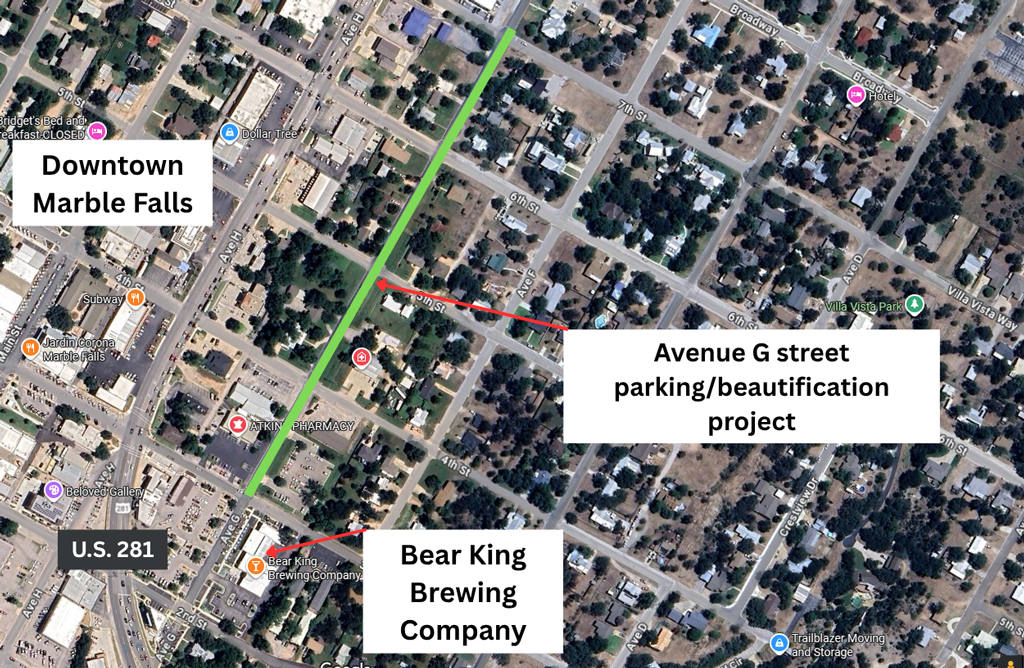
An Avenue G property owner got the greenlight to upgrade parking and pedestrian paths along a portion of the street, which runs parallel to U.S. 281 in Marble Falls. The project could change the look and feel of the east side of highway near downtown.
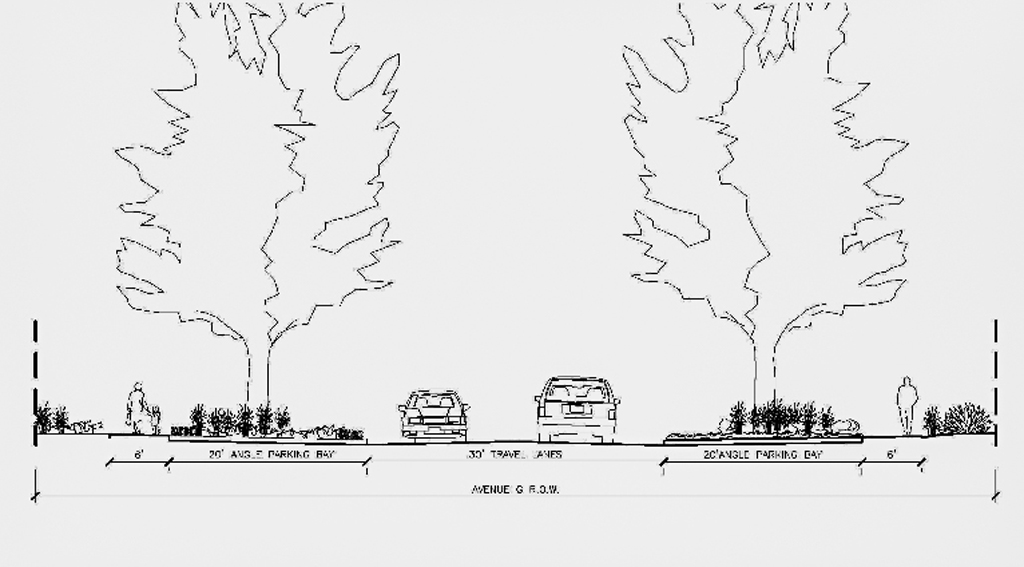
Proposed concept plans from landscape architecture firm Franke: Franke Inc. show new sidewalks, ample landscaping, large shade trees, and easy-to-access, on-street parking between Third and Seventh streets, adjacent to the firm’s office at 408 Avenue G.
This concept art shows the proposed dimensions and general layout of the sidewalk and landscaping that would stretch along Avenue G if recently approved plans moved forward. City of Marble Falls image
“They proposed on-street parking for Avenue G with a vision of sidewalks and landscaping, which would create a ‘complete street’ that accommodates both pedestrians and vehicles,” explained Marble Falls Development Services Director Scarlet Moreno to DailyTrib.com.
This concept art shows the proposed dimensions and general layout of the sidewalk and landscaping that would stretch along Avenue G if recently approved plans moved forward. City of Marble Falls image
The Marble Falls City Council approved the concepts and alterations to Avenue G during its regular meeting Tuesday, Aug. 5, after a presentation from Moreno. The project currently has no hard timeline for completion.
“If on-street parking for Avenue G is built out, we could use this as an example for other streets, such as Avenue J, or the numbered cross streets to show cohesiveness and give the feel of being in the ‘core’ of Marble Falls,” Moreno said.
News stories, staff photos, and other online content are copyrighted property of Victory Media. Reproduction in part or in whole is prohibited without the express written consent of the publisher.
The rebuild of the Cow Creek bridge on RR 1431 east of Marble Falls is rapidly progressing. The Texas Department of Transportation shared video footage of the construction on Aug. 5 that shows the new structure quickly taking form.
Contractor Hunter Industries is working 24 hours a day until the project is done, according to TxDOT. The estimated completion date is Sept. 19.
The bridge was destroyed July 5 during devastating flooding that swept across the Texas Hill Country. With the structure gone, travel between Marble Falls and Lago Vista has been greatly hampered, with the normally 30-minute drive now taking over an hour on alternate routes.
At least one person was killed due to the bridge collapse. The Hammond family mistakenly drove into the waters washing over the site where the bridge had been in the dark morning hours of July 5. Malaya Hammond, 17, was swept away and later found dead. She reportedly helped her family reach safety by holding their vehicle’s door open as they escaped before being pulled away by rushing water.
News stories, staff photos, and other online content are copyrighted property of Victory Media. Reproduction in part or in whole is prohibited without the express written consent of the publisher.
A Leander man has been charged with five counts of manslaughter in connection with a multiple-vehicle collision July 25 on U.S. 281 near Park Road 4 in Burnet County.
Kody Lane Talley, 37, was arrested Tuesday, Aug. 5, by Texas Department of Public Safety troopers and booked into the Burnet County Jail on a $1 million bond, according to a DPS media release.
The fatal collision happened in the late afternoon July 25 when Talley, driving northbound in a 2018 Ram 4500 pickup truck pulling a livestock trailer, crossed into oncoming traffic and collided with a Chevy Malibu. That impact caused a second collision between Talley’s truck and a Mercedes SUV, which overturned and caught fire, killing all five occupants.
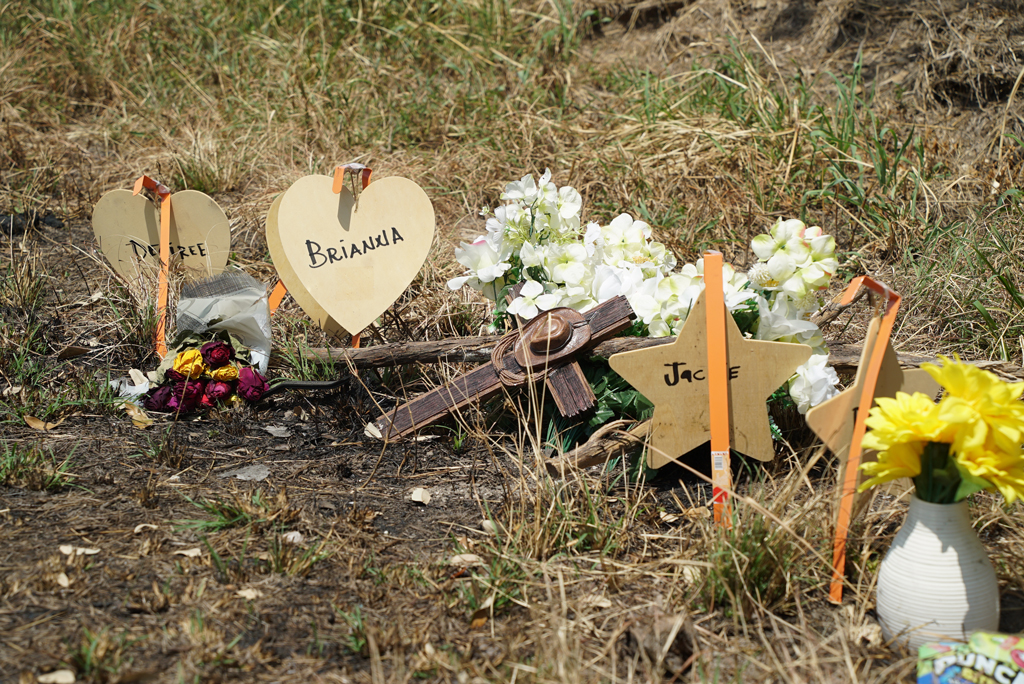
A small memorial to the five women killed in a July 25 wreck on U.S. 281 near Park Road 4 lies near the spot where their vehicle overturned and caught fire. Staff photo by Dakota Morrissiey
The DPS identified the victims as Thalia Salinas, Ruby Cruz, Brianna Valdez, Desiree Cervantez, and Jacqueline Velazco Ventura. The five friends, all in their early 20s, were visiting the Highland Lakes from the Dallas-Fort Worth area, according to a report by NBC 5 DFW.
The drivers and passengers of the other vehicles involved in the collision sustained non-life-threatening injuries, according to the DPS report.
News stories, staff photos, and other online content are copyrighted property of Victory Media. Reproduction in part or in whole is prohibited without the express written consent of the publisher.
The Burnet County Commissioners Court on Tuesday, Aug. 5, voted to extend its disaster declaration for the recent flood to Sept. 4.
The county has been under the declaration since July 4 and will likely remain so until victims who lost their homes are rehoused, according to Burnet County Emergency Management Coordinator Derek Marchio.
“Once we get folks into longer-term housing, that would justify possibly lifting the declaration,” he told DailyTrib.com.
Marchio explained that the official disaster declaration is necessary to keep the door open to state and federal support for Burnet County flood victims.
While the floodwaters receded within days of the disaster, recovery efforts are still well underway across the county.
Ark of Highland Lakes and Burnet County Emergency Management have identified over 400 long-term recovery cases that still need assistance.
Some flood victims, like the 45 who lived at the Burnet Housing Authority, might have to wait weeks or months before they are permanently rehoused.
According to Marchio, the county will likely reassess the disaster declaration every 30 days until all victims are able to return home.
“We’re still very much in the early steps of recovery,” he said.
News stories, staff photos, and other online content are copyrighted property of Victory Media. Reproduction in part or in whole is prohibited without the express written consent of the publisher.
On deadline to submit a 2025-26 budget, Burnet County Judge Bryan Wilson on Aug. 5 pitched a plan to lower taxes and trim spending.
The Burnet County Commissioners Court is currently working out a new tax rate and budget for the upcoming fiscal year, which starts in October. According to Judge Wilson, new funding requests from county departments amount to around $8.5 million, making the proposed general fund budget about $46.5 million, up from $38 million in 2024-25.
The court hopes to have a proposed budget by Aug. 26 or 27 to meet state filing deadlines.
As county judge, Wilson is Burnet County’s chief budget officer and responsible for putting together the budget for the rest of the Commissioners Court to then vote on.
During an open meeting on Tuesday, Wilson talked about possibly cutting the county tax rate by 3 percent, trimming excess from the $8.5 million in new requests, and allocating $1 million to road and bridge crews, specifically for road improvements.
“I’m a lifelong conservative and, to me, that means lowering taxes,” Wilson told DailyTrib.com after the meeting. “This government needs to be efficient and it needs to be accountable to people. That is their hard-earned money, and it doesn’t grow on trees.”
Asked if cuts to the tax rate and budget were feasible, Wilson replied: “Absolutely.”
The judge, who was appointed to the position in March, said the tax rate could be lowered if the county used a portion of its $29 million fund balance to make up the difference between the budget and how much money is brought in through taxes.
The fund balance is a pool of unallocated, surplus money kept for unexpected expenses, emergencies, and to help balance the budget if needed. Typically, a healthy fund balance is about 25 percent of a government’s operating expenses.
Wilson believes Burnet County has more than enough in the fund balance to maintain that 25 percent threshold and still support the 2025-26 budget.
“I’m glad we have a fund balance and we can afford to do this,” he said. “We do need to keep a good fund balance though, just in case things like the tornado, the tire fire, and the flood come up.”
The $8.5 million in budget requests is mostly for personnel and equipment for county departments, like more deputies and new patrol vehicles for the Burnet County Sheriff’s Office and a records clerks to handle the growing mountains of paperwork across departments.
No specific numbers were shared, but the judge expressed optimism that overall requests and even department budgets could be trimmed.
As of now, Wilson’s plan is still just that and requires approval from the four commissioners of the court.
Senior member of the court, Precinct 4 Commissioner Joe Don Dockery, agreed with Wilson’s pitch—mostly. At Tuesday’s meeting, he and the other commissioners asked Wilson to return with solid numbers on some of the requests and how a tax rate cut would look if implemented.
“I know that (Wilson) is doing everything in his power to drive the tax rate down a little bit,” Dockery told DailyTrib.com. “I’m cautiously optimistic. I think it’s feasible (to lower the tax rate), but I think most of our departments run very lean. I don’t know if there is any fat to be trimmed.”
Dockery also noted that the fund balance was more than capable of handling Wilson’s proposed tax cut but cautioned that Burnet County’s robust finances are largely dependent upon explosive growth and ever-rising property values.
“If that (growth) slows down, we could be in a world of hurt,” he said.
News stories, staff photos, and other online content are copyrighted property of Victory Media. Reproduction in part or in whole is prohibited without the express written consent of the publisher.
Texas is on high alert due to the potential threat of the New World screwworm, a once-eradicated, flesh-eating pest that devastated the U.S. cattle industry throughout the 20th century. While the parasitic fly seemingly hasn’t made it to Burnet County, local agriculture experts say awareness is key to stopping an outbreak.
The United States shut down cattle, horse, and bison trade with Mexico on May 11 when the screwworm was detected about 700 miles from the border. Since then, a coalition of local, state, federal, and international organizations have mobilized to control the insect’s spread before it can cause mayhem for ranchers north of the border.
“I wouldn’t say that we need to get panicked or scared right now; I just think that we need to be aware,” Burnet County AgriLife Extension Agent Kelly Tarla told DailyTrib.com. “Screwworms are definitely something that every livestock owner and every pet owner should be looking for.”
While Burnet County is far from the screwworm detection zone, Tarla said local ranchers should be vigilant.
“We are still rural enough where this could become a problem,” she said. “Believe me, if it comes close to a problem, we will be on top of it.”
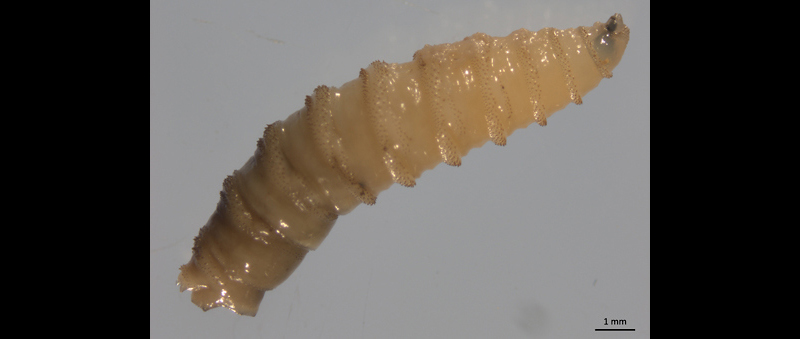
The New World screwworm fly (Cochliomyia hominivorax) is native to the tropical regions of the Western Hemisphere. The fly lays its eggs near open wounds on a warm-blooded animal—including livestock, wildlife, and pets—that then hatch into larvae, or maggots, and burrow like a screw into the flesh of the host, causing massive damage and often death.
The New World screwworm isn’t actually a worm. It’s a tropical fly that lays its larvae near open wounds in an animal. The larva, or maggots, then burrow into the flesh of their hosts, eating away at the wounds and potentially killing the animal. University of Florida photo
The fly was effectively eradicated in the United States in the 1980s, but not without some devastating consequences. In 1976 alone, the Texas economy lost about $329.59 million due to livestock deaths from a New World screwworm outbreak. Accounting for inflation, that would have been $1.8 billion in 2024. About 1.48 million cattle were reportedly infected in that outbreak.
The fly was a problem in the United States for decades, first becoming a threat in the 1930s, although it had been in the American Southwest since at least 1842. Eventually, scientists discovered a method of eradication: the Sterile Insect Technique. This was done by releasing massive numbers of sterilized male flies into infected areas, leading to infertile eggs and breaking the screwworm’s breeding cycle.
“There is a full generation between the guys who eradicated (the screwworm) and those who will be fighting it now,” Tarla said. “My grandad fought it, my dad didn’t, now I may have to.”
Since eradication in the 1980s, screwworms have had a minimal impact on U.S. ranchers, but even the threat of a potential outbreak is enough to raise the alarm. The U.S. Department of Agriculture estimates a screwworm outbreak could cost the Texas cattle industry $1.8 billion in annual losses and up to $10.6 billion in national economic damages.
U.S. Secretary of Agriculture Brooke L. Rollins suspended all trade of cattle, horses, and bison between the U.S.-Mexico border in May, and that order was reinforced in July.
To preemptively combat the screwworm threat, Texas is scrambling to bring a massive fly breeding facility online to once again implement the Sterile Insect Technique.
The Texas Farm Bureau is pushing for federal aid in the immediate construction of the SIT facility, which is planned in the Rio Grande Valley along the state’s border with Mexico.
“We cannot afford to wait. The New World screwworm is advancing, and the consequences of inaction are staggering,” Texas Farm Bureau President Russell Boening said in an Aug. 1 media release. “Secretary Rollins and her team have laid a strong foundation, and now we must build on it. A domestic sterile fly production facility is not just a strategic priority. It’s an emergency necessity.”
RESOURCES
Burnet County AgriLife Extension Agent Kelly Tarla recommends treating open wounds on livestock or pets as soon as they appear. If wounds seem to not be healing, or maggots are found in an open wound, she recommends contacting a veterinarian immediately to identify a potential screwworm infestation.
Texas A&M AgriLife Extension has an online resource portal to help combat the potential spread of screwworms, including livestock management strategies, screwworm identification guides, and more.
News stories, staff photos, and other online content are copyrighted property of Victory Media. Reproduction in part or in whole is prohibited without the express written consent of the publisher.
Aug. 3 marked a decade since the opening of Baylor Scott & White Medical Center near the Texas 71-U.S. 281 intersection in Marble Falls. In 2015, city leaders predicted the new hospital would have a long-reaching impact on growth and development in the Highland Lakes, and they were right.
Today, the 46-bed medical center has over 300 employees and is accompanied by seven clinics and urgent care facilities spread across Burnet, Marble Falls, Kingsland, Horseshoe Bay, and Llano.
When the Marble Falls hospital’s doors opened in the summer of 2015, George Russell, the former mayor and city manager, made an accurate prediction.
“I definitely feel it’s going to stimulate some growth in the area,” he said in a 2015 interview with DailyTrib.com.
Gross sales activity in Marble Falls grew from $725 million in 2013 to $1.335 billion in 2024.
Taxable sales grew from $349 million in 2013 to $731 million in 2024.
In Burnet County, the healthcare and social assistance industry grew from 1,482 employees with $18 million in earnings in 2013 to 2,282 employees with $41 million in earnings in 2024.
Across all industries during the same time period, total employment grew from 12,686 to 16,843 and total wages rose from $126 million to $256 million.
The infrastructure installed to support the hospital provided the utilities necessary for south Marble Falls developments like Thunder Rock and Gregg Ranch, making Marble Falls the seventh-fastest growing city in Texas from 2023 to 2024.
The average household income in the Marble Falls trade area grew from $68,172 in 2013 to $123,476 in 2024.
“From an economic impact standpoint, (Baylor Scott & White’s) presence in Marble Falls coincides with the community’s most prosperous era,” said EDC Executive Director Christian Fletcher in an emailed response to questions from DailyTrib.com. “The hospital in Marble Falls was the first major catalyst for the community’s current trajectory.
Before the hospital, the nearest major medical care was in Burnet, Llano, and Austin.
“(The Baylor Scott & White hospital has) been a real gift to the community, to the medical community,” Dr. Kimberly Russell told DailyTrib.com.
Dr. Russell has been practicing family medicine in the Highland Lakes area for 24 years and has seen the change in medical services available for locals before and after the hospital’s arrival.
At the time, an emergency room visit meant traveling to Llano, Burnet, or Austin. The Llano Hospital was the only medical facility in the Highland Lakes with a labor and delivery department for expectant mothers. Locals needing to see a specialist often had to drive to Austin.
The Marble Falls hospital brought big city medicine to the country, including a labor and delivery ward, emergency care, and a suite of specialists in cancer care; plastic surgery; digestive diseases; ear, nose, and throat ailments; eye care; foot care; cardiology; hematology; imaging and radiology; mammography and women’s health; physical rehabilitation; surgery; urology; wound care; and more.
“Though we are in a smaller community, we have not sacrificed quality,” Dr. Russell said. “The Hill Country region is a refuge for shockingly overqualified people.”
The Marble Falls hospital is a hub for Baylor Scott & White activity in Burnet, Llano, Blanco, and San Saba counties.
BSW Hill Country Region President Tim Ols explained to DailyTrib.com that Baylor Scott & White is the largest not-for-profit hospital system in Texas, and that any profit made is reinvested into upgrading facilities. The Marble Falls medical center is no exception. It has added operating rooms, emergency department rooms, a mammography suite, and new robotic surgery technology since it opened.
“We’ll continue to grow organically as the community grows,” Ols said.
The hospital also grows thanks to big donations from the community. According to Ols, Highland Lakes organizations and individual donors have given more than $20 million over the past 10 years, which directly funded new operating and emergency rooms.
“We are very, very thankful for the generosity of the community,” he said. “(The community) wants their hospital and they want it to be strong, and we do everything we can to make that happen.”
Ols’ predecessor, Eric Looper, also saw the hospital’s future value for Marble Falls, anticipating general population and job growth in the wake of its opening.
“A new facility like this is typically a catalyst for growth for the community, for the immediate area around the hospital,” the former BSW Hill Country Region president said in a 2015 interview with DailyTrib.com. “Over the coming years, I would expect you’d see other healthcare services attracted to be close to us.”
News stories, staff photos, and other online content are copyrighted property of Victory Media. Reproduction in part or in whole is prohibited without the express written consent of the publisher.
Two people were killed and two more were injured in a head-on collision on Texas 71 near Llano in the early morning hours of Aug. 3.
According to a Texas Department of Public Safety report, at around 4:45 a.m. Sunday, a 2005 Pontiac Grand Prix traveling west on Texas 71 about 10 miles east of Llano drifted into oncoming traffic for “unknown reasons.”
The drift led to a head-on collision with a 2015 Ford F-150. The Grand Prix burst into flames, according to the Llano Police Department. The driver and passenger of the Grand Prix were pronounced dead at the scene of the accident. The occupants of the F-150 were transported to area hospitals, one by ambulance and one by helicopter, with non-life-threatening injuries.
The identities of the deceased are being withheld by law enforcement until next-of-kin are notified.
These two deaths make eight fatalities from motor vehicle accidents in the Highland Lakes area over the past 10 days. One person was killed in a head-on collision on Texas 71 in Llano County on July 27. Five others lost their lives in an accident involving a truck and trailer on U.S. 281 in Burnet County on July 25.
News stories, staff photos, and other online content are copyrighted property of Victory Media. Reproduction in part or in whole is prohibited without the express written consent of the publisher.
This Content Submission and License Agreement (“Agreement”) is entered into by and between Victory Media Marketing LLC (“Company,” “we,” or “us”) and you (“User,” “you,” or “Submitter”) upon your submission of content through our websites’ See it, Share It form.
Submitted Content “Submitted Content” means any news tips, text, descriptions, images, photographs, videos, audio files, recordings, or other materials you upload, submit, or provide to us via the news tips forms on DailyTrib.com, KBEYfm.com, 101highlandlakes.com, or any other websites owned or operated by Victory Media Marketing LLC.
License Grant By submitting any Submitted Content, you hereby grant to Company a worldwide, non- exclusive, perpetual, irrevocable, royalty-free, fully sublicensable, and transferable license to use, reproduce, modify, adapt, publish, translate, create derivative works from, distribute, perform, display, and otherwise exploit the Submitted Content in any form or medium (now known or hereafter developed), including but not limited to:
Publishing on DailyTrib.com, KBEYfm.com, 101highlandlakes.com, other Company websites, apps, newsletters, and social media platforms (such as Facebook, Instagram, X, YouTube, etc.).
Editing, formatting, or combining with other content for news, promotional, archival, or commercial purposes.
Allowing third parties (e.g., affiliates, syndication partners) to use it under the same terms. You retain ownership of the copyright in your Submitted Content, subject to the license granted above.
User Representations and Warranties You represent and warrant that:
You are at least 18 years old and have the full right and authority to grant the rights in this Agreement.
The Submitted Content is your original work or you have obtained all necessary permissions, consents, and releases (including from any individuals appearing in photos/videos or owners of any third-party materials).
The Submitted Content does not infringe any third-party intellectual property rights, privacy rights, publicity rights, or defame any person.
It complies with all applicable laws and does not contain viruses, malware, or prohibited content.
You will not submit false, misleading, or confidential information.
No Compensation You understand and agree that you will receive no compensation for the submission or use of your Submitted Content.
Indemnification You agree to indemnify, defend, and hold harmless Company, its affiliates, officers, directors, employees, and agents from any claims, damages, liabilities, losses, and expenses (including reasonable attorneys’ fees) arising from your breach of this Agreement or any third-party claims related to your Submitted Content.
Moral Rights and Publicity You waive any moral rights or rights of attribution in the Submitted Content to the extent permitted by law. Company may use your name, username, or likeness in connection with the Submitted Content if applicable.
Termination and Removal Company may, in its sole discretion, edit, refuse to post, or remove any Submitted Content at any time without notice. This Agreement survives any termination.
Governing Law This Agreement is governed by the laws of the State of Texas, without regard to conflict of laws principles. Any disputes shall be resolved exclusively in the courts located in Burnet County, Texas.
Entire Agreement This Agreement constitutes the entire understanding between the parties and supersedes all prior agreements. Modifications must be in writing. By submitting content, you acknowledge that you have read, understood, and agree to be bound by this Agreement.