Marble Falls has a traffic problem, and the city is asking for “relief.”
The City Council on June 17 approved an official request to the Texas Department of Transportation for a feasibility study on a relief route in Burnet County, noting massive regional growth and a rise in daily traffic counts.
The relief route could be a loop or a bypass around the city, a designated trucking route, a new bridge across the Colorado River, or some other solution. Procedurally, it could take a year before the request is fully processed by TxDOT, another year before a study begins, and still more years before any sort of work is done.
“We’re trying to look at something that is a little more broad, maybe at the county level,” said Marble Falls Deputy City Manager Caleb Kraenzel, who spearheaded route talks with the council during its recent meeting. “Me, personally, I would like to see (TxDOT) do some sort of loop. I know a lot of businesses are concerned about some sort of bypass. It’s a balancing act.”
Two major traffic concerns are U.S. 281 congestion in the heart of Marble Falls, specifically near the RR 1431 intersection, and booming residential growth at the U.S. 281-Texas 71 intersection, Kraenzel told DailyTrib.com.
Finding a solution to traffic woes is paramount to Marble Falls residents, according to a survey and public workshops done before the city rolled out its 2024 Comprehensive Plan.
THE NUMBERS
The latest data from the TxDOT Statewide Traffic Count Map shows a massive rise in daily traffic near major intersections between 2010 and 2023. Traffic counts on U.S. 281 just south of the RR 1431 intersection rose 24 percent from 27,000 daily vehicles in 2010 to 34,369 in 2023. Counts on 281 just north of the Texas 71 intersection went up 48.7 percent from 14,100 daily vehicles in 2010 to 23,180 in 2023.
Marble Falls leaders estimate the city’s population could double within 40 years. That assessment seems highly likely after taking into account a 23.95 percent population increase—7,594 to 9,413—between 2023 and 2024, according to the latest U.S. Census data. The city also predicts roadway infrastructure could approach or reach its capacity within 10 years based on current vehicle counts.
While U.S. 281, RR 1431, and Texas 71 all lie within Marble Falls city limits, they are completely under the jurisdiction of TxDOT. The state agency is responsible for upgrading, improving, maintaining, and fixing the major thoroughfares.
Marble Falls cannot directly work on those roadways without collaborating with TxDOT. The request for a relief route feasibility study is one of the few actions the city can take on its own. TxDOT will now process the request and determine whether or not to move forward on the study, which must be done before the department begins a project.
“TxDOT regularly collaborates with local partners to develop and implement transportation projects,” reads a statement to DailyTrib.com from TxDOT officials. “We deeply value these partnerships, including our ongoing work with the city of Marble Falls. Transportation projects are typically identified many years before they receive funding or move into construction. A key tool we use in the early stages of project development is the feasibility study. These studies help us evaluate potential improvements to existing roadways or explore options for new routes.”
OTHER PROJECTS
While a relief route could be years in the making, TxDOT is currently addressing area traffic issues with other major projects.
Plans for the U.S. 281-RR 1431 intersection include adding a right-turn lane for northbound 281 traffic, rehabbing pavement, and upgrading traffic signals. The project should go out for bid in mid-2026.
TxDOT is conducting an environmental and schematic study of the U.S. 281-Texas 71 interchange to determine the best course of action for improving traffic flow. This project has been extended, but the last estimate for a start date was sometime between 2028 and 2033.
The department is currently improving the dangerous Texas 71-CR 401 intersection near Spicewood by adding right- and left-turn lanes and a new traffic light. This project should be finished by mid-2026.
TxDOT is funding and handling the Wirtz Dam Bridge project, which would connect RR 1431 and FM 2147 over the Colorado River between Cottonwood Shores and Granite Shoals. The project was delayed due to the discovery of an archaeological site nearby. Construction could begin in 2026.
News stories, staff photos, and other online content are copyrighted property of Victory Media. Reproduction in part or in whole is prohibited without the express written consent of the publisher.
With summer here and little precipitation in the Central Texas forecast, Highland Lakes reservoirs most likely will have to get by with what they’ve got until the fall, when the rain (hopefully) returns.
According to the Lower Colorado River Authority, the current combined storage level of lakes Buchanan and Travis is at 52 percent as of Thursday, June 26. LCRA firm water customers, which include many cities and communities across Burnet and Llano counties, are under Stage 2 drought restrictions until the major reservoirs have a combined storage of 55 percent, or 1.1 million acre-feet.
Stage 2 restrictions, found in the LCRA’s Drought Contingency Plan for Firm Water Customers, call for mandatory drought response measures from firm water customers to reduce water use by 20 percent. This includes once-a-week watering schedules for ornamental landscaping. These rules are passed down to residents and businesses by the river authority’s firm water customers, which in the Highland Lakes, are the cities of Marble Falls, Granite Shoals, Burnet, Cottonwood Shores, Horseshoe Bay, and Sunrise Beach Village and the Kingsland Water Supply Corp.
The current combined storage of 52 percent is derived from Lake Buchanan’s current level of 61 percent and Lake Travis’ current level of 45 percent. The combined storage is similar to that of the last two years around this time: 55 percent in July 2024 and 50.4 percent in July 2023.
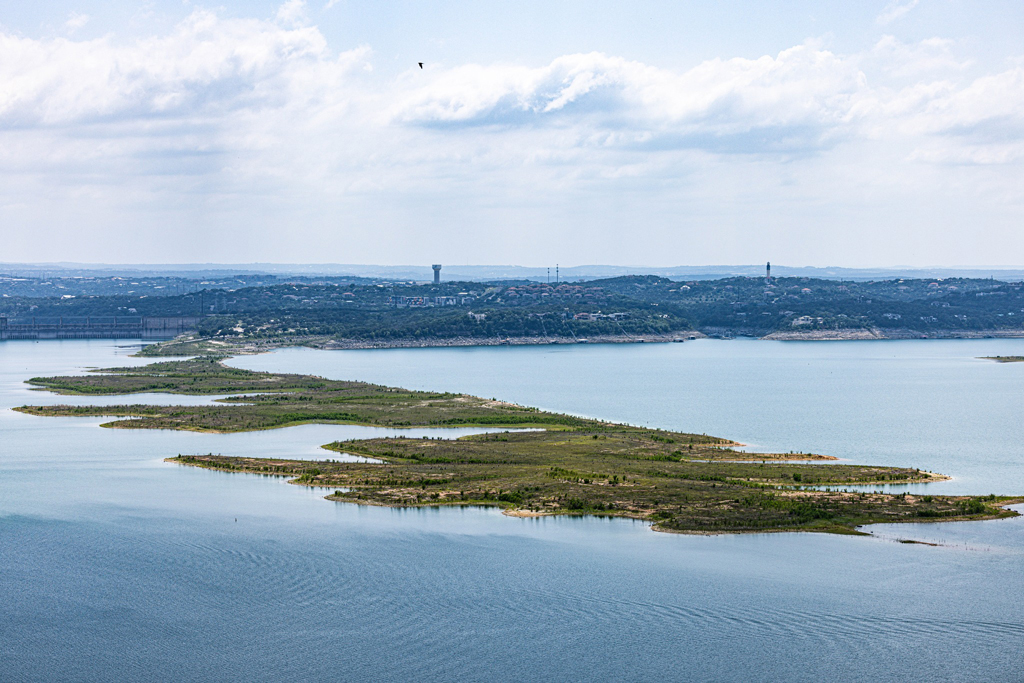
Lake Travis is about 45 percent full as of June 26, 2025. LCRA photo
Major Highland Lakes tributaries are still flowing but subdued. As of Thursday, the Llano River is flowing at around 61 cubic-feet-per-second to Lake Travis by way of Lake LBJ, and the Colorado River is flowing at 96 cfs. Both rivers have dropped steadily since spring rains dwindled in early June, when inflows were routinely in the hundreds or thousands of cubic-feet per second, according to the LCRA Hydromet.
National Weather Service forecasts do not show much rain on the horizon across the northern Lower Colorado River Basin, which includes Burnet, Llano, and Lampasas counties as well as Brown, Coleman, Concho, Kimble, Mason, McCulloch, Mills, and San Saba counties. Current forecasts call for temperatures in the 90s with no rain until a scant chance in some areas on July 1.
This year is the third straight that the LCRA has cut off Highland Lakes water to most downstream agricultural customers due to persistent drought conditions. Users within the authority’s Garwood Agricultural Division, which lies within portions of Colorado and Wharton counties, are still entitled to up to 18,100 acre-feet of water in 2025. This is due to a contractual obligation between the Garwood Irrigation Co. and the LCRA from 1998 when the river authority acquired the region’s water rights.
News stories, staff photos, and other online content are copyrighted property of Victory Media. Reproduction in part or in whole is prohibited without the express written consent of the publisher.
Jan and Austin Rose’s northeast Burnet County ranch has been in their family for 140 years. Soon, that iconic Hill Country view could be cut down the middle by a massive transmission line.
Burnet County recently learned it is ground zero for the largest powerline project in Texas history. Local officials are delving into what, if anything, can be done to alter the line’s course amid concerns from potentially impacted landowners like the Roses.
The project was a topic of discussion at the Burnet County Commissioners Court meeting on June 24. No solid action was taken, but the court heard several public comments to help inform its next steps and county attorneys were instructed to investigate all options before leaders proceed.
“This is just such a critical issue that we need to take our time and do it right,” Burnet County Judge Bryan Wilson said during Tuesday’s meeting. “This powerline has caused a tremendous amount of angst and stress for the citizens.”
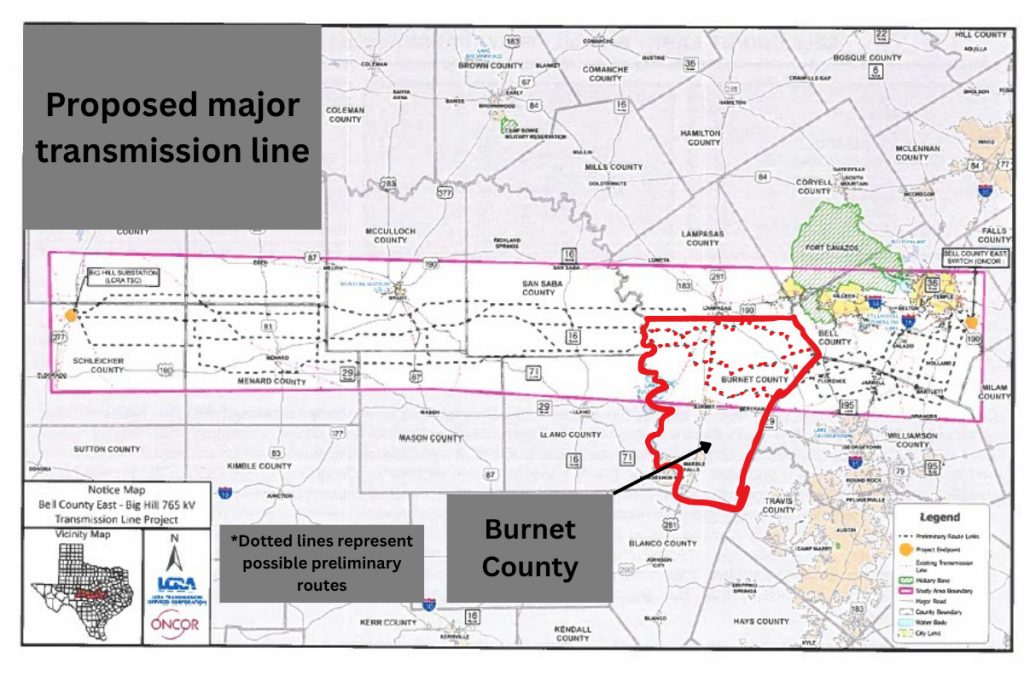
The transmission line is a major project of the Public Utility Commission of Texas, which is trying to improve the state’s electric grid. Part of that mission includes the construction of a 200-mile, 765-kilovolt transmission line between Bell and Schleicher counties, with all proposed preliminary routes cutting through northern Burnet County.
Burnet County leaders were officially notified of the project in January, but the correspondence was lost in the leadership shuffle following the resignation of former county Judge James Oakley. The next anyone heard about the project was in May. The Commissioners Court notified the public during its June 10 meeting, sharing the maps of preliminary routes and the dates of a series of planned public workshops on the transmission line to be held in Lampasas, Menard, and Salado.
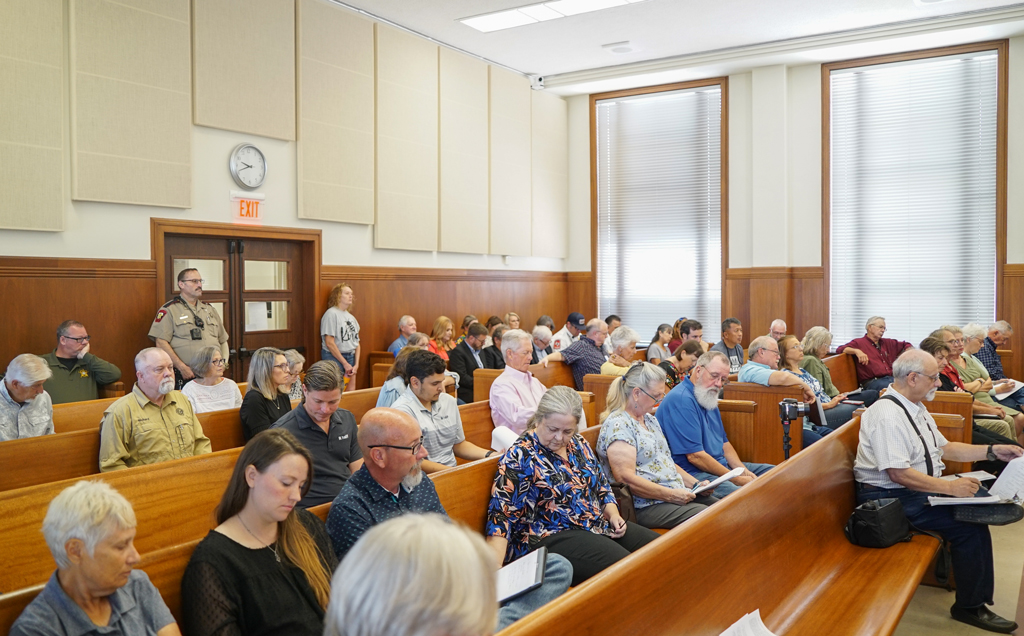
Dozens of Burnet County residents turned out for the June 24 meeting of the Burnet County Commissioners Court to learn more about a massive transmission line that would cut through the county. Many just listened, but several residents stood up to voice their concerns. Staff photo by Dakota Morrissiey
What makes the project unique isn’t necessarily the length of the lines, but the voltage. While 765-kilovolt transmission lines are common in the American Midwest, there has never been one in Texas. They require a 200-foot easement, and the towers holding them up are usually about 130-140 feet tall. The lines are the highest voltage available in the United States, capable of transmitting six times the power of a typical 345-kilovolt line, and are considered to be far more energy efficient and reliable than their lower-voltage counterparts.
The general layout of a proposed major transmission line that will almost certainly be built across northern Burnet County. Courtesy image
“The PUC is fully committed to building an ERCOT (Electric Reliability Council of Texas) grid that will serve Texans reliably for decades to come,” said PUC Chairman Thomas Gleeson in an April 24 media release. “Extra-high-voltage lines are more efficient and strengthen reliability. Because each line can carry more power, fewer lines are necessary to serve the needs of the Permian Basin Region, meaning less disruption to Texas landowners, natural habitats, and landscapes. Our priority now is ensuring utilities execute these projects quickly and at the lowest possible cost to Texas consumers.”
The eastern portion of the line is being built by energy delivery company Oncor and the western portion by the Lower Colorado River Authority. Burnet County’s part of the line will be handled by Oncor. Residents may contact Oncor Regulatory Manager Jeremy McConnell with questions at 214-486-5216 or transmissionprojects@oncor.com. Learn more about the project on LCRA’s information webpage.
Judge Wilson, who is responsible for crafting the county’s agendas, did have several possible action items concerning a response to the powerline project set for Tuesday’s meeting, but none were officially addressed due to the lack of a drafted resolution and the desire for more time to research the issue.
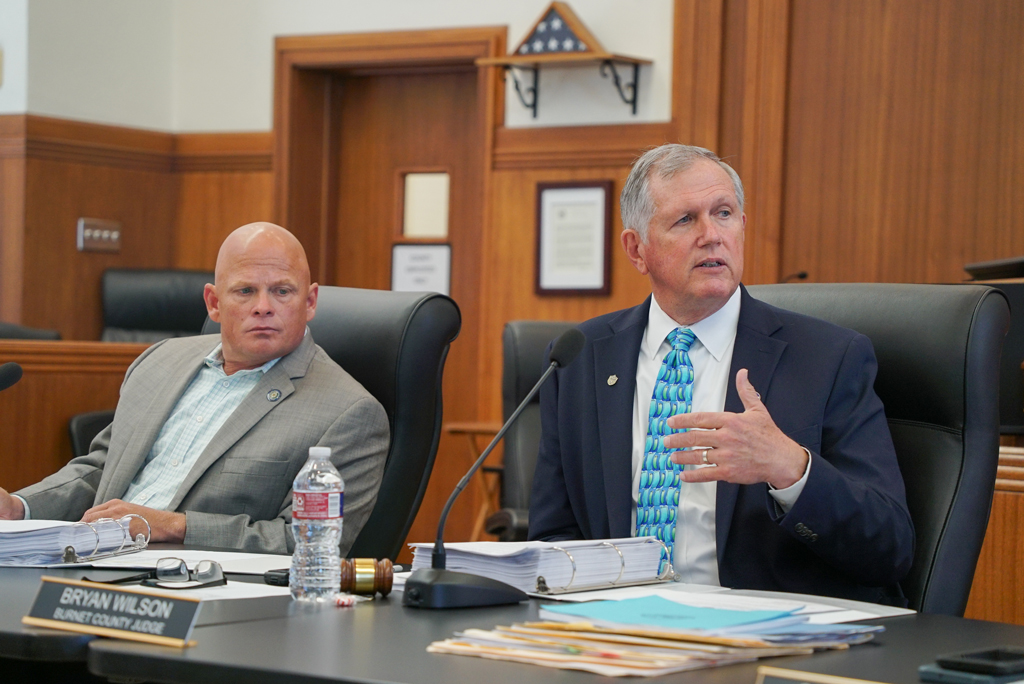
Burnet County Judge Bryan Wilson (right) voices his own concerns about how best to navigate the county’s position in relation to a massive state transmission line project. Staff photo by Dakota Morrissiey
“We don’t have a resolution ready today,” Wilson said. “This has been moving very quickly, so I did not have the opportunity to draft a resolution for you to consider. I don’t know what our options are, but if we can at least engage an attorney to hold the powerlines and the PUC accountable to state law, I don’t know.”
Among the considerations were possibly declaring the transmission line an issue of “unforeseen grave necessity or emergency.” Also up for consideration was spending as much as $100,000 on outside attorneys or professional services to help the county navigate the process.
Ultimately, the Commissioners Court settled on instructing county attorneys to investigate the matter further and help create a safe, legal route through the high-powered predicament.
“I’d like to see us move forward on the resolution and also maybe asking our attorneys to look into what our options are before we come in on an outside attorney,” Precinct 1 Commissioner Jim Luther said.
He was backed up by Precinct 2 Commissioner Damon Beierle. Both commissioners’ precincts would be in the path of the proposed project.
“We definitely need to start working on a resolution that has some teeth to it and find out the right people to send it to,” Beierle said.
Several Burnet County residents and landowners made their concerns clear, revolving around personal, financial, environmental, and historical impacts.
“I applaud the county for recognizing these problems,” Austin Rose said at the meeting. “I think your hundred thousand dollars is on the low side to get competent, experienced attorneys that are used to testifying and fighting for people or entities in front of the PUC. So I would encourage you to do that.”
Another landowner, Michael Smith, also spoke during the meeting.
“I don’t know if there is much we can do about this at this point, but any help that can be given to landowners in the county, we would greatly appreciate it,” he told the court.
News stories, staff photos, and other online content are copyrighted property of Victory Media. Reproduction in part or in whole is prohibited without the express written consent of the publisher.
Help the Texas Parks and Wildlife Department pick a new horned lizard design to mark the 25th anniversary of its Conservation License Plate Program.
Texans can choose among three potential designs online that update TPWD’s popular horned lizard plate, the first conservation plate offered to residents. Proceeds from the sales of a wide range of conservation plates go toward funding state fisheries, parks, wildlife management, research, and other projects.
“The Texas horned lizard is an iconic Texas critter,” said TPWD Wildlife Conservation Program Director Richard Heilbrun in a media release announcing the design survey. “Just tough enough and just the right amount of endearing to represent our people, our wildlife, and our wild places. Unfortunately, we don’t have as many horned lizards as we used to, but TPWD is trying to fix that through conservation projects, which are partially funded by the sale of this plate.”
Revenues boost a range of projects that help protect native species and their habitats, including the horned lizard, which is Texas’ official state reptile, bumblebees and other pollinators, Texas tortoises, alligator snapping turtles, and a long list of mammals, birds, reptiles, amphibians, and plants. Learn more from “Where the Money Goes” at conservationplate.org.
“Since its debut 25 years ago, the conservation plate program has generated more than $12 million in revenue,” said TPWD Deputy Communications Director Cory Chandler in the media release. “Even after all of these years, the horned lizard plate is still the fan favorite and the highest-selling plate, having contributed more than $3.4 million. With the plate redesign, we hope to freshen its look and attract new customers who are wild about nature and want to support wildlife conservation in Texas.”
Other conservation plate designs include:
monarch butterfly, rattlesnake, and hummingbird, benefiting non-game wildlife;
white-tailed deer and bighorn sheep for big game management;
camping and bluebonnet to help state parks;
largemouth bass and Texas rivers, which benefit fisheries;
and roadrunner for nature tourism and habitat conservation.
To purchase the horned lizard plate or one of the other 10 conservation license plates available, visit www.conservationplate.org or your local county tax assessor-collector’s office. The plates are available for vehicles, trailers, and motorcycles and cost just $30 per year, with $22 going directly to TPWD-sponsored conservation projects. Buyers do not have to wait until they receive a renewal notice—they can order at any time and the cost will be pro-rated.
News stories, staff photos, and other online content are copyrighted property of Victory Media. Reproduction in part or in whole is prohibited without the express written consent of the publisher.
A 58-year-old Marble Falls drug dealer was sentenced to 70 years in prison after being found guilty in a June 17 trial by a Burnet County jury. Jurors recommended the lengthy sentence, and 424th Judicial District Judge Evan Stubbs obliged.
Chandler Rodgers was first arrested following an October 2024 traffic stop. During and after the arrest, authorities discovered hundreds of grams of methamphetamine in his possession. At his trial, he admitted his intent to sell and distribute the dangerous drug.
The case was prosecuted by 33rd/424th assistant district attorneys Michael Walker and Kelly Bazie.
“We are grateful for the sentence, the work of our law enforcement officers, and for the work of the members of the jury who delivered justice in this case,” Walker said in a June 24 media release announcing the verdict and sentence.
District Attorney Perry Thomas also weighed in.
“I am grateful for the joint efforts of the Burnet County Sheriff’s (Office), Marble Falls Police Department and the Llano County Sheriff’s (Office) in their work to stop drug dealers in the Texas Hill Country,” he said in the release. “People who deal drugs will not be tolerated in our counties, and this jury’s punishment shows that.”
Rodgers was charged with manufacture/delivery of a controlled substance in an amount greater than 400 grams-Possession Group 1, which includes methamphetamine, heroin, and cocaine. If convicted, the crime carries a prison sentence of 10 years to 99 years and up to $100,000 in fines.
Rodgers was found to be in possession of 900 grams of methamphetamine in his vehicle during the October traffic stop conducted by the Burnet County Sheriff’s Office just outside of Marble Falls. This led to a wider joint investigation by the sheriff’s offices in Burnet and Llano counties and Marble Falls police.
Rodgers admitted his intent to sell and distribute the drugs following his arrest, according to the DA’s media release. After the arrest, law enforcement found another 400 grams of meth and several firearms at Rodgers’ home. After bonding out 11 days later, he was stopped by the MFPD and found with another 400 grams of meth in his vehicle.
“A guy like this, he is flooding our county with this amount of drugs,” DA Thomas told DailyTrib.com. “This is exactly the type of person that is preying on peoples’ addictions and weaknesses. This is a large amount of drugs, and he deserved a large amount of time.”
Thomas explained that an average meth user typically only has less than a gram, maybe 1-4 grams, of meth in their possession.
METH FACTS
The street price of methamphetamine in the United States can vary wildly depending on purity, availability, and location sold.
According to the most recent data from the United Nations Office on Drugs and Crime, a single gram of meth could be sold for $10 to $400 in the United States in 2018, but the price tended to not go above $100.
A kilogram of the drug—1,000 grams—could be sold wholesale for about $12,000 in 2019. Typically, a dealer will acquire a whole kilogram at the wholesale price then sell it piecemeal at a higher price for profit.
A single hit of meth might be as little as $5, but as addicts build up a tolerance to the high, they require more of the drug to reach the same sensation.
According to the drug-abuse support organization Recovered, meth abuse can cost an addict $12,800 to $38,300 a year based on their level of dependency.
According to the Centers for Disease Control and Prevention, about 1.6 million Americans over the age of 18 reported some level of methamphetamine use between 2015 and 2018.
“Meth is highly addictive and stimulates the central nervous system,” reads a report from Into Action Recovery Centers. “In the short term, methamphetamine makes users feel a sense of euphoria. The drug lessens fatigue and makes the person feel more awake. Because meth creates a rapid release of high levels of dopamine, the drug produces a strong urge in the user to keep taking more so they can continue to stimulate their brain’s reward center.”
The negative side effects of meth use are many:
extreme weight loss
severe dental problems
intense itching and scratching, leading to open sores on the body
anxiety
confusion
memory loss
sleeping problems
violent behavior
paranoia or an extreme and unreasonable distrust of others
hallucinations or sensations and images that seem real but aren’t
Overdosing on meth can lead to stroke, heart attacks, or other organ problems.
RESOURCES
Learn more about treatment for methamphetamine addiction here.
Open Door Recovery House is a Highland Lakes-based organization dedicated to helping women recover from drug addiction. Learn more here.
His Joshua House is a Highland Lakes-based addiction recovery resource for men. Learn more here.
News stories, staff photos, and other online content are copyrighted property of Victory Media. Reproduction in part or in whole is prohibited without the express written consent of the publisher.
With summer here and Texans spending more time outdoors, the risk of tick bites—and the diseases they could carry—is up across the state. The Texas A&M AgriLife Extension Service offers tips on how to spot, avoid, and remove ticks found in the state, whether you’re hiking, camping, ranching, or gardening.
Lone Star ticks are most active in late spring and through the summer. However, the Gulf Coast species is active year-round, especially in South Texas. Thus, these tick species are most active when outdoor activities are at their highest.
“Perhaps the most iconic human biting tick for Texas is the Lone Star tick, which gets its name from a single iridescent spot on the back of the adult female,” Teel said.
This tick has a wide host range, including many wildlife species and humans.
“You’ll most often encounter ticks when you enter their natural habitats,” Teel said. “This includes hiking, camping, trail riding, or even ranching.”
Ticks are surprisingly good at finding their next host.
“They can detect heat, carbon dioxide, shadows, and vibrations,” Teel said.
Ticks are hatched from eggs and enter the larval stage. The six-legged larvae, which can swarm in big groups, might leave tiny red spots that are so small they go unnoticed.
Nymphs and adults are eight-legged and slightly larger than larvae, making these stages easier to see. However, they can still transmit disease-causing pathogens if they are not removed.
Teel recommends the following preventive steps to spot, avoid, and remove ticks:
Wear light-colored clothing to help spot ticks.
Tuck pants into boots or socks when walking through tall grass or brush.
Consider using masking tape barriers made by folding tape lengthwise and wrapping it around your tucked pant legs with the sticky side facing out to trap ticks as they crawl.
Properly remove attached ticks (see below) and keep them for expert observation and pathogen testing.
“Always perform a tick check after outside activities. This can be for humans and your furry loved ones,” Teel said.
He explained a proper tick check inspection includes behind the ears, on the scalp, around the waistline, and under the arms.
HOW TO SAFELY REMOVE A TICK
“When removing a tick, it is important to not twist, jerk, burn, or douse with chemicals because this may cause the tick to spit pathogens into the bite, causing a tick-borne illness,” Teel said.
Instead, he recommends following these steps:
Use fine-tipped tweezers or a tick-removal tool to grasp the tick as close to the skin as possible.
Pull straight out with a steady, even pressure.
Clean the area with an alcohol swab or antiseptic after removing the whole tick.
Teel said once the tick is removed, consider placing it in a closed bottle or bag and saving it. Ticks removed from Texas residents can be submitted for identification and for tick-borne pathogen testing for free to the Texas Department of State Health Services.
“Awareness and prompt action go a long way in preventing a tick-borne illness,” Teel said. “Know how to avoid ticks and how to properly remove them.”
News stories, staff photos, and other online content are copyrighted property of Victory Media. Reproduction in part or in whole is prohibited without the express written consent of the publisher.
A busy Marble Falls side street undergoing repairs and upgrades could cause some headaches for H-E-B shoppers for about 30 days.
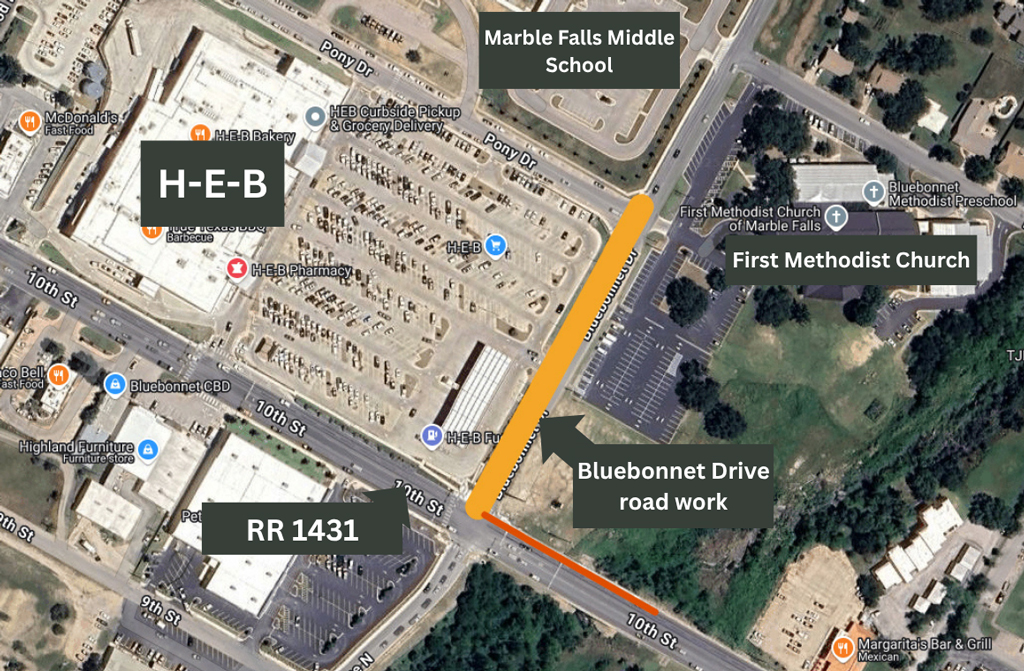
Around 550 feet of Bluebonnet Drive extending north from RR 1431 to the intersection of Pony Drive will be repaved and reinforced beginning June 24. A portion of 1431 and Bluebonnet will be under varying degrees of closures to traffic starting around 7 p.m. Tuesday through July 1. The Bluebonnet Drive entrance to the H-E-B parking lot and fuel station may not be accessible at intervals throughout the project.
Work is expected to take place night and day on the $246,000 project so closures can be as limited as possible. While the main body of work should be completed by July 1, peripheral projects like crosswalk restriping and recurbing will continue for a 30-day construction window.
Bluebonnet Drive is a regular thoroughfare between the H-E-B parking lot at 1503 RR 1431, Marble Falls Middle School at 1511 Pony Drive, and First Methodist Church at 1101 Bluebonnet Drive.
The general layout of Bluebonnet Drive road work in Marble Falls. The project will result in some closures and should be completed in about 30 days starting from June 23. Google Maps image
According to Marble Falls City Engineer Jeff Prato, Bluebonnet has seriously deteriorated due to heavy traffic, heavy trucks, and heavy buses that use it to reach RR 1431 and U.S. 281.
“You can see the rutting and divots in the asphalt,” he told DailyTrib.com.
The new concrete near the RR 1431 intersection should prevent future warping and last 20-40 years as opposed to 10-15 years for pure asphalt, according to city assessments.
News stories, staff photos, and other online content are copyrighted property of Victory Media. Reproduction in part or in whole is prohibited without the express written consent of the publisher.
In a few weeks, a pedestrian bridge spanning Backbone Creek between Johnson and Lakeside parks in Marble Falls could be open to foot traffic. The project is about a year in the making and should make for an easier walk between two of the city’s most popular parks.
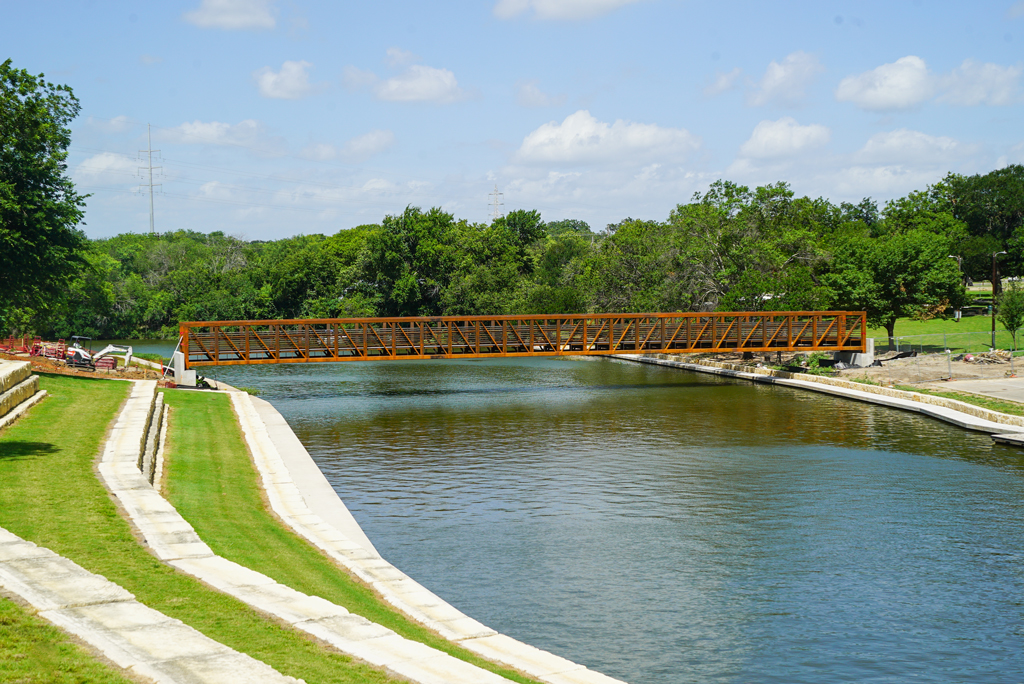
The actual bridge was installed June 19, but its accompanying infrastructure still needs to be finished before its ready for use by around Aug. 7, according to Marble Falls Economic Development Corp. Executive Director Christian Fletcher.
“It will take about 45 days to complete the approaches and pour the sidewalks on the bridge itself,” he told DailyTrib.com. “They are digging footings for the approaches right now (Monday, June 23).”
Work on a large pedestrian bridge between Johnson and Lakeside parks in Marble Falls should be finished in August. Staff photo by Dakota Morrissiey
The bridge links Johnson Park, 230 Avenue J South, with Lakeside Park, 305 Buena Vista Drive, crossing Backbone Creek near the Johnson Park boat ramp on the north side and the Buena Vista Drive loop on the south side.
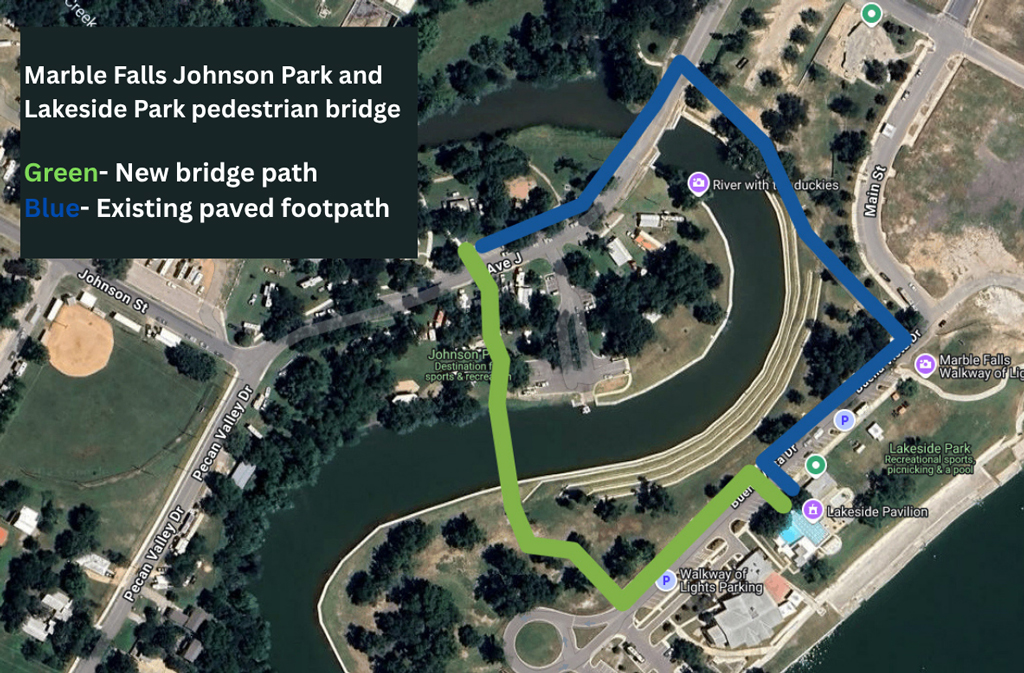
While a foot path already extends from Avenue J to Buena Vista Drive just north of both parks, the pedestrian bridge cuts off a few hundred feet from the trek between them.
It’s about 0.28 miles from the Johnson Park playground to Lakeside Park Pavilion along the current footpath. That trip will drop to about 0.22 miles via the bridge.
The general paved routes a pedestrian could take from the Johnson Park playground to Lakeside Park Pavilion. In green is the future route using the pedestrian bridge and in blue is the current footpath between the parks. Google Maps image
Also, park-goers taking the bridge path won’t have to walk along city streets or traverse the large, stone terraces between the parks. The metal-enforced bridge will have a paved walking surface.
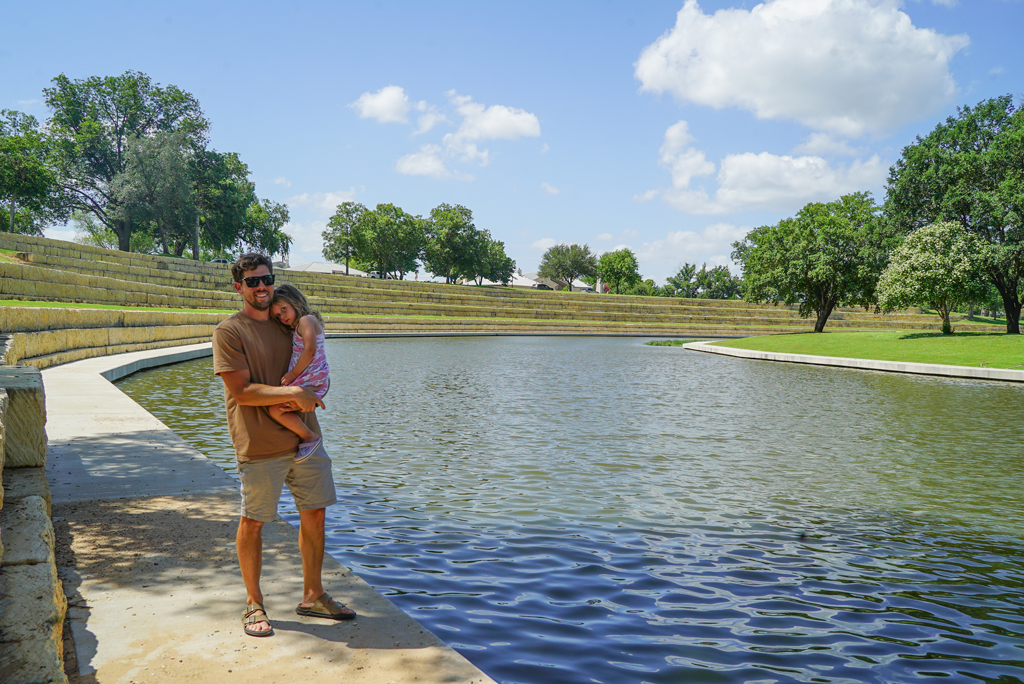
“I think it’s safer. Our kids love to walk on the rocks, but it will be nice to have something with guardrails,” Jared Brown, a Granite Shoals resident visiting Johnson Park, told DailyTrib.com. “I think that it has a lot of possibilities to make it a lot easier to go from one park to the next park or even help make parking easier.”
Brown said he and his family go to Johnson Park about twice a week and are looking forward to using the bridge.
Jared Brown, a Granite Shoals resident and regular visitor to Johnson Park in Marble Falls, poses for a photo with his daughter along the large stone terraces between Johnson and Lakeside parks. He and his family are looking forward to the completion of the pedestrian bridge for an easier walk between the parks. Staff photo by Dakota Morrissiey
According to the city, the bridge has about 10 feet of clearance from the surface of the water, allowing more than enough room for most recreational watercraft. Boats requiring higher clearance can use the Lakeshore boat ramp at 603 Lakeshore Drive, which is about a half-mile away from the Johnson Park boat ramp.
The bridge project adds up to about $500,000 of an approved $4.2 million of upgrades underway in the Marble Falls parks system, funded by the city’s EDC. The EDC gets its budget from a half-cent sales tax collected within city limits, which it can only spend on projects that attract, retain, and expand business and industry in Marble Falls.
News stories, staff photos, and other online content are copyrighted property of Victory Media. Reproduction in part or in whole is prohibited without the express written consent of the publisher.
Agendas for Highland Lakes governments are posted 72 hours before a meeting so are not always ready by the time this story is published. Check the links for more information.
approve reallocation of $110,000 from the Llano Hospital Authority Board to the county on behalf of Llano Regional Hospital
approve sheriff’s office purchase of ballistic helmets and breaching tools—amount not to exceed $26,000
approve Sunday, July 27, as a workday for the county attorney and justice of the peace office staff for Tyler Tech Training to prepare to go live with new software on July 28.
rescind appointment of Precinct 3 Commissioner Brent Richards to sell county-owned property at Rose Hill Drive in Kingsland
presentation and discussion related to desired future conditions for the water supply needs and water management strategies included in the state water plan
request from Region C Planning Group related to brackish groundwater water management strategies
public hearing, discussion, and recommendation on zoning text amendments to the city’s Code of Ordinances regarding land use, general development regulations, subdivision design and land development, access/driveways/circulation, parking/loading/stacking/lighting, trees/landscaping/buffering, and administration
News stories, staff photos, and other online content are copyrighted property of Victory Media. Reproduction in part or in whole is prohibited without the express written consent of the publisher.
This Content Submission and License Agreement (“Agreement”) is entered into by and between Victory Media Marketing LLC (“Company,” “we,” or “us”) and you (“User,” “you,” or “Submitter”) upon your submission of content through our websites’ See it, Share It form.
Submitted Content “Submitted Content” means any news tips, text, descriptions, images, photographs, videos, audio files, recordings, or other materials you upload, submit, or provide to us via the news tips forms on DailyTrib.com, KBEYfm.com, 101highlandlakes.com, or any other websites owned or operated by Victory Media Marketing LLC.
License Grant By submitting any Submitted Content, you hereby grant to Company a worldwide, non- exclusive, perpetual, irrevocable, royalty-free, fully sublicensable, and transferable license to use, reproduce, modify, adapt, publish, translate, create derivative works from, distribute, perform, display, and otherwise exploit the Submitted Content in any form or medium (now known or hereafter developed), including but not limited to:
Publishing on DailyTrib.com, KBEYfm.com, 101highlandlakes.com, other Company websites, apps, newsletters, and social media platforms (such as Facebook, Instagram, X, YouTube, etc.).
Editing, formatting, or combining with other content for news, promotional, archival, or commercial purposes.
Allowing third parties (e.g., affiliates, syndication partners) to use it under the same terms. You retain ownership of the copyright in your Submitted Content, subject to the license granted above.
User Representations and Warranties You represent and warrant that:
You are at least 18 years old and have the full right and authority to grant the rights in this Agreement.
The Submitted Content is your original work or you have obtained all necessary permissions, consents, and releases (including from any individuals appearing in photos/videos or owners of any third-party materials).
The Submitted Content does not infringe any third-party intellectual property rights, privacy rights, publicity rights, or defame any person.
It complies with all applicable laws and does not contain viruses, malware, or prohibited content.
You will not submit false, misleading, or confidential information.
No Compensation You understand and agree that you will receive no compensation for the submission or use of your Submitted Content.
Indemnification You agree to indemnify, defend, and hold harmless Company, its affiliates, officers, directors, employees, and agents from any claims, damages, liabilities, losses, and expenses (including reasonable attorneys’ fees) arising from your breach of this Agreement or any third-party claims related to your Submitted Content.
Moral Rights and Publicity You waive any moral rights or rights of attribution in the Submitted Content to the extent permitted by law. Company may use your name, username, or likeness in connection with the Submitted Content if applicable.
Termination and Removal Company may, in its sole discretion, edit, refuse to post, or remove any Submitted Content at any time without notice. This Agreement survives any termination.
Governing Law This Agreement is governed by the laws of the State of Texas, without regard to conflict of laws principles. Any disputes shall be resolved exclusively in the courts located in Burnet County, Texas.
Entire Agreement This Agreement constitutes the entire understanding between the parties and supersedes all prior agreements. Modifications must be in writing. By submitting content, you acknowledge that you have read, understood, and agree to be bound by this Agreement.