Horseshoe Bay’s DarkSky program is keeping the night skies clear over the lakeside city, and residents took advantage of that at an Oct. 16 stargazing event hosted by the Hill Country Astronomers.
The event included a guided constellation tour and high-powered telescopes focused on Saturn’s shimmering rings and moons as well as double stars, star clusters, and the distant Andromeda Galaxy, the farthest object visible to the naked eye.
“Events like this are an opportunity for members of the community to come together to celebrate and learn about our night skies in a safe and family-friendly environment,” an HCA spokesperson told DailyTrib.com
Founded in 1988, DarkSky International works to preserve natural night skies through education and the promotion of eco-friendly lighting practices. In November 2015, Horseshoe Bay earned the designation of DarkSky Community, becoming the eighth community in the United States and the second in Texas to receive the recognition.
The HCA also emphasized why protecting dark skies matters. Light pollution, the overuse or poor design of outdoor lighting, impacts not only stargazing but also human health, wildlife, and the environment. According to DarkSky International, each year an estimated 15 million tons of carbon dioxide are emitted in the United States just to power residential outdoor lighting, an amount that would require 875 million trees to offset.
Efforts to reduce light pollution are growing across the Highland Lakes area.
Cottonwood Shores is currently working toward a DarkSky certification, recently updating its lighting ordinance to meet the program’s standards. Nearby, Inks Lake State Park is also pursuing a DarkSky Place designation, joining the effort to preserve the area’s natural night skies. The park submitted its application in January and hopes to join Enchanted Rock State Natural Area, the region’s only certified DarkSky State Park.
A night sky conservation information series is also underway in Burnet County, featuring a noon talk on Oct. 30 and a live meeting at 5 p.m. on Nov. 5 at the Herman Brown Free Library.
Most recently, DarkSky International celebrated its 100th International DarkSky Place designation with Tumacácori National Historical Park, marking the protection of more than 73,800 square-miles of night sky worldwide.
News stories, staff photos, and other online content are copyrighted property of Victory Media. Reproduction in part or in whole is prohibited without the express written consent of the publisher.
The Burnet man at the center of a 2024 church threat hoax was recently released from jail after serving 60 days following his guilty plea to a felony deadly conduct charge this summer.
Jacob Wayne Tarver, 46, also must serve eight years of probation and pay $50,000 in restitution to Burnet County for expenses accrued during an investigation of the incident.
Judge J. Allan Garrett of the 33rd District Court passed down the sentence in August.
On Oct. 6, 2024, Burnet County law enforcement and several state and federal agencies responded to a report of two gunmen attempting to assault the congregation of Church at the Epicenter in Burnet. Tarver, who was an armed volunteer security team member for the church, told investigating officers he fired his weapon three times to drive away the “gunmen.” A massive manhunt began immediately but was called off the next day when investigators determined Tarver had made up the entire scenario.
“(Tarver’s story) led to a lot of fear and confusion and a lot of man hours for a hoax,” 33rd/424th District Attorney Perry Thomas told DailyTrib.com on Oct. 27, two days after Tarver was released from the Burnet County Jail after serving his 60-day sentence.
Tarver pleaded guilty to the felony deadly conduct charge on Aug. 27. If he violates the terms of his eight-year probationary sentence, he faces four years in prison. He also has eight years to pay back the $50,000 in restitution to the county.
At the time of his 2024 arrest, Tarver was also charged with making a false report that induced an emergency response and tampering with evidence with intent to impair an investigation, but these were not part of his final conviction.
BACKGROUND
A quote from a media release issued by the Burnet County Sheriff’s Office following the October 2024 event reads:
“In the course of this investigation, the safety team member who fired the shots admitted that he had fabricated significant details of this incident and had lied to law enforcement and others about this incident.”
“There were no hostile actions taken or directed at the church by any persons, and no weapons brandished toward the church or the safety team member. At no time was the safety of the congregation in jeopardy.”
Rumors swirled during the initial chaos of the incident, including that the alleged gunmen were cartel members wielding AK-47s or men in “headwraps” and “headdresses” speeding away from the scene in a white van.
Church at the Epicenter founder Kyle Byrd made a statement on Facebook following the incident:
“It is with confused and broken hearts that we report (news of Tarver’s fabrication of events),” reads the October 2024 post. “We now turn our hearts towards trying to understand what might have led our head of security to fabricate such a serious story. While we know that these types of threats are real around our state & nation, we have absolutely no idea why this happened.”
Byrd shut down his church, which had been open for 20 years at 2401 U.S. 281, on Oct. 28, 2024, three weeks after the hoax. The pastor attributed the closure to “the response that we got from the community.”
“It was a really shocking event that devastated us,” he told DailyTrib.com in October 2024. “We weren’t prepared for the response that we got from the community, both at large and among the spiritual community … . It was discouraging, and it just kind of helped us understand that it was time to make a change.”
News stories, staff photos, and other online content are copyrighted property of Victory Media. Reproduction in part or in whole is prohibited without the express written consent of the publisher.
After an abnormally dry start to fall, a few inches of rain fell across Burnet and Llano counties Oct. 24-25.
According to Lower Colorado River Authority Hydromet rain gauges, about 1-3 inches of rain came down across the Highland Lakes area when thunderstorms rolled through Friday and Saturday.
This was the first serious precipitation since fall began Sept. 22, with the last measured rainfall being on Sept. 25, when 0.75 inches was recorded near Burnet.
Historically, October is the second-wettest month of the year for Burnet County, with an average of 3.63 inches. The wettest month is May, with 4.15 inches.
Rain gauges measured the following amounts this weekend in the Highland Lakes:
News stories, staff photos, and other online content are copyrighted property of Victory Media. Reproduction in part or in whole is prohibited without the express written consent of the publisher.
Agendas for Highland Lakes governments are posted 72 hours before a meeting so are not always ready by the time this story is published. Check the links for more information.
News stories, staff photos, and other online content are copyrighted property of Victory Media. Reproduction in part or in whole is prohibited without the express written consent of the publisher.
The new Aqua Texas wastewater treatment plant in Granite Shoals is due to be completed by September 2026 despite early challenges.
The B&W Gatherings Wastewater Treatment Plant, located between Lakecrest and Moss drives, has been in development since 2023 and is expected to be finished by Sept. 30, 2026, according to Assistant City Manager/Fire Chief Tim Campbell. The plant is privately owned and currently services the Tropical Hideaway condominiums. It will also soon serve the Granite Pointe subdivision.
Campbell told the Granite Shoals City Council on Oct. 14 that the project has run into “a couple of snags,” including initial bids coming in higher than expected at around $4 million rather than the previously predicted $2.5 to $3 million. But, he said, the project remains on track.
“(Aqua Texas) was afraid accepting the bids on that would affect the bills—if you would—on the citizens they serve,” Campbell explained.
In response to the higher-than-expected bids, Aqua Texas rewrote the contract and received new bids at a more favorable price, though the company did not share the final figure with the city.
Campbell described it as a “complete changeout” from the current system, which has drawn numerous complaints about odor and performance.
The existing plant has faced scrutiny for years. In 2021, the Texas Commission on Environmental Quality cited Aqua Texas with 11 violations of state water treatment facility standards. In November 2022, about 2,000 gallons of sewage spilled into the Tropical Hideaway neighborhood over Thanksgiving weekend.
To avoid service interruptions, the old plant will remain in operation until the new facility is completed.
The upgraded plant is expected to be more efficient, have higher capacity, and produce less odor. Campbell said the added capacity is not expected to result in expanded services for homes outside of Tropical Hideaway and Granite Pointe.
“(Aqua Texas) kind of has a geographic area that they can serve, and I think they’ll probably stick to that,” Campbell said in the meeting.
The Granite Pointe subdivision, which includes 25 lots and several condominiums, is the only area currently planned for service expansion. Aqua Texas is under contract to provide wastewater services there, and homes in the subdivision cannot be occupied until the new plant is completed.
News stories, staff photos, and other online content are copyrighted property of Victory Media. Reproduction in part or in whole is prohibited without the express written consent of the publisher.
An inaccurate cost estimate for a new Marble Falls High School baseball facility has delayed its construction and potentially paused other bond projects for the school district. However, replacement of the turf on the softball field is moving forward as planned.
Originally, the Marble Falls Independent School District received an estimate of $6.5 million for the baseball field from Pfluger Architects. When the buildout bidding phase arrived, estimates came in at around $10 million.
“The (MFISD) Board of Trustees chose to table this item because the Board could not in good faith take action on this item as presented,” said board President Alex Payson in an Oct. 21 media release following the board’s Oct. 20 decision to hold off on construction of a new baseball facility.
With the delay, the Mustangs baseball team will play on its current field for the 2026 season.
MFISD Superintendent Jeff Gasaway told DailyTrib.com the district would take the next several weeks to review the baseball project’s budget.
“Our school board and the district administration is committed to delivering the (bond) projects as they were presented and ensuring they come in at or under the budget that was presented,” he said. “All options are on the table in an effort to deliver what we shared with the community.”
The baseball field is a critical bond project, as it must be completed before construction can begin on a $26.05-million multipurpose indoor sports facility at the high school, which would be on the site of the current baseball field. Work on the multipurpose facility was slated to start by February, and Gasaway hopes a solution can be found before then.
“We’ve got time to collect our thoughts and make a decision to move forward,” he said.
Pfluger Architects’ inaccurate cost estimate for the baseball facility also called into question other projects the firm worked on during pre-bond planning. MFISD has put a pause on Pfluger’s work and is diving into the numbers before moving forward on the multipurpose facility, career technology education building, and improvements to Max Copeland Gym.
Turf replacement at the softball field, which is not being held up, should be done by Jan. 30 in time for the Lady Mustangs’ 2026 season.
“We are excited for our softball program to have this turf upgrade,” said Athletic Director Keri Timmerman in the Oct. 21 media release. “This provides an exceptional field surface, which will allow our players a competitive advantage to practice and play despite weather that has affected those opportunities in the past. We are so thankful for our community’s support through the bond for our programs. I know the Lady Mustangs will be excited to take the field for the 2026 season.”
News stories, staff photos, and other online content are copyrighted property of Victory Media. Reproduction in part or in whole is prohibited without the express written consent of the publisher.
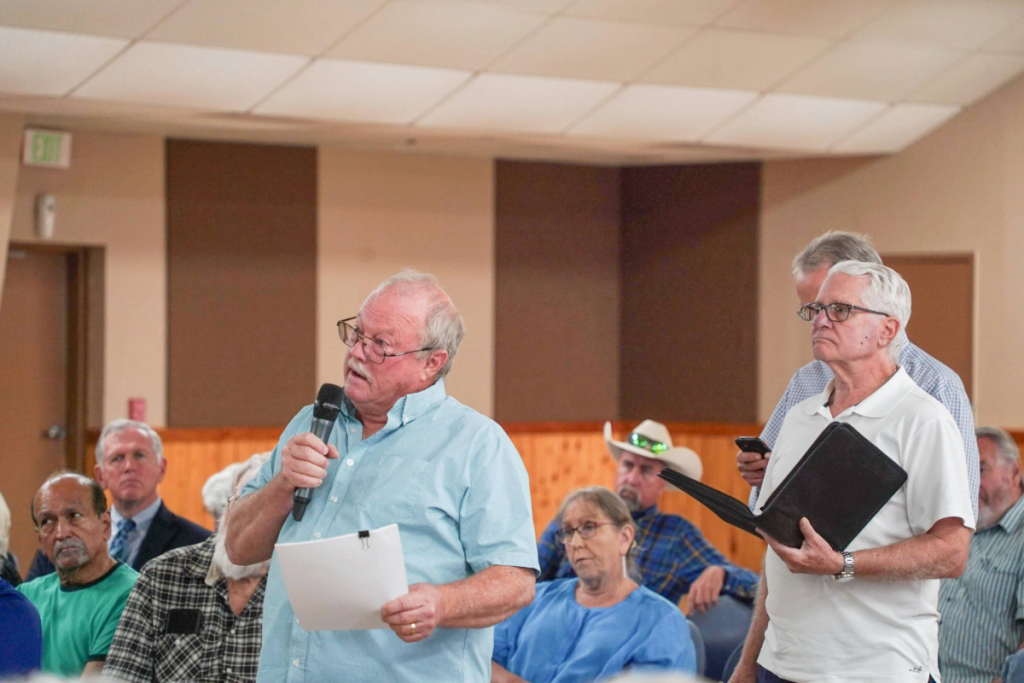
Landowners turned out in force Oct. 21 for a town hall in Burnet regarding a massive proposed transmission line that would cut through the north end of Burnet County. During the Public Utilities Commission of Texas-led event, many questions were raised, but few were answered, and solid feedback might not come until an application for the state project is filed, likely in November or December.
PUCT Director of Public Engagement Mike Hoke took questions from those present at the Tuesday meeting on the Bell County East to Big Hill 765-kilovolt Transmission Line Project. Plans consist of running 200 miles of high-voltage transmission lines from Central Texas to West Texas to provide power to the Permian Basin region. The project would require building 15-story towers across rural ranchland in Burnet County.
Several landowners had pointed questions for Hoke:
“What information does PUCT have, if any, concerning who the end user is going to be?”
“Was thought given to the installation of co-generation plants adjacent to the users as opposed to transmission lines across the state?”
“We just push (the transmission lines) off to our neighbors?”
“When were you going to tell us that this is for cryptomining?”
“Why can’t the state not simply say you (Permian Basin users) can provide your own power?”
“What’s going to be done for the landowners that are going to be affected?”
“Do you know how much of this electricity goes, long term, to data centers?”
The entire town hall, which was organized by the Burnet County Commissioners Court, can be watched on the Burnet County Government YouTube channel.
Burnet County resident Michael Smith took the mic at a town hall on the proposed Bell County East to Big Hill 765kV Transmission Line, voicing his concerns about the project. Staff photo by Dakota Morrissiey
While residents had dozens more questions and concerns about the risks, impacts, and true purpose of the 200-mile transmission line, and how to stop it, Hoke explained that not much could be done or addressed until an official application for the project was filed with the PUCT.
“Any other specific concerns you have, you will have to have in your comment, in your intervention, in your protest,” he said, deep into the 2½-hour town hall. “Things that aren’t in the application that you think (PUCT) commissioners need to know to make an informed decision, it all needs to be in the public record (to be considered).”
Hoke was referring to an application that will eventually be filed by the Lower Colorado River Authority and Oncor Electric Delivery. The PUCT has tasked the two entities with the actual construction of the 765kV line. Once the application is filed, anyone potentially impacted by the project will have a window to file a comment, protest, or intervention.
The application will likely be filed by late November or December, according to LCRA and Oncor estimates, at which point, official filings for the case can begin. An interactive map from the LCRA gives a clear view of the potential routes for the transmission line.
Those impacted will have 30 days to file for an intervention. Until that window opens, comments may be made and the case can be followed through PUCT docket no. 58559 on the commission’s website.
Once all filings have been made, PUCT will review the submissions and make a decision on the proposed transmission line route, how it will be done, and whether it will be done at all. Until then, no solid decisions can be made regarding the project, Hoke said.
The Burnet County Commissioners Court has established an information portal for the 765kV project on its website, outlining what is known so far and how to stay up to date on the project.
The attorney hired by Burnet County to help navigate the transmission line process, Margaret Pemberton, told those present at the town hall that the county could file as an intervener in the project when the time comes. As an intervener, the county would become a party to the case and have more input in the PUCT’s deliberation on the matter.
“(Filing) is something we’ve been discussing, and we’ve been drafting some things, but we wanted to hear input from the community first,” she said. “We have drafts that we are going to be filing soon.”
She also provided context for where Burnet County residents were in the process, hitting home that the time for action was soon, but not quite now.
“This (town hall) was really a forum to talk about the (PUCT) process, and we are so early in the process right now that we just don’t have answers,” Pemberton said.
News stories, staff photos, and other online content are copyrighted property of Victory Media. Reproduction in part or in whole is prohibited without the express written consent of the publisher.
David Dewayne Mann, 43, of Tow was arrested Tuesday, Oct. 21, on a charge of criminally negligent homicide for his involvement in a 2024 traffic collision in Kyle that led to the death of another driver.
According to Kyle police, on June 6, 2024, Mann was driving a GMC Yukon on Interstate 35 through the city when he rear-ended a black Nissan driven by 52-year-old Timothy Wray. After the initial collision, both drivers then hit a Toyota pickup truck. Mann and Wray were taken to the hospital and treated for their injuries. Mann survived, but Wray died from wounds suffered in the crash.
After an investigation into the wreck, Kyle police submitted their findings to the 274th District Attorney’s Office. A grand jury later indicted Mann on a charge of criminally negligent homicide, leading to a warrant for his arrest.
Criminally negligent homicide is a Texas state jail felony punishable by 180 days to two years in jail and up to $10,000 in fines. The crime is committed when someone causes the death of another person because they failed to recognize the risks or dangers of their actions, which would have or could have been recognized by a “reasonable” person.
The case and investigation are ongoing, and the specific circumstances that led to the charge against Mann have not been publicly shared.
Mann was being held in the Hays County Jail on a $4,000 bond as of Thursday, Oct. 23.
News stories, staff photos, and other online content are copyrighted property of Victory Media. Reproduction in part or in whole is prohibited without the express written consent of the publisher.
The Lower Colorado River Authority’s Arbuckle Reservoir just came online, marking the first large water storage project completed by the authority since the 1950s. While the new, $456 million reservoir is over 100 miles away from the Highland Lakes, in Wharton County, it could mean relief from some of the water demands on lakes Buchanan and Travis.
Water from this new reservoir will be used to serve customers, including agricultural operations, in the lower basin of the Colorado River and to satisfy required environmental flows into Matagorda Bay. Prior to Arbuckle’s completion, water had to be released from the Highland Lakes to satisfy those needs.
Some water will still be sent downstream from Buchanan and Travis for coastal purposes according to LCRA, but the burden on them should be greatly reduced.
“This is historic for the lower Colorado River basin and LCRA,” said John Hofmann, LCRA executive vice president of Water, in an Oct. 21 media release. “These large water supply projects can be very challenging, but we kept at it and are very pleased to say the new reservoir is up and running and ready to serve.”
The new reservoir spans nearly 1,100 acres and is about two miles wide by one mile long. While it holds about 40,000 acre-feet of water, it will add about 90,000 acre-feet of usable storage capacity when used in combination with management of lakes Buchanan and Travis. Those reservoirs hold about 1.99 million acre-feet combined when full and serve as the primary water supplies for communities throughout Burnet and Llano counties, and the greater-Austin metro-area.
“Arbuckle Reservoir benefits everyone in the basin,” Hofmann said. “In addition to reducing the amount of water from the Highland Lakes that will be sent downstream, it also enables us to store water in the lower basin for the first time. This allows us operational flexibility, so we can meet some or all the needs in the area with water stored locally and be more efficient in using downstream runoff.”
Arbuckle will likely fill up more regularly and can sustain more draw down due to higher levels of rainfall in the Wharton County area, which is about twice as much as the Highland Lakes watershed, according to LCRA. Its current storage level can now be tracked on the LCRA Hydromet river report.
The reservoir is completely manmade, and does not have natural inflows from creeks and tributaries like Buchanan and Travis do. Water will be pumped from the Colorado River into Arbuckle for storage, to capture it while flows are strong, and then pumped back out as needed.
LCRA will still release water from the Highland Lakes to supply water to customers below Lake Travis, including the cities of Austin and Pflugerville, the West Travis County Public Utility Agency, several power plants, industries and agricultural operations, as well as to meet environmental flow requirements for locations in the river above the intake for Arbuckle Reservoir.
The project had a $456 million price tag, partially paid for by grants and funding from the Texas Water Development Board.
Arbuckle is not open to recreation, like fishing, boating, or swimming, like lakes Buchanan and Travis. It will strictly function as a water storage facility.
News stories, staff photos, and other online content are copyrighted property of Victory Media. Reproduction in part or in whole is prohibited without the express written consent of the publisher.
This Content Submission and License Agreement (“Agreement”) is entered into by and between Victory Media Marketing LLC (“Company,” “we,” or “us”) and you (“User,” “you,” or “Submitter”) upon your submission of content through our websites’ See it, Share It form.
Submitted Content “Submitted Content” means any news tips, text, descriptions, images, photographs, videos, audio files, recordings, or other materials you upload, submit, or provide to us via the news tips forms on DailyTrib.com, KBEYfm.com, 101highlandlakes.com, or any other websites owned or operated by Victory Media Marketing LLC.
License Grant By submitting any Submitted Content, you hereby grant to Company a worldwide, non- exclusive, perpetual, irrevocable, royalty-free, fully sublicensable, and transferable license to use, reproduce, modify, adapt, publish, translate, create derivative works from, distribute, perform, display, and otherwise exploit the Submitted Content in any form or medium (now known or hereafter developed), including but not limited to:
Publishing on DailyTrib.com, KBEYfm.com, 101highlandlakes.com, other Company websites, apps, newsletters, and social media platforms (such as Facebook, Instagram, X, YouTube, etc.).
Editing, formatting, or combining with other content for news, promotional, archival, or commercial purposes.
Allowing third parties (e.g., affiliates, syndication partners) to use it under the same terms. You retain ownership of the copyright in your Submitted Content, subject to the license granted above.
User Representations and Warranties You represent and warrant that:
You are at least 18 years old and have the full right and authority to grant the rights in this Agreement.
The Submitted Content is your original work or you have obtained all necessary permissions, consents, and releases (including from any individuals appearing in photos/videos or owners of any third-party materials).
The Submitted Content does not infringe any third-party intellectual property rights, privacy rights, publicity rights, or defame any person.
It complies with all applicable laws and does not contain viruses, malware, or prohibited content.
You will not submit false, misleading, or confidential information.
No Compensation You understand and agree that you will receive no compensation for the submission or use of your Submitted Content.
Indemnification You agree to indemnify, defend, and hold harmless Company, its affiliates, officers, directors, employees, and agents from any claims, damages, liabilities, losses, and expenses (including reasonable attorneys’ fees) arising from your breach of this Agreement or any third-party claims related to your Submitted Content.
Moral Rights and Publicity You waive any moral rights or rights of attribution in the Submitted Content to the extent permitted by law. Company may use your name, username, or likeness in connection with the Submitted Content if applicable.
Termination and Removal Company may, in its sole discretion, edit, refuse to post, or remove any Submitted Content at any time without notice. This Agreement survives any termination.
Governing Law This Agreement is governed by the laws of the State of Texas, without regard to conflict of laws principles. Any disputes shall be resolved exclusively in the courts located in Burnet County, Texas.
Entire Agreement This Agreement constitutes the entire understanding between the parties and supersedes all prior agreements. Modifications must be in writing. By submitting content, you acknowledge that you have read, understood, and agree to be bound by this Agreement.