Marble Falls is weighing the pros and cons of letting golf carts cruise around its residential and downtown districts.
While the proposal is only being considered at this point, the City Council heard a thorough presentation from city staff Tuesday, Sept. 2, on the potential benefits and risks of allowing the carts on city streets in certain parts of town.
“It’s already happening in Marble Falls,” Downtown and Marketing Manager Erin Burks told the council during the presentation. “People are already using them. They’re coming downtown, they’re parking in regular parking spots, they’re using them at events.”
Burks explained that golf carts already can technically drive on city streets under specific conditions.
By Texas law, carts can legally be on the road if:
the street has a speed limit of 35 mph or less;
the cart has a state license plate;
the driver is on their way to or from a golf course within 5 miles of their home;
and there is no city ordinance prohibiting golf carts on streets.
“There have been several requests by residents to allow golf carts in the (downtown) area, and some of our businesses have made that request,” Burks added.
She went on to say that golf cart use could stimulate downtown economic growth and tourism and improve recreational aspects for residents and visitors. Part of her presentation to the council cited current trends, like the growth of the golf cart industry, which is projected to nearly double in size from $1.7 billion to $3.4 billion by 2034. Burks noted that other tourism-heavy communities see some benefits from golf cart use, like improved parking availability, reduced traffic, and increased visitor satisfaction.
“By creating a golf cart-friendly zone, Marble Falls can enhance its tourism experience, encourage local spending downtown, and strengthen its identity as a walkable, visitor-friendly community,” she said.
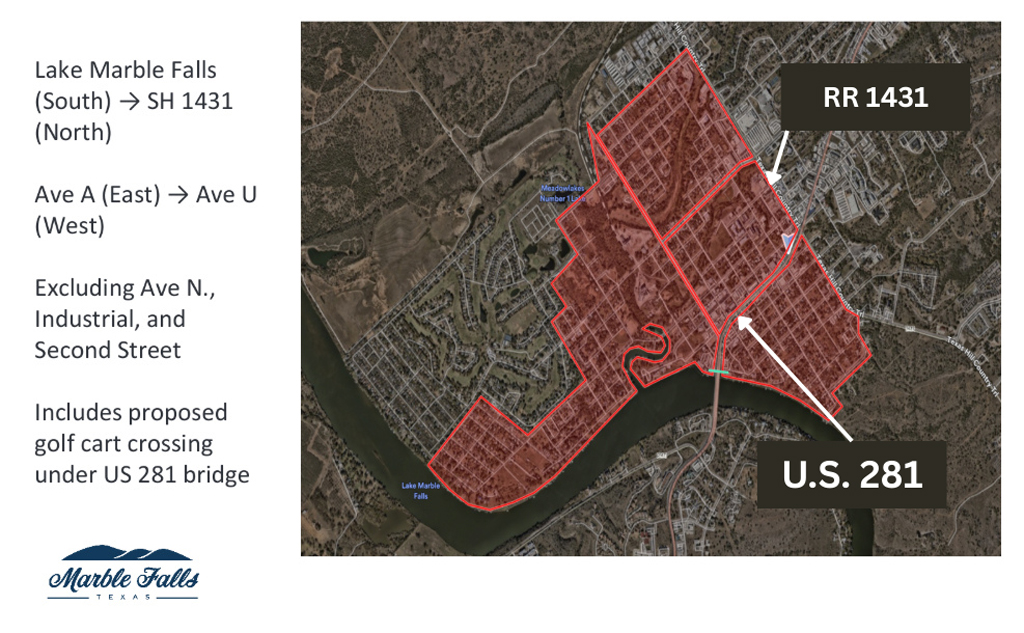
The red on this map shows the potential zone in which golf carts could drive in the city of Marble Falls. Carts could only cross U.S. 281 using a special crossing that would be installed beneath the U.S. 281 bridge. Image courtesy of city of Marble Falls
Under Burks’ proposal, golf carts would be allowed to travel along city streets south of RR 1431 and west of U.S. 281 on roadways with a speed limit lower than 35 mph. They would not be permitted north of RR 1431. Crossing U.S. 281 would be allowed if a special route were made beneath the bridge on the north bank of Lake Marble Falls.
Residents also likely would be required to have a city-issued permit and registration as well as ample safety and visibility attachments on their carts. Normal rules of the road would apply to golf cart drivers, who would also need a driver’s license to operate on city streets.
Special golf cart parking could be created downtown along with other multi-use driving paths throughout the city, allowing for easy travel in general.
CONCERNS
“If this is already happening, are we going to shut it down even harder or try to come up with some rules?” Burks posed to the Marble Falls City Council at the close of her presentation.
While the council seemed favorable toward the proposal, there were some questions about safety, the ability to enforce regulations, and how to prevent swarms of rental carts from flooding the city.
“We can certainly do it, but we have to do it safely,” Marble Falls Police Chief Glenn Hanson told the council.
Hanson noted that having golf carts on the streets would inevitably lead to accidents with larger vehicles, his officers might not always be able to respond to regulation violations, and strict enforcement would be needed to keep everyone safe and in line.
“You’re mixing a lightweight vehicle with two-ton vehicles on the streets. It is not a matter of if (accidents) will happen, it is when it will happen,” he said. “And (enforcement) could add a workload to my officers (who) really already don’t have enough time.”
If the council moved forward on the golf cart proposal, Hanson said it should include bans on driving along thoroughfares used by first responders during emergencies, like Avenue N, Industrial Boulevard, and Second Street.
Place 1 Councilor Griff Morris said the city should note the chief’s safety concerns before taking action.
“I need to know a lot more about this,” he said. “More data, more statistics, more fatalities, EMS calls. How many people is it going to take (to adequately regulate)?”
Mayor John Packer, who was backed by Place 5 Councilor Richard Westerman, showed his support for the plan but had reservations about rental companies flooding the city with golf carts.
“I’m all for it, but I’m not for 500 golf carts on every corner for rent,” he said.
Ultimately, the council directed Burks and Hanson to do more research regarding the proposal and for City Attorney Josh Brockman-Weber to look into the legality of limiting golf cart rentals within the city.
News stories, staff photos, and other online content are copyrighted property of Victory Media. Reproduction in part or in whole is prohibited without the express written consent of the publisher.
EDITOR’S NOTE: The following column is by LCRA Executive Vice President of Water John Hofmann and was submitted to area media organizations. DailyTrib.com is running it in full with only minor editing.
On July 2, our region was in a serious, years-long drought.
Then came July 3 and the start of heavy rains that caused devastating flooding throughout the Hill Country. By the end of the month, our water supply reservoirs were back to almost-full levels.
Welcome to Flash Flood Alley. It’s droughts and floods, and floods and droughts, and then more droughts, and then—you guessed it—another flood.
So what happens now that lakes Buchanan and Travis are close to full?
The answer is anything.
LCRA Executive Vice President of Water John Hofmann. Photo courtesy of LCRA
We could go back to prolonged dry conditions, but it also wouldn’t take much rain for us to again have to open floodgates along the Highland Lakes. Remember: droughts and floods and floods and droughts. With that in mind, I wanted to offer a short primer for newcomers and maybe some old-timers who might be a little rusty on life with almost-full lakes.
First, the time to plan for floods is now. Not next month. Not next year. Now.
We don’t know what the rest of the year holds, and with rain in the right places, we could see flood operations needed quickly at every dam along the Highland Lakes.
Let me set the stage regarding the Highland Lakes, a chain of lakes northwest of Austin. From north to south, they are Lake Buchanan, Inks Lake, Lake LBJ, Lake Marble Falls, Lake Travis, and Lake Austin.
The two largest lakes—Buchanan and Travis—are water supply reservoirs that are designed to fluctuate. The other lakes are known as “pass-through” lakes, built mainly for hydroelectric generation. The pass-through lakes are normally managed within a range of about a foot, but during a flood, flows are much swifter and water levels can be significantly higher.
Lake Buchanan is basically full. That means there is no room to store additional water, so any rain over the lake, or importantly, any rain upstream of the lake, will need to be passed downstream through Buchanan Dam through Inks Lake, Lake LBJ, and Lake Marble Falls into Lake Travis, the only one of the Highland Lakes designed to store floodwaters.
And did I mention Lake Travis is just a few feet short of being full?
If Lake Travis rises several more feet, the LCRA might need to open floodgates at Mansfield Dam for the first time since 2019 to send floodwater down the Colorado River through Austin and then Bastrop, Fayette, Colorado, Wharton, and Matagorda counties into Matagorda Bay. If the lower river is already running high, we might need to temporarily store water in the Lake Travis flood pool. (Stay with me here, because this gets a little complicated. Lake Travis is considered “full” at 681 feet above mean sea level (feet msl), but it has a large flood pool above 681 feet msl that can hold an additional 776,000 acre-feet of water, or the equivalent of 31 Lake Austins.)
That means people on the Highland Lakes and the lower river need to be ready. Know your flood risk. Develop your plan now.
To be blunt: If you are in an area where you could be affected by floodwaters on the Highland Lakes or Colorado River, you need to pay attention in a way you probably haven’t had to over the past few years. With lakes at these levels, you need to be on alert not just when it rains in your neighborhood but also when it rains upstream in the lower Colorado River basin, because that water will sooner or later flow into the Highland Lakes.
Things changed after the July rains, and our region is now in an entirely different operational posture than we were on July 2. Additional flooding could come quickly. We encourage Central Texans to join us in being prepared and ready to act if and when the time comes.
This is not a drill.
John Hofmann is executive vice president of Water for the Lower Colorado River Authority. For more information on flood preparedness along the Highland Lakes, visit www.lcra.org/floodmanagement.
News stories, staff photos, and other online content are copyrighted property of Victory Media. Reproduction in part or in whole is prohibited without the express written consent of the publisher.
Law enforcement found the body of a kayaker on the morning of Sunday, Aug. 31, near Black Rock Park on Lake Buchanan in Llano County. The man died in an apparent drowning, according to officials.
A 911 call at around 8 p.m. Saturday reported the kayaker missing when he did not return to the park after going fishing on the lake earlier in the day. Multiple agencies responded to the scene but did not find him that night.
The missing man’s body and kayak were found by drone early Sunday morning, about 400 yards from where he had been staying at Black Rock Park, a Lower Colorado River Authority-owned site on the southwest side of Lake Buchanan, 3400 Texas 261 in Buchanan Dam.
The man had not been publicly identified as of Tuesday afternoon but was not a Highland Lakes resident, according to officials.
While an exact cause of death has not been released, and there are no theories as to what exactly led up to the death, it is believed to have been a drowning. The victim was not wearing a life jacket at the time, something Buchanan Volunteer Assistant Fire Chief Rusty Ward believes might have contributed to the tragedy.
“We have never pulled anybody dead out of the lake that was wearing a life jacket,” Ward told DailyTrib.com. “Life jackets, life jackets, life jackets—no matter what.”
Buchanan VFD was aided by the Llano County Sheriff’s Office, Burnet County Sheriff’s Office, Texas Parks and Wildlife Department game wardens, LCRA rangers, Cassie VFD, and East Lake VFD in the search.
News stories, staff photos, and other online content are copyrighted property of Victory Media. Reproduction in part or in whole is prohibited without the express written consent of the publisher.
News stories, staff photos, and other online content are copyrighted property of Victory Media. Reproduction in part or in whole is prohibited without the express written consent of the publisher.
Burnet city leaders are considering using a federal program that would allow for a split-cost buyout of properties severely damaged by the Fourth of July weekend flood. The program is completely voluntary, and it would ultimately be up to the property owners to decide whether or not they wanted to make a deal.
According to Burnet City Manager David Vaughn, 13 properties in the city have been identified as substantially damaged in the flood. The owners of 10 of those properties have expressed interest in a potential buyout; however, the City Council is still determining the best course of action to move forward.
“At this point, the council has not 100 percent committed to do this,” Vaughn told DailyTrib.com. “Many of these properties could technically be rebuilt, but it wouldn’t be financially viable.”
The buyouts would be through the U.S. Department of Agriculture’s Natural Resources Conservation Service Emergency Watershed Protection program. Under this program, the USDA would cover 75 percent of the cost of purchasing a high-flood-risk property, with the city of Burnet, a partner entity, covering the remaining 25 percent. The purchase would be made at fair market value of the property before any flood damage occurred, and again, it would be totally voluntary based on the owner’s decision.
“Buyouts are effective in preventing future damage, make residents safer, and protect communities,” reads a USDA report on the nature of the EWP program. “Once purchased, the land is returned to a natural open space where it provides the added benefit of absorbing storm runoff, reducing future flooding, and providing wildlife habitat.”
Vaughn said it might not be possible for the city to buy out every property that applies for the EWP program, but he believes it could help alleviate a burden on the city and assist a few property owners in tight spots following the flood damage.
“We’re all built to want to help, but we have to be fiscally responsible with the community’s money,” he said. “But, if we buy these properties out, it means we don’t have to worry about people getting flooded out or endangering first responders during those events, or using city resources when that happens, so there is a public purpose and justifiable reason to utilize public funds.”
News stories, staff photos, and other online content are copyrighted property of Victory Media. Reproduction in part or in whole is prohibited without the express written consent of the publisher.
Burnet City Manager David Vaughn was recognized for his 25 years of civic service during a City Council meeting Tuesday, Aug. 26.
During the ceremony, Vaughn was presented with a 25-year service pin and a specially engraved award to commemorate his milestone.
“David, on behalf of the City Council, our employees, and the people of Burnet, I want to thank you for your 25 years of service,” said Mayor Gary Wideman at the meeting. “We are truly fortunate to have had your leadership, and we look forward to many more years of working together to keep Burnet strong and moving forward.”
Vaughn began his long journey with Burnet government in 2000 as an administrative clerk in the Water and Sewer Department, according to a media release from the city. Just a few, he transferred to the Administration Department, and by December of that year, he was promoted to purchasing agent.
In May 2002, Vaughn became the city’s assistant finance director, a job he held for 2½ years before stepping into the role of director of Planning and Development in October 2004. Four months later, he was promoted to assistant city manager.
For more than six years, Vaughn served as assistant city manager, helping guide Burnet through significant growth and development and stepping in as interim city manager when needed.
He officially became Burnet’s city manager on April 26, 2011. Under his guidance, the city has advanced critical infrastructure improvements, invested in parks and quality-of-life amenities, and strengthened the foundation for long-term growth.
News stories, staff photos, and other online content are copyrighted property of Victory Media. Reproduction in part or in whole is prohibited without the express written consent of the publisher.
Layne’s Chicken Fingers opened its doors earlier this week in Marble Falls and plans a grand opening celebration Saturday, Aug. 30, from 10:30 a.m.-2 p.m. at 2711 U.S. 281 North. The new chicken joint has been on the Highland Lakes community radar since March. This brings an end to a silly saga that began when two teens pranked the city with a Raising Cane’s Chicken Fingers “coming soon” sign at the same location in the summer of 2024. Staff photo by Dakota Morrissiey
News stories, staff photos, and other online content are copyrighted property of Victory Media. Reproduction in part or in whole is prohibited without the express written consent of the publisher.
The Burnet County Democratic Party is holding a “workers over billionaires” demonstration on Labor Day on the U.S. 281 bridge in Marble Falls.
Local Democrats and activists will line the bridge starting at 10 a.m. Monday. The demonstration will not impede traffic, according to Democratic Party Precinct 6 Chair Roseann Thornton and Marble Falls Police Chief Glenn Hanson.
Marchers will unfurl “pro-democracy” banners during the demonstration.
“We’re going to celebrate Labor Day by celebrating working people over billionaires,” Thornton said.
News stories, staff photos, and other online content are copyrighted property of Victory Media. Reproduction in part or in whole is prohibited without the express written consent of the publisher.
As of Wednesday, Aug. 27, the Burnet County judge’s race seems to have two potential candidates, both powerful players in county government.
Burnet County Sheriff’s Office Chief Deputy Alan Trevino and currently appointed county Judge Bryan Wilson have each officially filed for campaign treasurers for next March’s Republican primary. While the actual filing window for the judge’s seat is Nov. 8 through Dec. 8, the campaign treasurer submissions signify a strong intention to run by both men.
The winner of the GOP primary will almost certainly take the seat as there is rarely a Democratic challenger in November’s general election.
Wilson hand-delivered his campaign treasurer filing at 11:41 a.m. Wednesday, taking the first recorded step toward a potential run for office. Since being appointed judge in March, he has been tight-lipped on his intentions to seek the seat when it is put on the ballot, until now.
“There’s still much work to do, and that’s why we’ve decided, after much prayer and with the support of our family, that I am running for Burnet County judge,” Wilson said in a statement sent to DailyTrib.com.
Trevino has been publicly campaigning for judge after announcing his intention to run in December 2024 immediately following the resignation of former county Judge James Oakley. The chief deputy filed for a campaign treasurer on Dec. 13, 2024.
Both Wilson and Trevino sought the Burnet County judge appointment following Oakley’s resignation. After weeks of deliberation and two deadlocked votes, the four remaining members of the Burnet County Commissioners Court chose Wilson.
Wilson and Trevino have recently battled in Commissioners Court over the 2025-26 fiscal year budget. Trevino and Sheriff Calvin Boyd are strongly advocating for more funds for the Sheriff’s Office and the hiring of four new deputies, while Wilson has stuck to his guns for a leaner budget and reduced tax rate that has left out the requested deputies.
The Burnet County judge is the chairperson of the five-member Burnet County Commissioners Court, which includes a commissioner from each of the county’s four precincts.
The court is the general governing body of Burnet County, responsible for approving the tax rate and county budget; appointing officials and hiring personnel; setting voting precincts; calling bond elections; authorizing contracts and billing; maintaining and building county roads, bridges, and facilities; providing veterans assistance; overseeing the county library system; and providing technology and archival needs for county records.
The terms “judge” and “court” in this case are not meant in the traditional judicial sense. The county judge’s role is more that of a presiding officer over a board of officers charged with operating the county and all of its subsidiaries.
While the judge is essentially the chief executive officer of the county, they are an equal voting member to each of the four commissioners of the court.
The county judge serves four-year terms and has an annual salary of $113,337 per the 2024-25 Burnet County budget.
acting as the chief budget officer of the county, creating the budget to be ultimately voted on by the entire Commissioners Court;
setting the agendas of the Commissioners Court;
serving as the head of emergency management for the county;
calling for elections and posting election notices;
and potentially serving as judge of the county court for certain criminal or civil cases, including probates.
CORRECTION: A previous version of this story said Alan Trevino filed for a campaign treasurer on July 14, 2025, which is incorrect. That date was when Trevino had last filed a campaign finance report. Trevino appointed a campaign treasurer on Dec. 13, 2024. The story has been corrected.
News stories, staff photos, and other online content are copyrighted property of Victory Media. Reproduction in part or in whole is prohibited without the express written consent of the publisher.
This Content Submission and License Agreement (“Agreement”) is entered into by and between Victory Media Marketing LLC (“Company,” “we,” or “us”) and you (“User,” “you,” or “Submitter”) upon your submission of content through our websites’ See it, Share It form.
Submitted Content “Submitted Content” means any news tips, text, descriptions, images, photographs, videos, audio files, recordings, or other materials you upload, submit, or provide to us via the news tips forms on DailyTrib.com, KBEYfm.com, 101highlandlakes.com, or any other websites owned or operated by Victory Media Marketing LLC.
License Grant By submitting any Submitted Content, you hereby grant to Company a worldwide, non- exclusive, perpetual, irrevocable, royalty-free, fully sublicensable, and transferable license to use, reproduce, modify, adapt, publish, translate, create derivative works from, distribute, perform, display, and otherwise exploit the Submitted Content in any form or medium (now known or hereafter developed), including but not limited to:
Publishing on DailyTrib.com, KBEYfm.com, 101highlandlakes.com, other Company websites, apps, newsletters, and social media platforms (such as Facebook, Instagram, X, YouTube, etc.).
Editing, formatting, or combining with other content for news, promotional, archival, or commercial purposes.
Allowing third parties (e.g., affiliates, syndication partners) to use it under the same terms. You retain ownership of the copyright in your Submitted Content, subject to the license granted above.
User Representations and Warranties You represent and warrant that:
You are at least 18 years old and have the full right and authority to grant the rights in this Agreement.
The Submitted Content is your original work or you have obtained all necessary permissions, consents, and releases (including from any individuals appearing in photos/videos or owners of any third-party materials).
The Submitted Content does not infringe any third-party intellectual property rights, privacy rights, publicity rights, or defame any person.
It complies with all applicable laws and does not contain viruses, malware, or prohibited content.
You will not submit false, misleading, or confidential information.
No Compensation You understand and agree that you will receive no compensation for the submission or use of your Submitted Content.
Indemnification You agree to indemnify, defend, and hold harmless Company, its affiliates, officers, directors, employees, and agents from any claims, damages, liabilities, losses, and expenses (including reasonable attorneys’ fees) arising from your breach of this Agreement or any third-party claims related to your Submitted Content.
Moral Rights and Publicity You waive any moral rights or rights of attribution in the Submitted Content to the extent permitted by law. Company may use your name, username, or likeness in connection with the Submitted Content if applicable.
Termination and Removal Company may, in its sole discretion, edit, refuse to post, or remove any Submitted Content at any time without notice. This Agreement survives any termination.
Governing Law This Agreement is governed by the laws of the State of Texas, without regard to conflict of laws principles. Any disputes shall be resolved exclusively in the courts located in Burnet County, Texas.
Entire Agreement This Agreement constitutes the entire understanding between the parties and supersedes all prior agreements. Modifications must be in writing. By submitting content, you acknowledge that you have read, understood, and agree to be bound by this Agreement.