




Burnet tweaks multi-family residential regulations to better manage developments
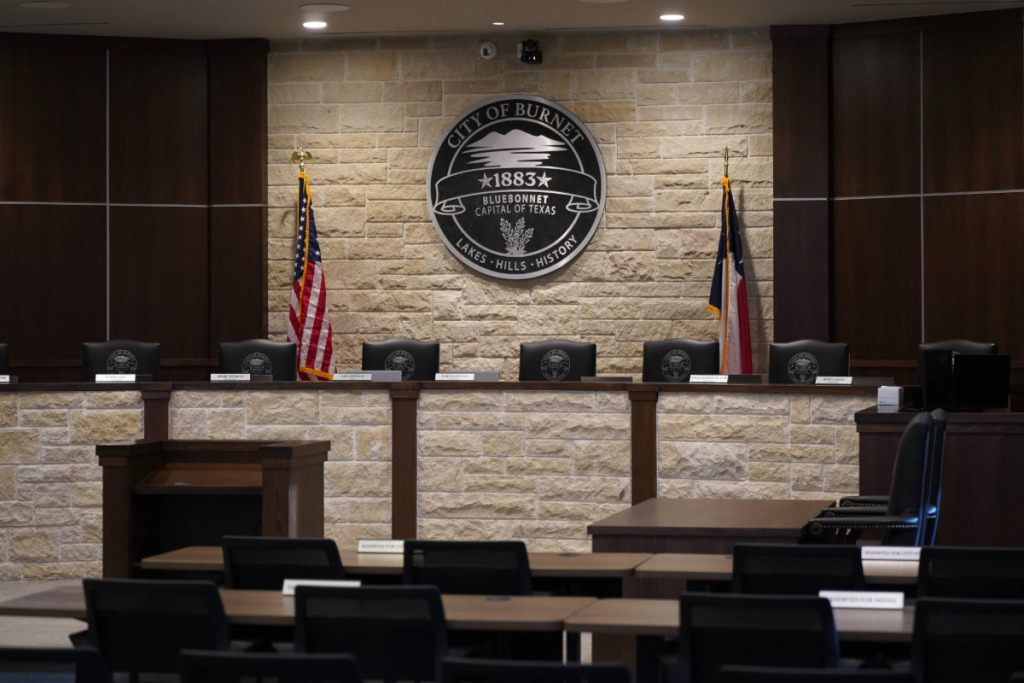
The Burnet City Council chambers. Staff photo by Caden Senn
The Burnet City Council recently approved amendments to the city’s multi-family residential district “R-3” regulations at a Feb. 24 council meeting in an effort to manage and incentivize future housing developments.
The changes, mostly tightening regulations on setback distances, lot sizes, height limits, and building materials, will give the city more negotiating powers with developers on certain standards of multi-family dwellings to increase their curb appeal and longevity.
City Planning Manager Leslie Kimbler pointed out the success of these sorts of changes in other municipalities in the area.
“(These regulations) are pushing developers (in other cities) to come to the city and request a planned unit development, which then gives the city the ability to negotiate some of the development standards with that developer,” Kimbler said at the meeting.
Additional changes requiring parking spaces, downward-facing lighting, masonry fencing, and amenities were made to provide residents of such dwellings with more benefits.
Kimbler again spoke on the beneficial effects of such changes in other cities, specifically in requiring developers to add amenities.
“Right now, we don’t require any amenities when we build an apartment complex,” Kimbler said. “What we’re seeing in a lot of municipalities surrounding us, they’re requiring (developers) to add amenities whenever they build a certain number of units.”
A full list of the changes approved, as presented in the online meeting packet beginning on page 84, are as follows:
Setbacks, lot size, and height limit
- Side yard setbacks increased from 10 feet to 15 feet
- Street side yard setbacks increased from 15 feet to 25 feet
- Minimum lot square footage area increased from 4,000 square feet to 10,000 square feet
- Maximum height limit increased from 35 feet to a variable of 35-55 feet
Parking, amenities, fencing, and lighting
- Parking increased from two spaces per two-bedroom unit plus one space per two additional bedrooms, to two spaces per one-bedroom unit and three spaces per two or three-bedroom unit
- Added amenity requirements based on total units, ranging from zero to four amenities per project
- Added impervious cover requirements for a masonry fence made of brick, stone, or concrete, joined with mortar, and being six feet in height, to be constructed on all sides of the property
- Requires all exterior lighting to be shielded or downward facing to the greatest extent possible to reduce light pollution
Masonry and density
- Each multi-family complex shall contain a minimum of five single-family dwelling units
- Density shall not exceed eight units per acre, unless:
- The exterior surface area of the building is comprised of 100 percent masonry, the density may be increased to up to 25 units per acre
- The exterior surface area of the building is comprised of at least 85 percent masonry for first-story walls and 50 percent masonry for each additional story, the density may be increased to up to 18 units per acre