




Oncor ‘strongly disagrees’ with several state concerns regarding 765-kV transmission project
Oncor Electric Delivery has addressed a recent decision by state officials to recommend denial of the company’s application to build out a large transmission line project. Stock photo with Oncor Electric Delivery logo
One of the companies behind a massive transmission line project looming over Burnet County has pushed back on recent opposition from state officials. Following a recommendation from the State Office of Administrative Hearings to completely deny the application for the 765 kilovolt transmission project, Oncor Electric Delivery issued a statement claiming that the lines are necessary to satisfy a growing demand for power in Far West Texas.
The SOAH and its administrative law judges issued their recommendation on Aug. 20 for denial of Oncor’s application with the Public Utility Commission of Texas, sharing that they believed developers failed to establish that their plans were necessary for “service, accommodation, convenience, or safety of the public,” along with concerns that at least 1,400 potentially-impacted landowners were not properly notified of the proposed project.
“While Oncor respects the role of the administrative law judges in this process, we strongly disagree with several of the conclusions within the Proposal for Decision, including findings related to the need for these projects and compliance with established notice requirements,” reads a statement from Oncor sent on Tuesday, Aug. 25, to DailyTrib. “We recognize the significant impact transmission projects can have on landowners and have consistently supported opportunities for public engagement. Oncor maintains that we complied with all applicable state laws and regulations when providing landowner notice for this project and that the PFD’s reading is inconsistent with the rule.”
Oncor and the Lower Colorado River Authority have been in a lengthy application process with the Public Utility Commission of Texas, working to develop a massive transmission line network that would carry power from Central Texas to the Permian Basin in West Texas to help address a growing demand for power in that region.
Their project would include building out hundreds of miles of high-voltage 765 kV transmission lines, suspended from 18-story steel towers along wide easements that would cut through much of Central Texas, including northern Burnet County.
“Ultimately, these projects were identified through the established transmission-planning process, by the grid experts charged with maintaining reliability, and the evidence supporting their need has only continued to grow,” continues Oncor’s statement. “Oncor has an obligation to serve our customers, and we cannot do that without the infrastructure required to provide that service. We look forward to addressing the (Proposal for Decision) findings as these projects continue through the regulatory process and remain confident that the record supports moving these critical reliability projects forward.”
While the SOAH administrative law judges recommended denial of Oncor and the LCRA’s application, the decision is up to the Public Utility Commission of Texas, which is still reviewing the matter as of Wednesday, Aug. 26.
Oncor pointed to the need for the 765 kV project as determined by the Electric Reliability Council of Texas and its Permian Basin Reliability Plan Study, which was carried out at the direction of the PUCT after the 88th Texas Legislature passed House Bill 5066 in 2023, which mandated that the state improve its electric grid, especially in the Permian Basin.
According to the Permian Basin Reliability Plan Study, that region is expected to see large load growth by 2038. Some of the expected increase in power demand is attributed to the oil-and-gas industry, but much of it is to new sectors.
ERCOT’s study was based on data collected over several years and predictions made as to what the future load growth would be for the Permian Basin by 2030 and 2038. Some of the foundational data for this study was contributed by Oncor itself through a 2022 load forecast developed by S&P Global on behalf of the electric delivery firm.
According to the study, the Permian Basin is expected to have a total demand load of an estimated 26,400 megawatts.
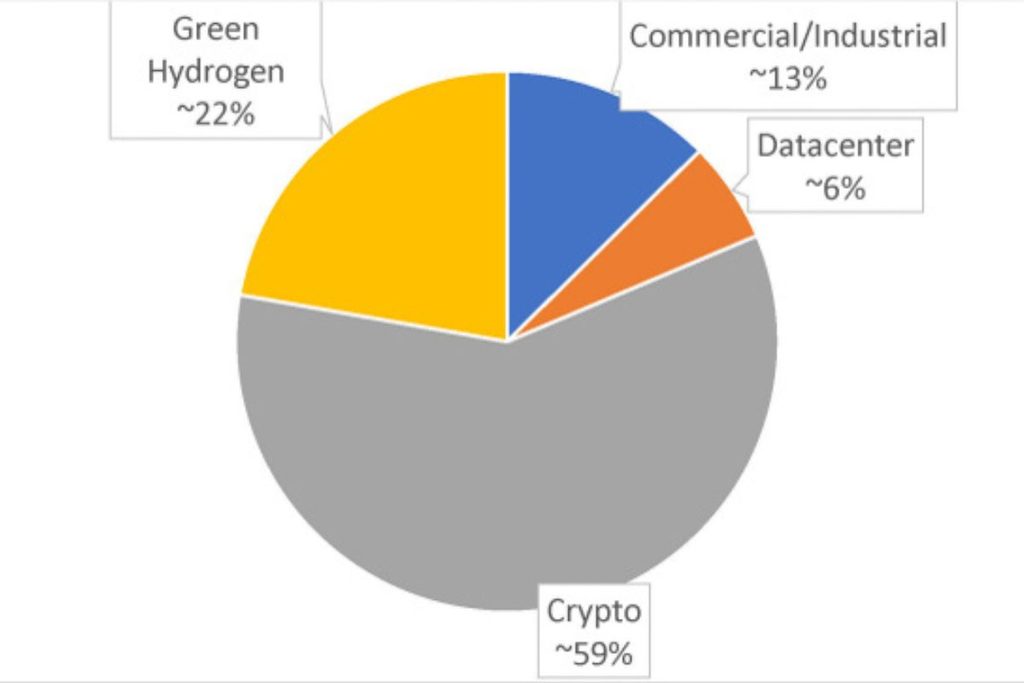
Of that predicted 26,400 MW, about 55.7 percent, or 14,705 MW, would come from the growing oil-and-gas industry while about 44.3 percent, or 11,695 MW, would come from completely new sources.
The expected increase of 11,695 MW worth of non-oil-and-gas loads is attributed to: 59 percent cryptocurrency mining operations, green hydrogen, 13 percent other commercial/industrial projects, and 6 percent data centers.
“The need for additional transmission into the Permian Basin has been extensively and repeatedly studied and confirmed by ERCOT, the independent grid operator responsible for maintaining reliability and planning the Texas electric system, as well as by the Public Utility Commission of Texas (PUCT) and every other administrative law judge sitting in the Permian Basin import path dockets,” reads Oncor’s statement.
Lengthy testimony from oil and gas and electric-generation industry representatives was given during a 12-hour hearing of the Committee on State Affairs held on Aug. 19.
“Testimony also made clear that while new generation is being built, including new gas generation in the Permian, generation and transmission are not substitutes for one another,” Oncor explained. “Representatives from the oil and gas and electric-generation industries emphasized that additional generation alone cannot and will not resolve the transmission constraints in Far West Texas. All of these facts were presented as evidence in the proceeding and we are disappointed that the (SOAH administrative law judges) disregarded the real looming reliability issues in the Permian Basin.”