




New evidence reignites Llano County cold case
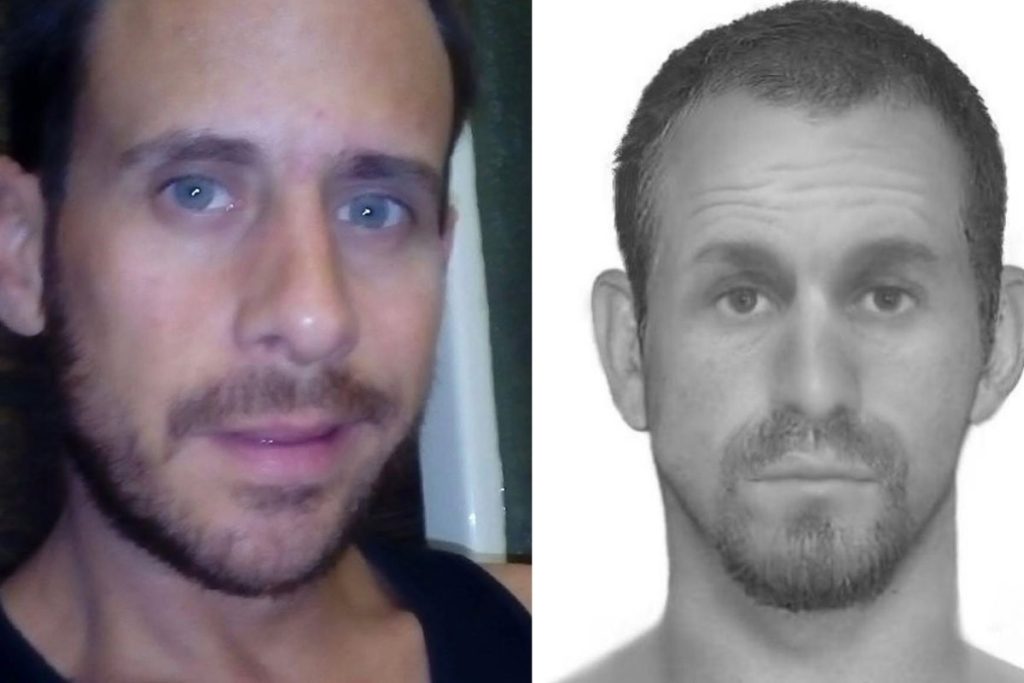
Investigators believe that human remains discovered on a Llano County ranch in 2018 may belong to Eric William Wallace, pictured on the left. The image on the right is a facial reconstruction created in 2022 of the owner of the remains, who was unidentified at the time. Llano County Sheriff’s Office images
Human remains were discovered on a Llano County ranch in 2018, but went unidentified until now. Investigators believe they know who the remains belong to and are looking for further information to bring closure to the cold case.
According to the Llano County Sheriff’s Office, the remains likely belong to Eric William Wallace, a man with connections to San Antonio, North Carolina, and Florida that had been out of contact with his family since 2017.
“Recent forensic developments have advanced the investigation, and investigators are actively following up on new information related to the case,” reads a LCSO media release issued on June 12. “No piece of information is too small, and any information could be valuable to the ongoing investigation.”
Contact investigator Adam Guerrero at 325-247-5767 with information on Wallace or the case.
Background
Skeletal remains were found by a landowner on April 1, 2018 on a 1,500-acre ranch in western Llano County, about 8 miles west of the city of Llano on Texas 29. At the time the body was discovered, officials did not suspect foul play, and no further updates have been shared regarding the nature of the death.
Initially, investigators weren’t able to determine much about the identity of who the remains belonged to, or how they may have died. The Texas State University Forensic Anthropology Center assisted with the recovery of the remains and took them in for analysis.
In 2022, the Llano County Sheriff’s Office had a breakthrough, and released a facial reconstruction of the skeletal remains, sharing that the person they belonged to was likely a man between 24 and 39 years old and between 4 feet 11 inches and 5 feet 7 inches tall.
Despite the evidence shared in 2022, the case remained cold until recent developments.