




Young thespians reap rewards on and off stage
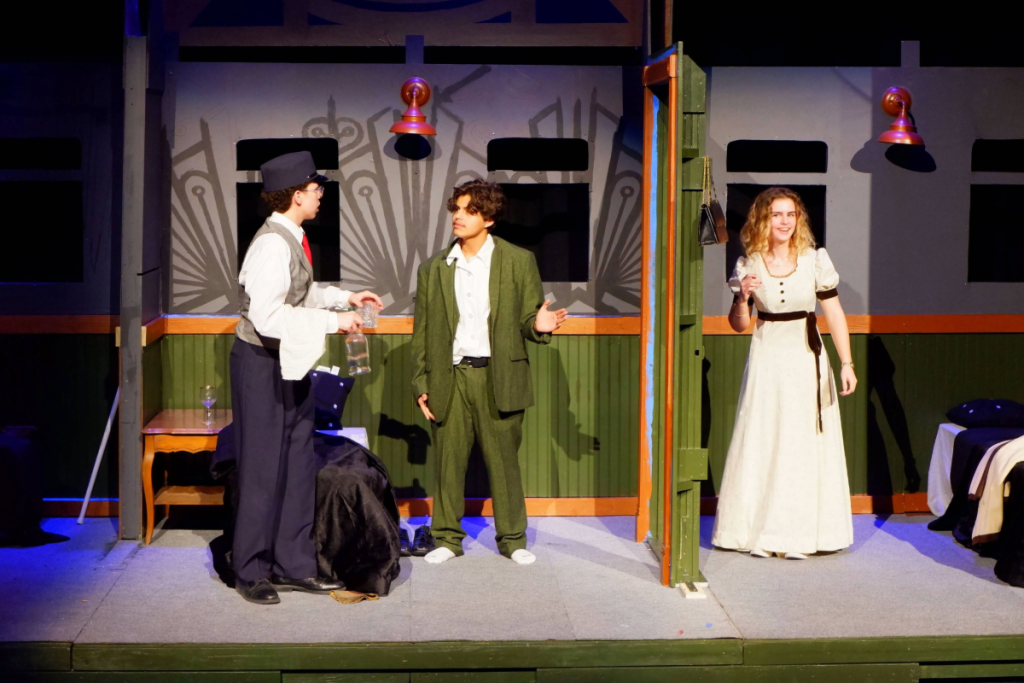
Marble Falls High School students Evan Puga (left), Santiago Gaytan, and Brixton Osloond rehearse for ‘Murder on the Orient Express,’ which was performed for the public in January. Staff photo by Maci Cottingham
At first glance, it’s just another afternoon at Marble Falls High School, but inside the campus’ 1,000-seat auditorium, creative chaos reigns.
Students rush between sets, adjusting lighting and running lines, while props fly through the air as someone rehearses a dramatic entrance. Rehearsals for productions such as “The Collective” and “Murder on the Orient Express” turn ordinary afternoons into extraordinary experiences, and an extracurricular activity into a lasting memory.
“I think theater is the most diverse thing a student can do in high school,” said MFHS theater director Jon Clark. “There’s a place for you in theater, no matter what.”
Theater offers students a chance to find their niche—costume design, technical work, acting—and in the process, maybe even themselves, Clark said.
The program’s reputation has been steadily building.
Last year, the Marble Falls troupe won silver at the University Interscholastic League one-act state competition for “Moby Dick-Rehearsed,” a condensed adaptation of Herman Melville’s classic tale. Performance of the 40-minute play, which was trimmed from two acts to one act, earned the team its third state medal in four years.
Reflecting on the production, assistant director Jordan Jones said the biggest challenge was “trying to toe that line of theatrical disbelief.”
“As performers, you sometimes get lost and forget you’re acting—you’re just living in the world of the play,” he said. “The challenge is making it believable so the audience doesn’t think, ‘Wait, they were just in a theater, now they’re on a ship.’”
The troupe’s preparation is as meticulous as it is intense. Students rehearse three days a week under UIL’s eight-hour limit, with occasional weekends to refine scenes and perfect cues.

Senior Anthony Ruiz knows that intensity firsthand. He stumbled into theater as a freshman when he joined Clark’s group for Rick Edwards Day of Service, and Clark encouraged him to give it a try. He started as an alternate that year, expecting little in return.
“A lot of people think of an alternate as being a throwaway role, but it’s really rewarding as long as you put in the work,” Ruiz said.
By his sophomore year, he had moved into the tech aspect, focusing on stage management and lighting.
“It’s organized chaos in a way,” Ruiz said. “It’s helping everyone that needs it when they need it, and it involves knowing a lot about how the tech works—lots of quick thinking—but the lighting aspect is what I really love.”
In November, Ruiz earned perfect scores and qualified for national competition at Texas Thespians, the largest national chapter of the Educational Theatre Association. Though he plans to pursue nursing after graduation, he said theater will always be part of his life.
“Nursing was my first calling, and then theater sort of found me,” Ruiz said. “I’ve been really pulled both ways trying to figure out what I want to do, but I think I’m going to do nursing.”
Instructor leadership drives the program’s success. Jones, a graduate of Marble Falls High School, returned to teach alongside Clark, his former theater teacher and fellow alumnus. Both emphasized that every production is a growth opportunity for students.
“We don’t want to just produce shows,” Jones said. “We want to make sure students continue to evolve, becoming stronger with each show. I want everybody to know that Marble Falls has some great kids who are super talented.”
Clark chimed in with his own goal for the program.
“With every show, I try to make it the best one yet, pushing ourselves and the students to keep growing,” he said.
Even after last year’s success, Marble Falls students and faculty are pushing boundaries. Their current production, “The Collective,” promises to be just as ambitious.
“The shows are very complex in terms of ensemble and technical items, so I have to plan everything out,” Clark said. “Maybe I challenge our kids too much, but it usually works out for us.”
For the students, the magic is in the details: the thrill of a perfectly executed lighting cue, the satisfaction of a positive audience reaction, and the camaraderie behind the scenes. Some thrive in the spotlight, others manage props, design costumes, or orchestrate complex cues. Every role matters, and every contribution shapes the final performance.

“The ultimate goal is to have fun but also enjoy the process so it doesn’t feel like a chore and, of course, return to state (competition),” Jones said.
At the end of the day, the program’s focus is on creating a space where students discover new passions and develop skills they can carry off stage.
Rehearsals become a training ground where students practice quick thinking, problem-solving, and collaboration alongside peers with whom they might not normally work. And long after the lights dim and scripts are tucked away, those lessons linger.
For the young participants, and their instructors, theater is not just a stage, it’s a home.
“This is where I want to be and where I want to end my career,” Jones said. “I don’t want to be anywhere else.”