




Almighty dog: Locally bred Lacy Hog Dogs, the Texas state canine
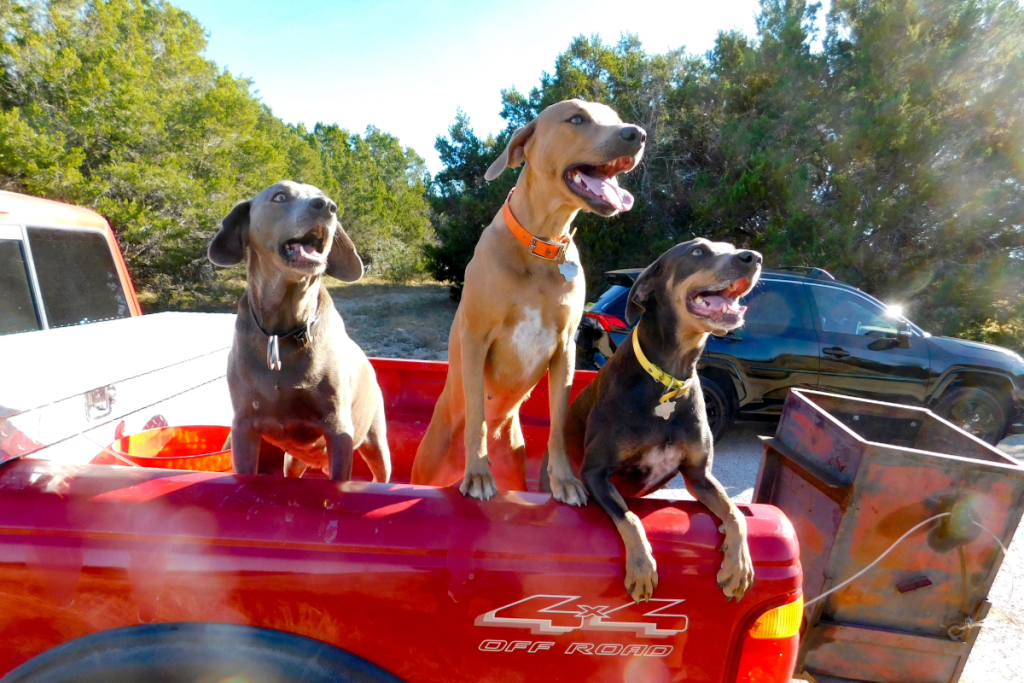
Jax (left), Stevie, and Charlie in the back of Andy Lyda’s working ranch truck on the Lyda Ranch in Bertram. Jax is about 8 years old and a true-blue Lacy Hog Dog, owned by Andy. His son, Ethan Lyda, owns Stevie and Charlie. Stevie is a yellow Lacy; Charlie is a tri-color.
Stevie easily kept up with a pickup truck rambling down Lyda Ranch Road on the Lyda Ranch near Bertram, even as the vehicle hit 25 mph. That’s when the 18-month-old yellow, female, Lacy Hog Dog kicked it into high gear and ran on past.
“That’s not high speed, she’s just lollygagging,” said her “grandpa,” Andy Lyda, who keeps his son Ethan’s two Lacy Hog Dogs busy during the day while “dad” is at work. “She’s already run a mile and a half from the house down here to the gate. More like two miles, cause she never runs in a straight line. She runs a big circle.”
Unless, of course, she’s racing Lyda’s red truck.
“You will not believe how fast that little dog will go,” he said. “I’ve never seen anything like it.”
Like many ranchers, Lyda has recognized the value and hard work of the official Texas state dogs in herding cattle and pigs. They are easy to train and loyal to their owners.
“I had Lacy’s when I was a kid, and I loved them,” Lyda said. “My wife and I got married, and we had a Lacy. Somehow, we got out of them for a while, then I got another one. I forgot what a good dog they are.”
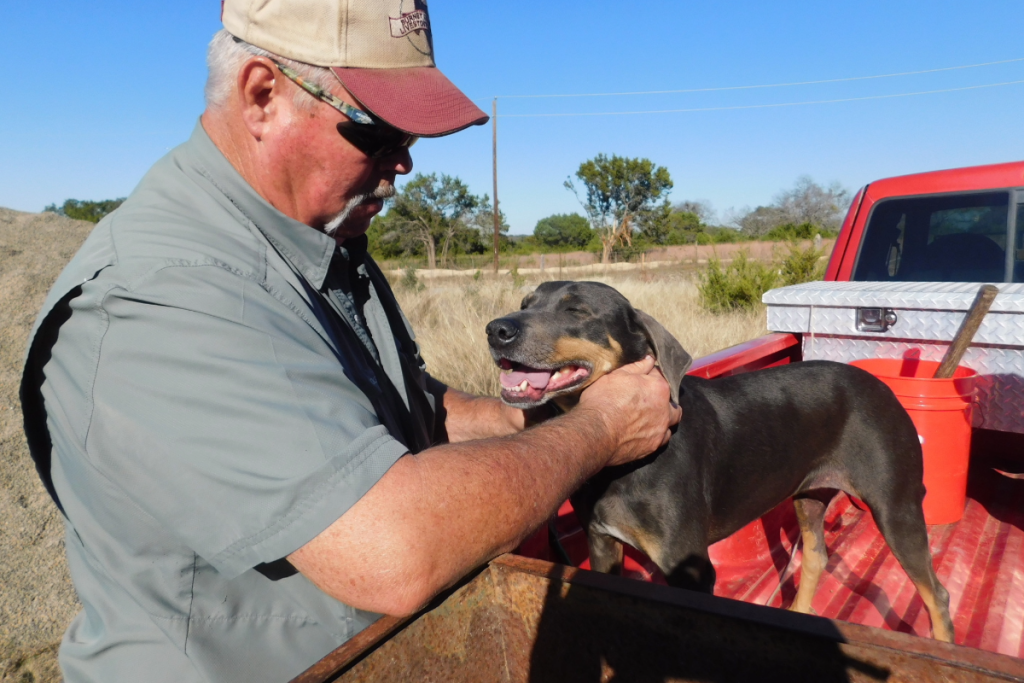
The name derives from George Washington Lacy, who brought them to central Texas from Kentucky in 1859. The dogs were bred and trained by G.W. and his three brothers, Erwin, Francis (Frank), and John Hiram (Harry), who migrated to Texas together.
Although named Blue Lacy by the Texas legislature, the dogs are not that, according to Jeff Mezger, a great-grandson of G.W. Lacy. Mezger lives and raises cattle on parts of the original Lacy Ranch between Marble Falls and Granite Shoals, which includes Honeymoon Camp on RR 1431.
“Don’t call them Blue Lacys,” he said. “They are Lacy Hog Dogs. For one thing, they’re not all blue.”
Lacy Hog Dogs can also be yellow or tri-color, depending on their breeding. A “tri-co,” as Mezger calls them, has a blue base; red points above the eyes, on the muzzle, under the tail, and down the legs; and white markings on the cheeks and paws.
“Also, a true Lacy doesn’t have any papers,” Mezger continued. “Grandpa used to give them away to anybody. He never sold them.”
The dogs are not recognized by the American Kennel Club but are listed in the Texas Lacy Game Dog Registry, which was established by Texas House Concurrent Resolution 108 in 2005. They are available for purchase.
Another of G.W.’s great-grandsons, Robert Christian Lacy of Tom Green County, breeds and sells the dogs.
Mezger is old-school when it comes to Lacys, though he doesn’t own one anymore. He has a 5H Stock Dog named Sonar, a composite breed out of Australia, as his constant companion on the ranch.
“I broke my own rule,” he continued. “That’s the first time I ever bought a dog.”
To show off a Lacy Hog Dog, which just happens to be blue, Mezger drove across RR 1431 to his cousin Chuck Mezger’s ranch. Liz is around 9 years old, but still a working dog—sort of.
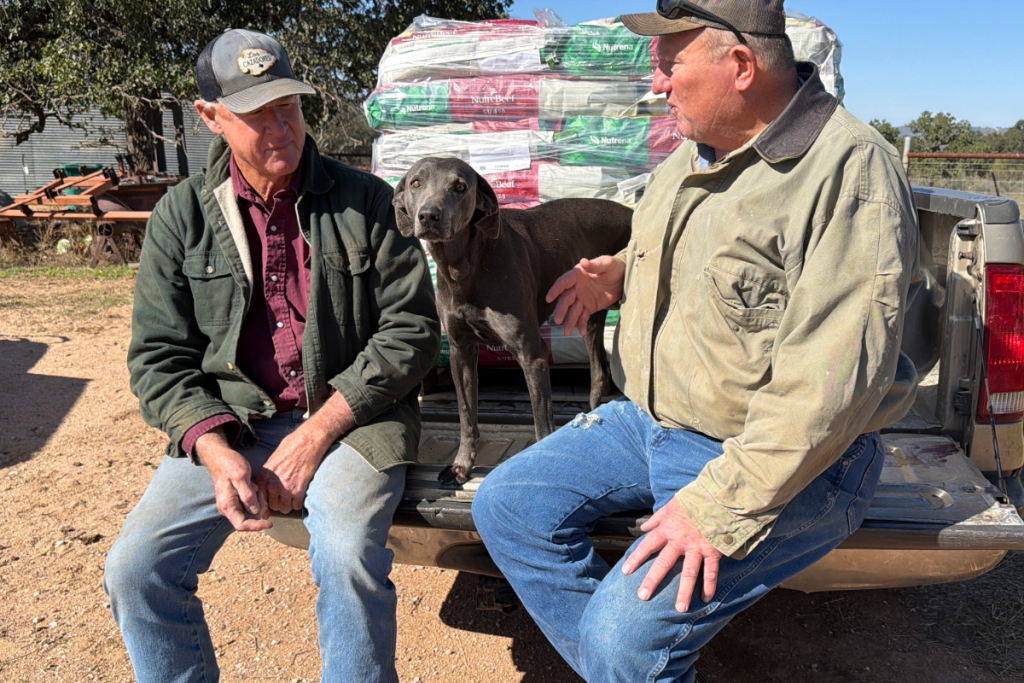
“She’s a lover,” Chuck said, rubbing her behind the ears as they sat on the tailgate of the ubiquitous rancher’s pickup with Jeff. “At least once she gets to know you.”
Working Lacy Hog Dogs are exceptionally loyal to their owners, owners’ families, and friends, but friend or foe, watch out if no one’s home when you come calling.
“If we’re home, you pull up, he’ll come right out to you and lick your hands,” Lyda said of his dog Jax, the only male of the three Lacy’s that live on his Bertram ranch. “If we’re not home, don’t get out. They’ll be on top of your car.”
The other two dogs referred to, Charlie and Stevie, are his son’s dogs. They herd cows and pigs, but are also excellent hunting dogs, along with Jax. All the dogs are related to each other.
“Jax trailed his first deer when he was not even a year old,” Lyda said of the 8-year-old dog. “He trailed one deer a mile and a half, and that deer was barely grazed by a bullet. It takes just a drop. Then my wife retired and made a house dog out of him.”
Wife, Tisha, “threw a fit” when he first brought the dog home.
“Now he never leaves her side,” he said. “She won’t go out without him.”
Lacys have “a nose as good as a coon hound and better than a Lab,” Lyda said, describing favorite characteristics. “They are a whole lot smarter than a Lab, too.”
According to Lyda, the dogs can read his mind.
“If I’m doing something in the pasture, (Jax) knows where I’m going before I do,” he said. “If I tell him, ‘Come on, we’re going to get Charlie and Stevie,’ he takes off and is there waiting for me when I get there.”
They have their own personalities, skill sets, and phobias. Charlie, for example, is afraid of guns, while Jax “is one hunting dude.”
“You pull out a gun, and Charlie starts to go in the house,” Lyda said. “As soon as you shoot, Jax goes where the bullet goes. ”
Jax decoys coyotes by trying to pick a fight.
“If it’s just one, he’ll kill it, but two or three, and he’ll get them to chase him and bring them back to you,” Lyda said
That’s also how they herd range hogs, the first job of the pioneering Lacy Hog Dogs. They are lead dogs with big claws they use to rile up a herd of protective mother hogs and their babies. Once upset, the hogs chase the dogs right where those dogs want them to go. Lacys are trained to follow the whistles and hand signals of the cowboys on horseback, showing where to lead the angry animals.
In the early days, ranchers cut the tips off the dogs’ incisors to keep them from ripping the hogs’ flesh and damaging the meat when antagonizing them, Jeff Mezger said.
The ranch and camp where Mezger lives is part of 30,000 acres that G.W. Lacy eventually accumulated. That original ranch stretched from Kingsland to Marble Falls on both sides of what would become RR 1431. Some of the original acreage is now under the waters of Lake LBJ.
The land Mezger calls home was rife with post oaks in the early days of the ranch, making it a perfect fattening ground for the Poland China and Hampshire range hogs G.W. preferred.
“They raised those pigs like cattle,” Mezger said. “They used this portion of the ranch to finish them with the post oak trees. When hog-killing weather came, they gathered them up and took them to Austin.”
According to stories Jeff heard from his father, Robert “Bobby” Mezger,G.W. sometimes had as many as 1,000 hogs. The road trip to Austin took four days, with dogs in the front and cowboys giving signals in the rear. The Lacy brothers operated a butcher shop in Austin where they cut up the meat, cured it, and sold it, sans any middlemen.
The Lacy Hog Dog is said to be a mix of greyhound, English shepherd, and wolf. The Texas versions are believed to include coyote. According to Mezger, they are a mix of “old hunting dog stock and other stuff.”
“I was always told that Old Yeller was a Lacy Hog Dog,” Mezger said. “He certainly behaved like a hog dog. He was loyal and fierce.”
The trio of Jax, Charlie, and Stevie certainly fit that description, especially when dealing with each other.
“They aggravate each other all the time,” Lyda said, watching the dogs running and jumping in circles on the roadside. A sharp whistle puts a stop to the antics, and with a quiet “load up” from Lyda, they are soon in the back of the truck, ready for the next chore, tasty treat, or photo op.
“These dogs are a blessing,” he said. “Jax guards my chickens like a guard dog. He protects the house; he protects my wife. Anything you want done, they’ll do it.”
Unlocking Lacy Hog Dogs
Key characteristics
• medium-sized, muscular, agile
• light shedding, smooth coat
• born with blue eyes, maturing to amber, yellow, or brown
• compact body built for endurance, speed
Key behaviors
• highly intelligent, easily trainable
• intense drive, work ethic
• alert, watchful, wary of strangers
• loyal, family-oriented
• high energy, good stamina
Key working traits
• silent trackers, surprising quarry
• brave, loud bray when cornering hogs
• true grit for handling aggressive hogs without touching
• excellent trackers, herders
Key needs
• lots of exercise and mental challenges
• gentle but firm guidance without yelling
• early socialization to integrate with smaller pets