



Young Briggs beekeeper creating a buzz for the industrious insects
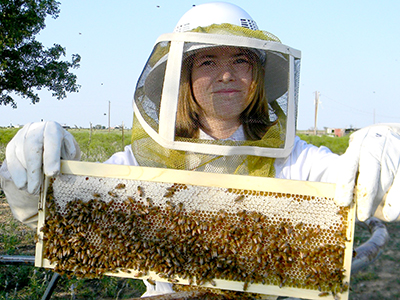
Briggs 4-H member Callie Herring works with one of her bee hives. She took up beekeeping in 2012 after winning a 4-H essay competition. Members of the Williamson County Area Beekeepers Association read her essay and helped her establish her first hive. She and her family now manage three but are considering expanding. Herring is giving a beekeeping program June 14 at 4 p.m. during the Burnet County Area Fair in Burnet. Courtesy photo
DANIEL CLIFTON • PICAYUNE EDITOR
BRIGGS — When 15-year-old Callie Herring’s mother saw a 4-H essay competition two years ago, she encouraged her daughter to pen a paper on the topic.
MaryAlice Herring probably didn’t realize that more than a year later, the essay’s topic still would be buzzing around the family’s Briggs home. The topic was beekeeping, and Callie’s paper won the state 4-H competition. It also caught the attention of the Williamson County Area Beekeepers Association.
Not long after meeting with club members, the beekeepers bestowed a hive of her own on Callie and a mentor to help her learn the craft. Her father, Kevin Herring, wasn’t too sure where this was going to end up, but now even he’s become a bee afficianado.
“They are very interesting insects,” he said. “You’re always learning about them.”
Callie now has four hives. She hopes to expand to up to 10 hives at some point.
Like her father, Callie can’t learn enough about bees.
“They are amazing,” she said. “I just love the way they work. Each one has a job, and they do it so well. They will work so hard that their wings will fray and they won’t be able to fly anymore.”
She recalled working with one of her hives one day when she found a bee crawling across the top of it. Unable to fly because of its frayed and tattered wings, but with pollen on its legs and nectar for the hive, the bee kept crawling toward the entrance.
“They are so dedicated,” the Briggs 4-H club member said.
Despite each hive having up to 60,000 bees, Callie only has been stung once. It was on her ear lobe and while working her newest hive.
Kevin Herring smiled. He knows all too well about that particular hive. While his daughter and his wife can work it, he can’t get within 100 yards without the bees getting worked up.
“Each hive has its own personality,” he said. “I never knew bees were so interesting until Callie began keeping them.”
All three — MaryAlice, Callie and Kevin — now work the hives. Callie and her mother gathered about two-and-half-gallons of honey. The mother and daughter bottled some of it and sold it through local stores. Now they’re considering offering more honey as The Itty Bitty Honey Company.
As she gets deeper into the beekeeping pursuit, Callie hopes others come to understand the wonders and benefits of the creatures. One of bees’ biggest contributions, she pointed out, comes from their role as plant pollinators.
“Bees are responsible for more pollinating than any other insect,” she said. But the pollination comes on the legs of their primary role, gathering nectar for the hive. As they fly from flower to flower, or plant to plant, collecting nectar, pollen latches onto the bees’ legs and bodies. They then deposit the pollen on other flowers and plants.
While humans see the bee’s major role as a cross-pollinator, Callie said the insects themselves are actually working for one thing: gathering enough nectar for the hive to make it through the winter.
One of Callie’s goals is to inform people about the vital role bees play in the world. She’ll be giving a presentation at the Burnet County Area Fair at 4 p.m. June 14. Callie said she hopes to have a glass-contained hive display, so people can actually watch bees at work.
The fair, June 14-15, runs 10 a.m.-7:30 p.m. both days and features exhibits, displays and programs. There also will be a car show June 15 from 10 a.m. to 4 p.m. The Burnet County Area Fair will be at the Burnet County Fair and Rodeo Grounds on Houston Clinton Drive behind the municipal airport off U.S. 281 South in Burnet.
For more information on the fair, go to www.burnetcountyfair.com.
Though Callie gives programs about bees, she said she still has so much more to learn about the insects. She and her father offered a little advice when people find a bee buzzing around them: Don’t swat at it or squish it.
When a person does swat or squish a bee, it releases a chemical compound that draws other bees to its aid. And these bees aren’t necessarily coming to share their honey since the compound release is a defense mechanism developed to protect a hive under attack.
“I learned pretty quick not to squish a bee,” Kevin Herring said with a smile. Callie agreed.
“Once you start learning about bees, you’ll never look at a hive or a bee the same way (you did before),” she said.
For more information on beekeeping, go to www.wcaba.org.
daniel@thepicayune.com