



Burnet County steps up for landowners in transmission line filing
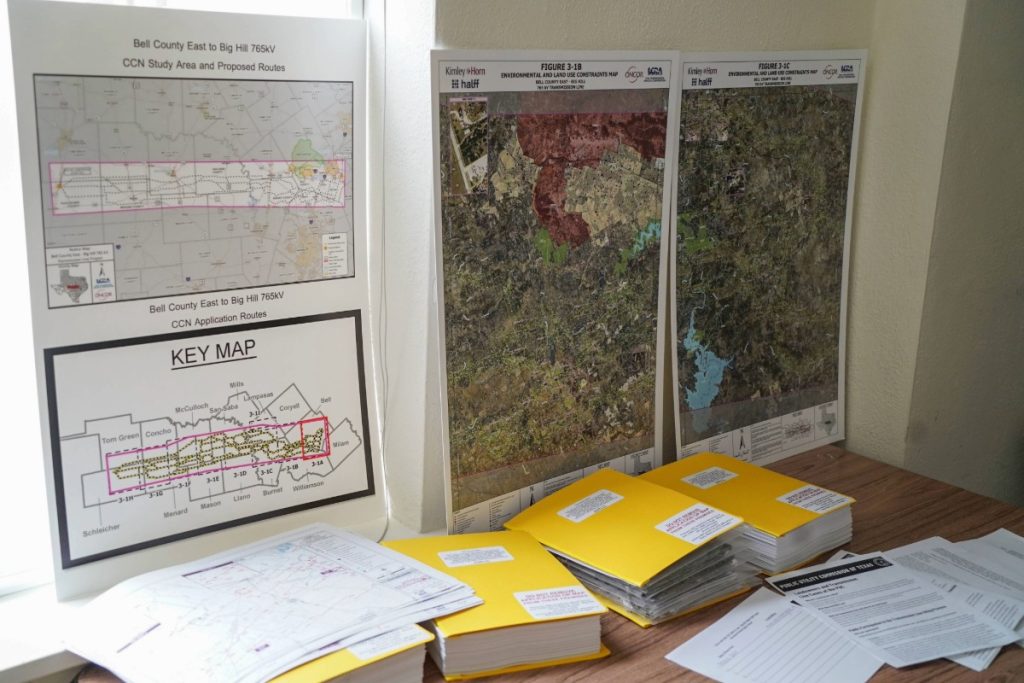
Physical maps and documents regarding the Bell County East to Big Hill 765 kV Transmission Line Project are on display at the Burnet County Courthouse. Staff photo by Dakota Morrissiey
A massive state transmission line project is grinding forward, with all possible paths cutting through Burnet County. Local leaders have officially filed to intervene in the proceedings of the state-officiated approval process for the line in the hopes of protecting property owners and county assets.
The Burnet County Commissioners Court voted on April 1 to file as an intervener in the Public Utility Commission of Texas’ proceedings on the Bell County East to Big Hill 765 kV Transmission Line Project. As an intervener, Burnet County is now legally invested in the project, and will participate in the coming hearings that will determine the ultimate route of the 200-plus mile transmission line.
Part of the court’s vote included directing legal counsel to begin researching and assembling information regarding the county’s stake in the transmission line, including the possible public health and safety impacts it could bring and its potential disruption of the Western Regional Radio System, which is based in Burnet County.
The official application for the transmission line was jointly filed by Oncor Electric Delivery and the Lower Colorado River Authority on March 26. The court was optimistic that the final proposed routes could circumvent Burnet County, but that was not the case, and all three major paths still pass through the Highland Lakes.
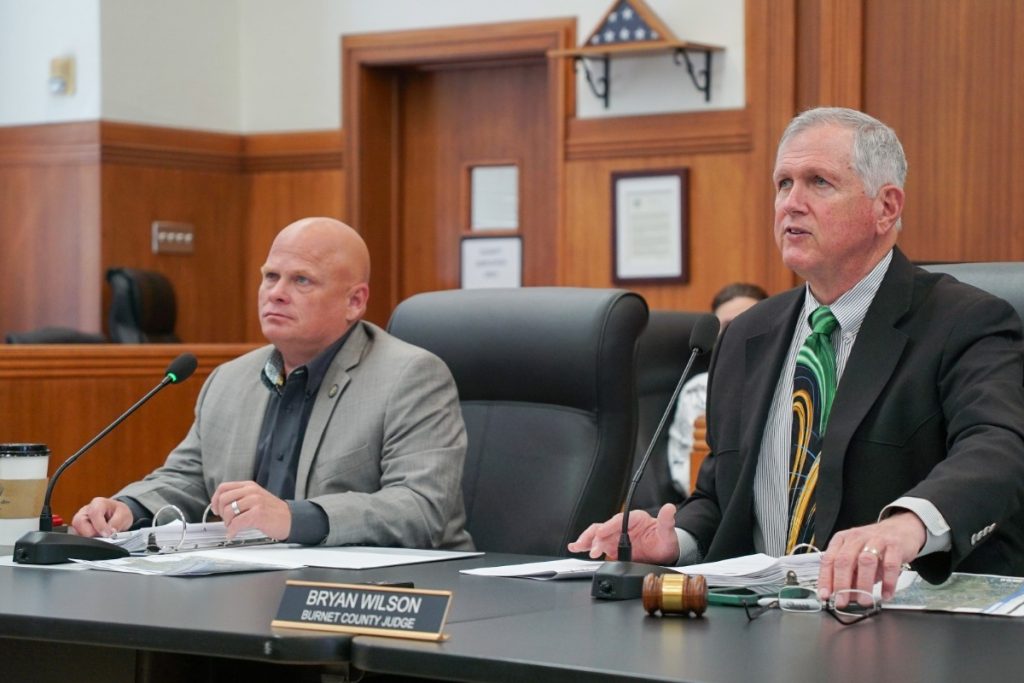
“There is a concern that we’ll end up wasting taxpayer money on things that may not be of fruition because all three lines are going to stay in Burnet County, but that doesn’t necessarily mean that we shouldn’t advocate for our citizens, our landowners, and for the health and safety of our community,” Burnet County Judge Bryan Wilson said during the court’s April 1 meeting.
As it stands, the exact path of the transmission line has not yet been determined, but multiple proposed paths are up for consideration. The coming proceedings with the Public Utility Commission of Texas will help inform that agency’s decision on which route the line should take or if the project needs to be completely reconsidered.
The court made it clear that it would not be advocating for any particular line route, as that would mean taking the side of some property owners over others, but it would be intervening to ensure that the PUCT, Oncor, and the LCRA follow the law and to advocate for the county overall.
“Our job is to hold (the PUCT, Oncor, and the LCRA) accountable to the rules and not pit neighbor against neighbor,” Precinct 2 Commissioner Damon Beierle said.
Intervention
The deadline to file as an intervener in the case is April 27. Anyone living within an affected county may file.
Once the 30-day deadline is up, the PUCT will begin hearing interventions and protests leading up to a final decision on which route the line should take or if the project needs to be altered. A decision is expected in September.
The application for the certificate of convenience and necessity (CCN) is a major step in the transmission line project’s development, and gives concerned parties the first solid look at the dimensions and scope of the line.
- To view the full CCN application, visit this link: Oncor and LCRA CCN joint application
- To file a formal intervention or protest, visit this link: PUCT interchange portal for control number 59475
- To learn more about the intervention and protest processes, visit this link: PUCT Permian Basin Reliability Plan
- To see an interactive map for all proposed routes for the line, visit this link: Bell County East to Big Hill 765 kV Transmission Line interactive map
- Physical maps and documents showing the proposed route plans can be seen at a dedicated display on the second floor of the Burnet County Courthouse, 220 S. Pierce Street.
In this case, “intervening” would mean participating in the actual legal process of developing the project and pleading your respective case on how it should be adjusted to accommodate your position. “Protesting” refers to a publicly filed comment that will be taken into account as part of the PUCT’s consideration on the matter. A protest can be filed by any interested party.
The line would run over 200 miles total, from Bell County to Schleicher County, passing through Burnet County along the way. According to the project developers, it is meant to bring power to far west Texas to help power an array of rising power needs for cryptocurrency mining, “green hydrogen” projects, industrial uses, data centers, and the electrification of the petroleum industry.
Critics of the transmission line say that if it is approved, it would likely have severe impacts on property owners resulting in large eminent domain seizures, reduced property values, and negative impacts on the daily lives of nearby residents. The line would likely require 200-300 foot easements and 15-18 story towers suspending the highest voltage powerlines that Texas has ever seen.
Background on the Bell County East to Big Hill 765 kV Transmission Line
The Bell County East to Big Hill 765-kV Transmission Project has been on Burnet County’s radar since June 2025. Since then, public opposition and protest has risen and the county has officially taken up opposition to the state project.
The transmission line project’s intention is to bring power to West Texas, but many Burnet County residents believe that it would be at the expense of Hill Country landowners.
The project was mandated by the Texas Legislature in 2023 through House Bill 5066. The bill aimed to increase the reliability of the Texas electric grid, and also specifically targeted bringing power to the Permian Basin region of West Texas.
The Public Utility Commission of Texas took on the task, requesting the Electric Reliability Council of Texas to conduct a study on the power needs of the Permian Basin, resulting in the Permian Basin Reliability Study.
The results of that study showed a massive increase in the projected demand for electricity from that region, mostly to satisfy an estimated addition of 11,695 megawatts to the grid from the non-oil and gas industry. Per ERCOT’s study, this load would be made up of 59 percent cryptocurrency operations, 22 percent “green hydrogen” projects, 13 percent “other” commercial and industrial projects, and 6 percent datacenters.
Once ERCOT’s study was completed, the PUCT tasked Oncor Electric Delivery and the Lower Colorado River Authority with devising a plan to deliver more power to the Permian Basin. After months of planning the organizations created a preliminary plan and route for 765 kilovolt powerlines to be run from Central Texas to West Texas. Burnet County was notified of the plans, and the fact that it would likely be included in all possible routes, in May 2025.
The project, to be paid for by the state, has an estimated total cost of $33 billion, and would include three major lines, including the Bell County East to Big Hill project.
Read the DailyTrib stories below to learn more:
- ”Massive transmission line would cut through Burnet County,” June 6, 2025
- ”Burnet County considers careful next steps in response to transmission line,” June 25, 2025
- “Burnet County seeks legal counsel for transmission line project,” July 10, 2025
- “Burnet County OKs funds for transmission line legal help,” July 22, 2025
- “Power line project protesters: Why here?,” Oct. 13, 2025
- “Questions raised, but few answered, at transmission line town hall,” Oct. 24, 2025
- “Burnet County takes official stance against transmission line,” Oct. 29, 2025
- “Oncor and LCRA update transmission line timeline,” Nov. 4, 2025
- “Llano County joins transmission line opposition,” Nov. 11, 2025
- “Transmission line opposition creates protest schedule and theme song ‘Two Hundred Miles of Greed’,” Nov. 24, 2025
- “Troxclair takes public stance against transmission line project,” Jan. 20, 2026
- “Burnet County considers intergovernmental commission to combat transmission line; community workshop Feb. 3,” Jan. 29, 2026
- “Burnet County group hosting anti-transmission line meeting series: ‘The time to advocate for our area is now,” Feb. 20, 2026
- “Burnet County and city of Burnet join forces to battle state transmission line project,” Feb. 25, 2026
- “Transmission line plans expected soon; Llano County now in possible impact zone,” March 10, 2026
- “The countdown starts: 30 days to file intervention/protest in state transmission line project,” March 27, 2026
1 thought on “Burnet County steps up for landowners in transmission line filing ”
Comments are closed.
The power line will have immediate and lasting consequences for residents across the state. The power carried by this line is destined for the Permian Basin-one of the most energy rich regions in the country- not for the communities whose land,scenery and finances will bear the burden. Our communities will see no improvement in service,no increase in reliability and no meaningful infrastructure investment in return.
Transmission provides are allowed to recover every dollars they spend and are guaranteed a profit margin. All of the costs are passed directly to rate payers state wide. Home owners could see their year bills rise by roughly $200. Companies like ONCOR and LCRA will profit from higher utility rates while the Hill country will be permanently scarred by massive transmission structures 170 ft tall) . Please go to https://www.stopthisline.com for details