




Llano County joins transmission line opposition
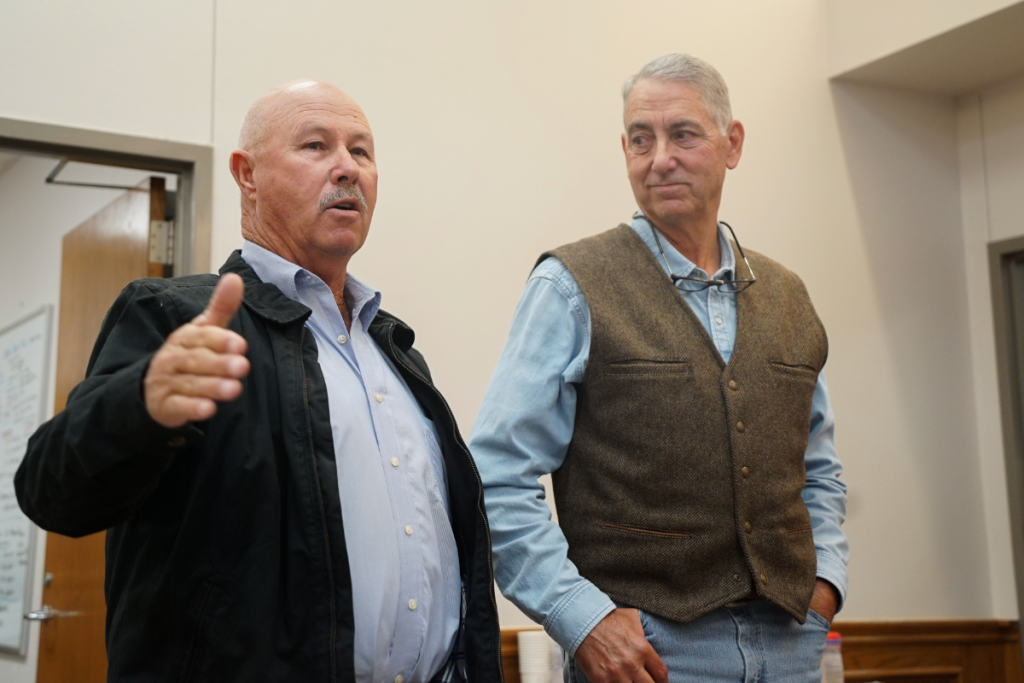
Representatives from the Llano County Soil and Water Conservation District presented a resolution to the Commissioners Court on Monday that would put the county in opposition to a proposed, massive state transmission line project that would cut through Central Texas. Secretary Joe Freeman (left) makes an impassioned speech beside Chairman Steve Haverlah. The resolution was ultimately passed. Staff photo by Dakota Morrissiey
Llano County has joined the rising wave of opposition to the Bell County East-Big Hill 765 kV Transmission Line Project. The Commissioners Court passed an official resolution on Monday, Nov. 10 asking that state agencies deny any plans for the line, which would cut across Central Texas on its way to the Permian Basin.
Llano County is the latest to join in the battle against the transmission line. Burnet County announced its official opposition to the project on Oct. 28 after months of research and discussion.
The Bell County East-Big Hill transmission line would stretch about 200 miles, running from Bell County to Schleicher County, with the intent of bringing reliable electricity to the Permian Basin region of West Texas. This would be the largest transmission line project in state history and be the first time that high-voltage 765 kilovolt lines would be used in Texas.
None of the currently proposed routes would run directly through Llano County, but the northern half of the county is technically within the study area for the project, and could be susceptible to a line reroute in the future.
Visit the Lower Colorado River Authority’s online interactive map to see the proposed routes and study area.
An excerpt from the resolution passed by the court on Monday reads:
“The (Llano County) Commissioners Court recognizes the importance of protecting the soil, water systems, wildlife, environment, historical and cultural sites, land values, and local economies, and the aesthetics of the beautiful Texas Hill Country and therefore Llano County resolves and requests that the state of Texas, Texas Parks and Wildlife Department, Texas Commission on Environmental Quality, and the Public Utilities Commission of Texas oppose and reject any submitted application for approval of such routing for the Bell County East-Big Hill 765 kV Transmission Line Project.”
The resolution was presented by Steve Haverlah, chairman of the Llano County Soil and Water Conservation District.
“Our role, more or less, is to just bring awareness,” Haverlah told the court. “There are so many people that have no idea this (transmission line) is coming. They have no idea the impact it’s going to have, they have no idea the size of this project.”
Haverlah’s concerns were wide ranging, covering the potential impacts the line would have on property values, groundwater, wildlife, ranching, farming, historical sites, cultural sites, health of nearby residents, wildfires, and the “aesthetics” of Llano County.
The transmission line project would include the construction of 15-story towers every 1,000 feet along a predetermined route. The towers would carry 765 kV power lines, which are more than twice the voltage of traditional 365 kV lines normally seen in Texas.
“Nobody (in Llano County) knows about this,” Joe Freeman, Llano County SWCD secretary, said. “These things are monsters.”
The LCRA and Oncor Electric Delivery have been tasked with building out the transmission line project by the Public Utility Commission of Texas. The PUCT was mandated by the Texas Legislature in 2023 to develop a plan to bring more power to the Permian Basin region.
The lines would not directly provide power to the counties along its length. They are intended to transfer energy from Central Texas to West Texas to meet the projected growth in demand for power in that region.
The LCRA and Oncor have not yet filed their official application with the PUCT to begin work on their project. Comments can be filed now on the PUCT’s website, but the window to file as an intervener or make comments on the case will not open until the application is submitted, at which point everyone will have 30 days to respond.
Once the application is submitted, the PUCT will conduct a lengthy review of the project and determine whether it moves forward or if it needs to be adjusted in any way.
Recently, the LCRA and Oncor estimated that they would file their application in March 2026. If everything were to go according to plan, the project would receive approval in September 2026 and construction would be complete by 2030.