




Groundwater district establishes new management zone; big increase to minimum tract sizes
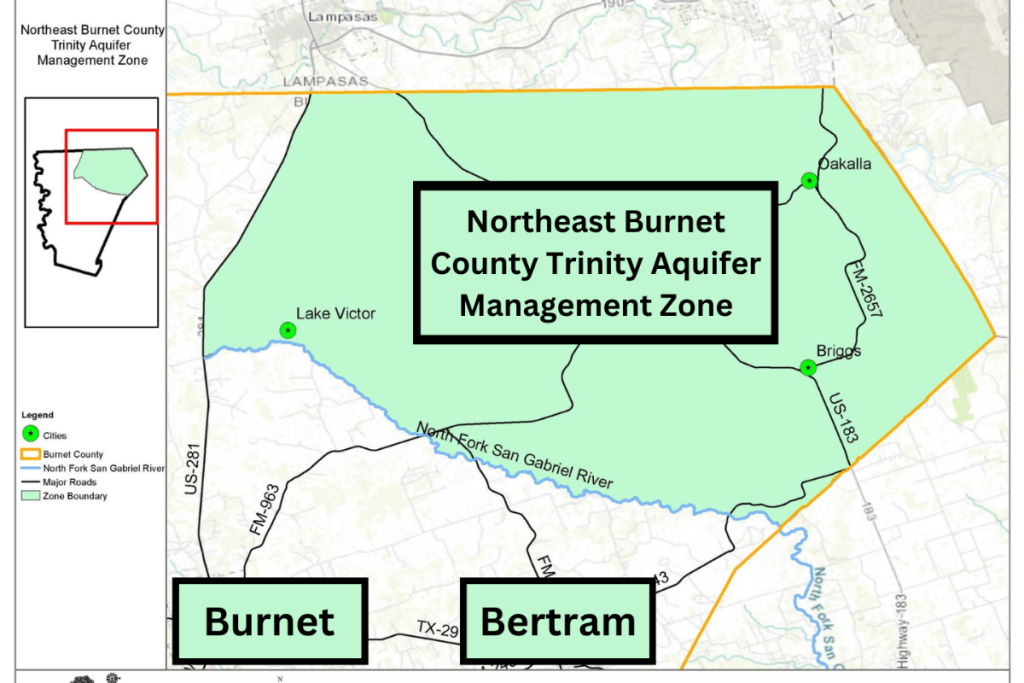
The Northeast Burnet County Trinity Aquifer Management Zone adopted at the Jan. 23 Central Texas Groundwater Conservation District meeting. CTGCD image
The Central Texas Groundwater Conservation District created a new water management zone spanning the Briggs-Oakalla region of Northeast Burnet County at a Jan. 23 district meeting. The new zone brings specific rules and regulations to help protect the region’s precarious groundwater supply, including a drastic increase to the minimum tract size.
The new zone, named the Northeast Burnet County Trinity Aquifer Management Zone (NBCTAMZ), was established in response to increasing concerns about the water use and strains of the Trinity Aquifer portion of the Briggs-Oakalla area. The Trinity Aquifer portion of the Briggs-Oakalla area. The CTGCD also noted water quality degradation, high density of wells, and various approved subdivisions relying on groundwater as red flags of declining water levels in the area.
“The District established the Northeast Burnet County Trinity Aquifer Management Zone in response to hydrogeologic conditions indicating that the Trinity Aquifer in this area exhibits low transmissivity, generally modest to low well productivity, and minimal available drawdown in many locations,” reads a historical note included in the management zone rules.
The CTGCD is tasked with managing and regulating the use of groundwater in Burnet County. It began work on the proposed NBCTAMZ in April of 2025, forming a local stakeholder committee of residents, land owners, and business operators. The committee met multiple times over several months to review data on the Trinity Aquifer and water conditions in the area, and to discuss potential rules and regulations.
Such rules were adopted for the management zone at the meeting, including establishing a new minimum tract size of 10 acres, rather than the previous two acres. This means only one well is permitted to be built in the area where five were previously allowed. The CTGCD made it clear that this new management zone only applies to the Trinity Aquifer, and not any additional aquifers.
“For many longtime residents, this development is not surprising,” CTGCD General Manager Mitchell Sodek told DailyTrib. “They are well aware that the Trinity Aquifer in this area is naturally susceptible to stress, and some have even expressed that this action may have come later than it should have. It gives the district a clearer structure for monitoring conditions and responding proactively.”
Addressing potential concerns from future residents of the area, Sodek acknowledged that growth may certainly continue, and with it the need for more groundwater, but that it must occur with understanding of the area’s limitations.
“For future residents, the key message is awareness and sustainability,” Sodek said. “The aquifer is a vulnerable resource, but with a conservation minded approach, it can remain reliable for many years to come.”
The biggest change
One of the most drastic changes in the new management zone is the establishment of a minimum tract size of 10 acres. For reference, this means that 10 acres of land are required for each well. The current rules for the rest of the Trinity Aquifer establish a two-acre tract, and all other aquifers a one-acre tract.
These changes address long-held concerns about well density in subdivisions planned for the northeast part of Burnet County in the Trinity Aquifer. For reference, the Burnet County Commissioners Court publicly struggled over a mandatory approval of a preliminary plat for The Estates at Dominion Ranch in 2023, a proposed 210-lot subdivision on 996 acres near Briggs. The plans were approved despite concerns about the average 4.74 acre tract sizes due to the lack of regulatory authority available to the county and the CTGCD at the time.
Here’s an at-a-glance look at the differences across tract size minimums for aquifers in the Burnet County:
Minimum Tract Size
- Trinity Aquifer inside of NBCTAMZ, minimum tract size of 10 acres
- Trinity Aquifer outside of NBCTAMZ, minimum tract size of two acres
- Hickory, Ellenburger-San Saba, Marble Falls, Welge-Lion Mountain, Granite, and other non-Trinity Aquifers; minimum tract size of one acre
For the full breakdown of the differences in regulations and rules, take a look at the current and proposed rules of the CTGCD online. Note that the proposed rules concerning the NBCTAMZ are subject to change pending revisions from the district meeting.
On community feedback
While the conservation district board approved the new management zone, several revisions were made to the proposed rules following feedback received during the public hearing portion of the meeting.
Nearly a dozen representatives of well drilling companies operating in the Highland Lakes area attended the meeting to comment on the proposed regulations. While many representatives stated that the majority of the rules were reasonable additions, others showed concern regarding a subsection addressing well completion standards.
The subsection, 4.05(e)(2), required drillers to include a concrete seal above the producing interval of the well, designed to prevent the mixing of water between different aquifer layers.
Drilling representatives argued that the requirement would likely increase drilling costs by a substantial amount, and that existing industry-standard completion methods, involving a packer, already protected against water mixing.
For reference, the proposed concrete seal would require drillers to drill a larger hole than traditionally necessary all the way down to the producing portion of the well. Drillers said they would have little idea whether or not the concrete had been set properly if they did so, and that costs would more than double. A packer on the other hand, is able to be easily slipped on the well tubing, and is said to have the same or greater level of seal as concrete.
Following discussion and clarification between the board and drillers, the district approved the creation of the management zone with revised language to address the concerns. As per Precinct 1 Director Kathy Griffis-Bailey, the adopted rule will read: “If a well is completed below the Glen Rose layer of the Trinity Aquifer, a commercially available packer that is not biodegradable must be installed immediately above the producing interval in accordance with rule 6.04(g).”
The board also moved to remove an additional portion of the rules regarding waste, which may be brought back for discussion at a later date.
Going forward, the district will continue to collect data and study the management zone, potentially making future changes to regulations as it sees best fit.
“The District’s commitment remains the same: We will continue studying, monitoring, and evaluating the conditions within the management zone and adjusting our approach as needed,” Sodek said. “The goal is straightforward: protect the long term viability of the Trinity Aquifer while supporting sustainable community growth.”
For more information about the Central Texas Groundwater Conservation District and its efforts in the Highland Lakes, visit the CTGCD website or email district@centraltexasgcd.org.