




Falls museum exhibit honors local impact of German settlers
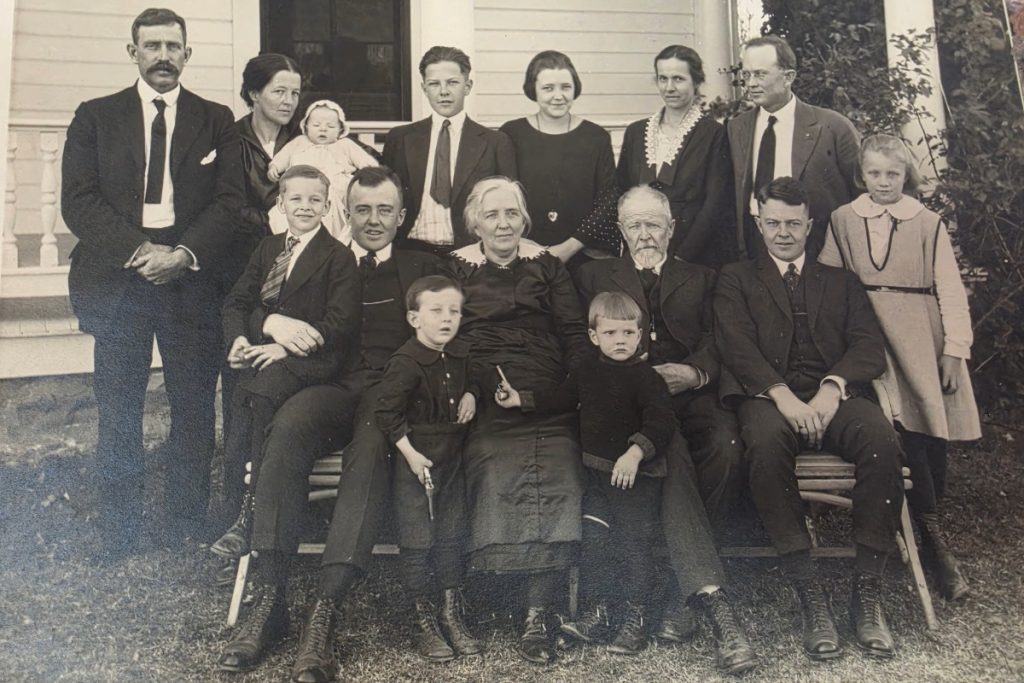
Posing for a family portrait in front of the Giesecke home on Avenue E in Marble Falls are (back row, from left) Percival and Ottilie Giesecke Franklin holding (probably) their child, Frank Franklin; Ernst Giesecke, vice president at Texas Tech University and youngest son of Walter and Ullie; Lulu Giesecke Butler, a violinist who played for the Chicago Symphony Orchestra; Ana Mina Wolf and Rudolph Richard Giesecke, grandparents of Dick Giesecke; (middle row) Richard Wolf Giesecke, Dick’s father; Ulike and Walter Christian Giesecke, who each wrote rememberances of their lives as settlers; their son, Walter Giesecke, a top executive for Johns Manville Corp.; a young girl believed to be Percival and Ottilie’s only daughter; (front row) Walter Franklin, Percy and Ottilie’s oldest child; and Walter Ralph Giesecke, Dick’s uncle, who grew up to become a banker and businessman. Photo courtesy of The Falls on the Colorado Museum
‘Sie stammen aus Deutschland’
The long-barreled, muzzle-loading rifle from the 1700s that rancher and retired banker Dick Giesecke recently held out for a visitor to inspect represents more to him than a decorative antique.
The family heirloom’s journey to the G Bar Ranch in Valley Spring includes a tale of hardship aboard a 19th-century sea voyage to Galveston from what was then the German Confederation of sovereign states.

The rifle also went along on cattle drives to the northern United States and ox-driven supply trips to Austin and beyond. It was used to protect the ranching family from panthers and wolves and hunt deer, turkey, and rabbit for the kitchen table, always remaining in the family’s hands.
“It was brought over from Germany by my great-great-great-grandfather George Frederick Giesecke in 1847,” said Dick Giesecke, a descendant of one of many German families that left their homeland to settle in the Marble Falls area in the mid-1800s. “It was given by him to his son, Albert Giesecke, in the 1860s, and delivered by Albert to his son, Walter Christian Giesecke, in the early 1870s in southern Burnet County near Shovel Mountain.”
Walter Christian Giesecke was Dick’s great-grandfather
A host of historic artifacts passed down through generations of local German settlers have been curated and will soon be on display at The Falls on the Colorado Museum, 2001 Broadway in Marble Falls. (The gun will not be present as the museum is on school grounds.) The museum plans a grand opening of its second-floor exhibits on Dec. 12, the same night as its annual Christmas Home Tour fundraiser.
“It will be a great time to come and see what the museum has been working on for the past three years,” board Chair Darlene Oostermeyer said. “The upstairs windows have all been replaced, and the entire second floor has been renovated for public use for the first time since the museum moved into the Old Granite School in 2010.”
Many items on display in rooms dedicated to ranching and immigration were donated or loaned by local families of German descent, including the Gieseckes.
Museum board member, docent, and fellow German descendant Robyn Richter hopes the second-floor exhibits will reignite the sense of community she once found at family reunions. Richter’s father, the late state Sen. Walter Richter, dubbed the gatherings SMACK reunions, an acronym for Shovel Mountain and Cypress Kinfolk.
“Dad used to say you couldn’t just have a Richter family reunion without the Gieseckes, Fuchses, and Hoppes,” Robyn Richter said. “These and a bunch of other German families who settled here all married each other, so you had to include them all to have a family reunion.”
Richter noted that the German families that came to southern Burnet County were not part of the larger migration of Germans that settled in the Fredericksburg, New Braunfels, and Comfort areas. Those families were part of the Mainzer Adelsverein at Biebrich am Rhein (Adelsverein for short), which translates to the Society for the Protection of German Immigrants in Texas. German noblemen organized the group in 1842 to establish a new Germany in Texas through mass emigration.
“The Germans who came here (Burnet and Blanco counties) came here independently and for different reasons,” Richter said. “For instance, one of them had sons of draft age and didn’t want them drafted into the Kaiser’s Army. They were all looking for freedom and a better life.”
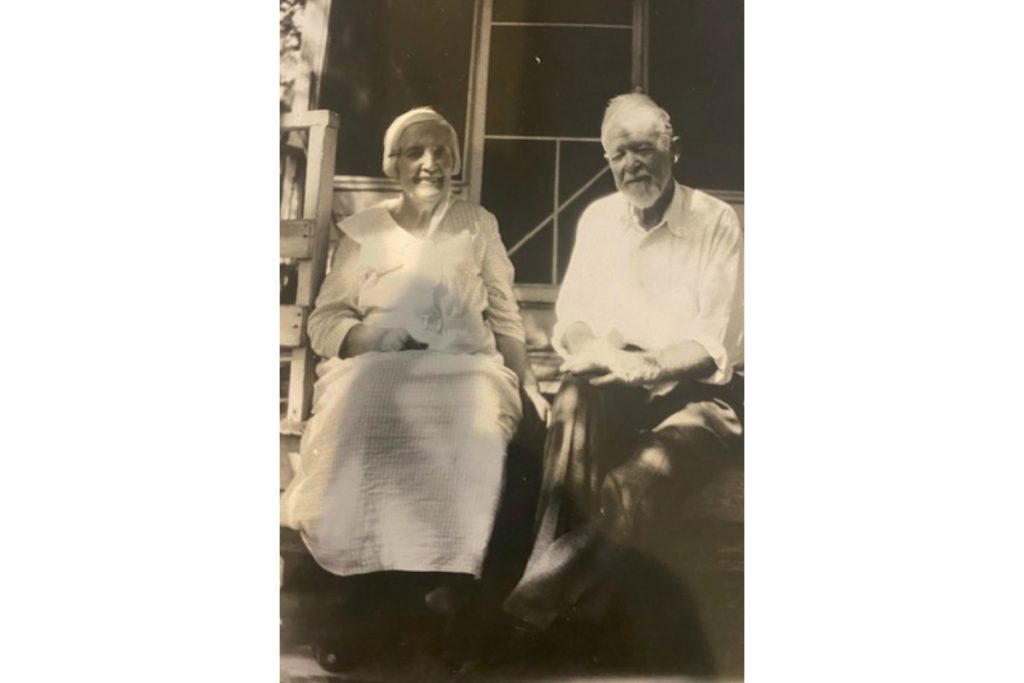
Walter Christian’s stories were written by family members who interviewed him about a year before he died in 1935. His wife, Ulike “Ulli” Giesecke, wrote her own “scribblings” (her title) about six months later. All of the writings describe the hardships and joys of farming and ranching along the Colorado River and its tributaries and are available to read at the Falls museum.
A third available memoir, “The Diary of a Journey to a New World and a New Life,” was written by Adolph Richter on board the Karl Ferdinand, a 125-ton brig that brought 16 members of the Giesecke family to Texas. The ship was overcrowded, and many passengers suffered from seasickness and diarrhea. Food and water were scarce and of poor quality.
“This morning we discovered that all of the American beans that we had eaten the day before yesterday contained an insect, almost 1/4 as large as the bean, and that it had hollowed out nearly all of each bean,” wrote Adolph Giesecke of Clausthal, Hannover, in his personal ship’s log. “It is revolting when one realizes that people will give people such food on a ship where it must be eaten to stay alive and not starve.”
Some of the family settled in Brenham, at least temporarily. Walter Christian was born in Washington County in 1856. Nine years later, the family moved to Burnet County. Walter describes his childhood on horseback, herding sheep and hunting. He was 9 years old when he was first given responsibility for 366 head.
“I had to be out with them all day, rain or shine, and as we had no oilcloth coats or raincoats at those times, I got wet when it rained and dry when the sun would shine,” he said. “I counted those sheep a dozen times and oftener every day. I hated those sheep.”
After a band of indigenous people stole the family’s donkey and horse, they purchased two oxen, Coley and Spot, who roamed the fenceless land at night. Walter’s job was to go out every morning to bring them in to work. Spot had a loud bell around his neck to make it easier to find them both, as they were always together.
That large bell, which had the Giesecke’s name and initials stamped into it, was lost after Spot was killed in another raid in 1869. Spicewood rancher B. Middleton spotted the bell some 55 years later as he was riding in his pasture. It was too rusted over to see the lettering. He took it home and put it on one of his horses.
“After it had been used a while, Mr. Middleton noticed the lettering on it,” Walter said. “He brought it to me, and I recognized it at once as Spot’s bell.”
Walter doesn’t say what became of the bell, which remained lost to the family. Dick Giesecke said everyone assumed Middleton kept it. He didn’t find out what happened until about seven years ago—another 93 years from its last appearance.
“I was introduced to the story of the bell by reading Walter’s reminiscences,” Dick said. He gave a copy of the story to Ralph Ebling, a distant cousin and friend in Round Mountain. Ebling read the story and invited Dick and his wife, Kay, to dinner.
“We were having wine by the water before dinner, and Ralph pulls out Walter’s memoir and reads the parts about Spot’s bell,” Dick said. “Then he picks up a box and says, ‘I think it’s time for Spot’s bell to come back to the Gieseckes.’”
In that box was the lost bell, all cleaned up.
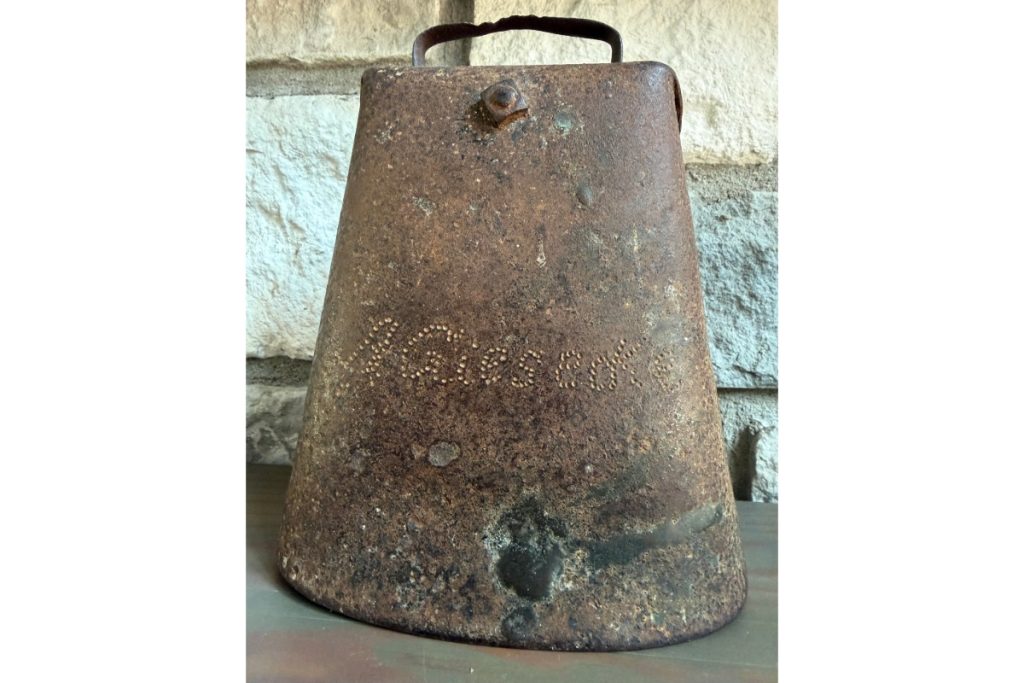
“Dick’s eyes beamed when he saw that bell when I gave it to him,” Ebling said. “I found it in the saddle room at the barn.”
Ebling lives on part of the original Ebling Ranch on the Blanco-Burnet county line. He thinks the bell came to his family in an animal trade between his grandfather “Papa” Max Ebeling and the Middletons.
“It was an emotional moment for me because I had no idea it was still around,” Dick said.
The bell now sits on his fireplace mantel at the G Bar Ranch. It will be temporarily on loan to the museum for the German exhibit opening.
“I have treasured that bell ever since Ralph gave it to me,” Dick said. “It’s a heavy bell that was originally owned by Walter’s father. My guess is it came up from Brenham when Walter brought the family to Burnet County in 1865.”
The rifle made its way from Brenham to Burnet County after 13-year-old Walter rode a horse for seven days to visit his grandparents for the summer. His grandfather gave it to him as he prepared to return home.
“The gun is equipped with a very fine hair or ‘set’ trigger,” Walter said. “I learned to shoot it so I could clip a jackrabbit’s head off at 50 yards almost every time I tried to.”
Guns and bells are not the only artifacts the Gieseckes have loaned to the museum. Much of the ranch exhibit also contains items from family farms.
When asked about the importance of German settlers in the area, Dick brought out another artifact that he called “a flute-like instrument.” His great-great-great-grandfather often played at family gatherings. It was passed down to Walter, who wrote in his diary that he once tried calming the sheep with a tune, but they didn’t much like it.
“One of the great messages I get out of my family history is this kind of talent,” Dick said. “Walter and Ulli both played, and Ulli gave music lessons. Their daughter was a professional violinist in Chicago. I don’t have that talent, but there are a number of people in the family who are awesome in that area.”
In the 20th century, Giesecke descendants opened and operated grocery stores, ran banks, and served as leaders on local school boards, councils, churches, and other community organizations. Some were professional musicians and successful real estate developers. And some still raise cattle and run businesses in the Hill Country and beyond. Rich with details of 19th-century life in the Texas Hill Country, Ulli and Walter Giesecke’s memoirs chronicle the struggles, tragedies, and triumphs of a family in pursuit of the American dream.
“It really pleases me that his (Walter’s) and Ulli’s notes allow us to have items today that we can look at and know it is part of their story,” Dick said.
Their family story is part of the Central Texas story. Visit The Falls on the Colorado Museum to learn more about how these settlers influenced our lives today.
*“Sie stammen aus Deutschland” is German for “They are of German heritage.”
The Falls on the Colorado Museum at 2001 Broadway in Marble Falls is open from 10 a.m.-2 p.m. Monday-Saturday. Visit fallsmuseum.org, call 830-798-2157, or email focmuseum@gmail.com for more information.