




Wood work: local artisans scavenge wood for museum exhibits
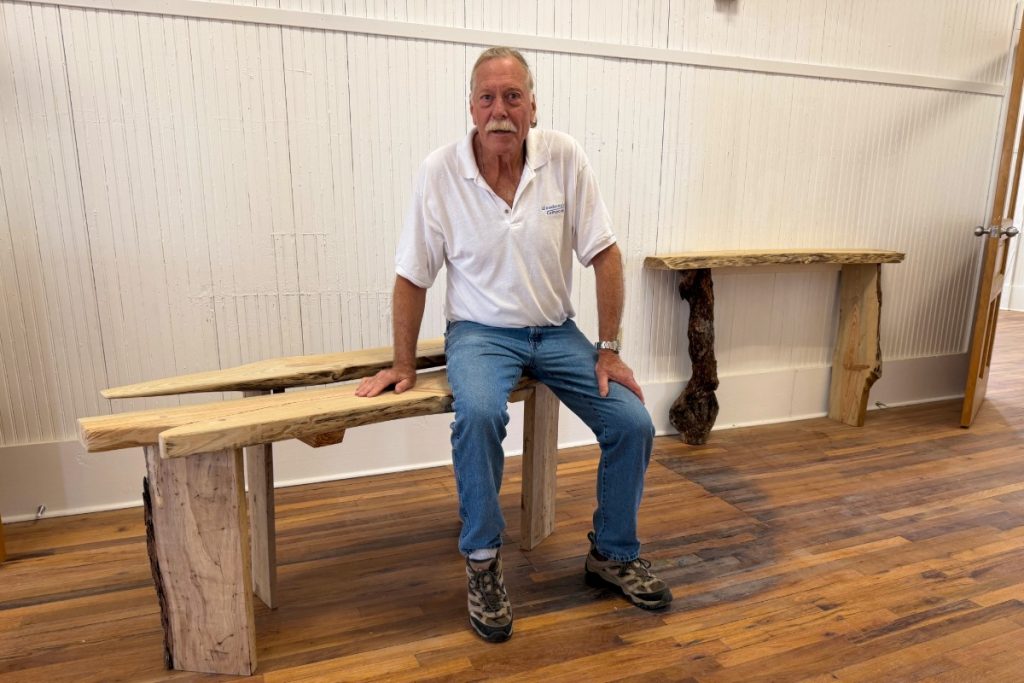
Rod Oberhaus sits on a table he crafted for a schoolroom exhibit at The Falls on the Colorado Museum in Marble Falls. The table was made from a donated pine tree that died in the front yard of a home in Pecan Valley and will be part of the new exhibits expected to open in the fall on the recently restored second floor. Staff photos by Suzanne Freeman
Display tables, shelves, and desks inside The Falls on the Colorado Museum are not just functional furniture. Almost every piece tells a story, whether through the very wood it is made of or the woodworkers who cut and crafted it.
Rod Oberhaus of Smithwick has been putting his talents to work creating cabinetry, display stands, tables, school desks, and more in preparation for new exhibits slated for the museum’s second floor in the Old Granite School Building at 2001 Broadway in Marble Falls.
The newly renovated floor is due to open to the public sometime this fall. It will be the first time the floor has been open to the public since the museum moved into the building in 2010. Owned by the Marble Falls Independent School District, the building is 135 years old.
Renovations have been ongoing for the past two years and include restoring all 30 windows to their original look. When opened, rooms will display exhibits on German immigration as well as mining, farming, and ranching. The floor will also include a pioneer schoolroom and a meeting room for 100 people.
Oberhaus said the choice of wood and the need to look authentic to the mid- to late 1800s was a challenge.
“I don’t think of a thing right off the top of my head real fast,” he said when asked about some of his more unusual creations. “I have to dream about it. It takes a couple of days of thinking about it.”
He has favorite pieces among the many he’s created so far. Some even have names.
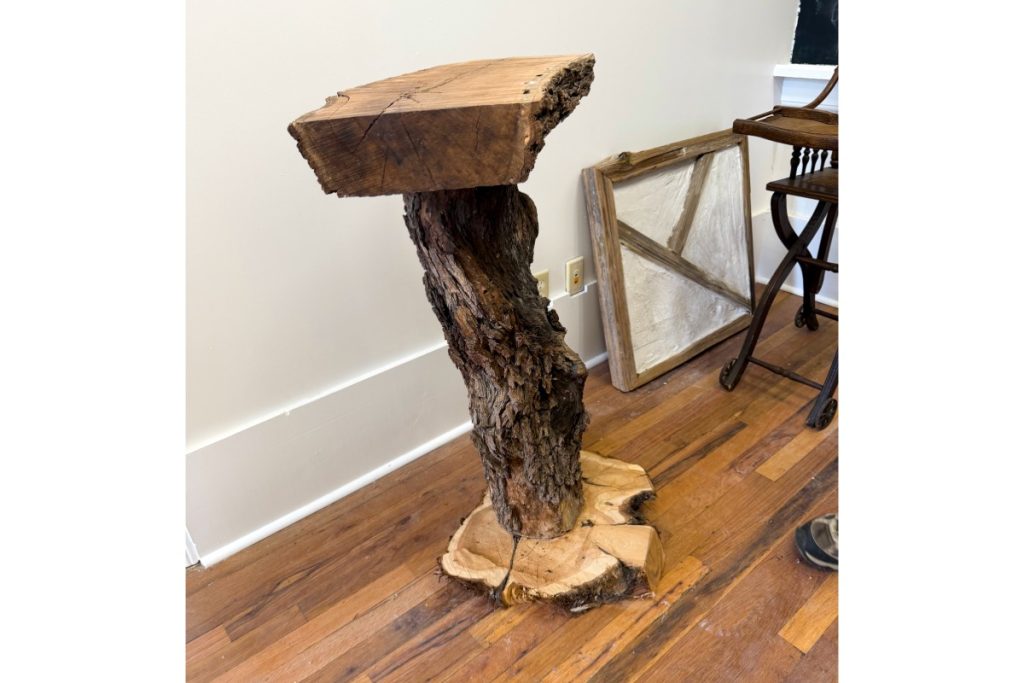
The evolution of an accordion stand for the German immigration room, he calls “Twisted Sister.” He incorporated the stump of a mesquite tree he cut from his property years ago. Instead of burning it, he kept it because he liked how it looked and knew he could put it to good use someday.
That led to another display table, which he titled “Twisted Sister’s Sister,” since it featured a branch broken off the original block of wood for “Twisted Sister.” The two pieces are thick, unfinished branches, still dressed in their twisted, uneven bark.
“That’s why I call it ‘Twisted Sister’s Sister,’” he said. “I wanted it to stay together.”
Another creation came about when Darlene Oostermeyer, chairman of the museum’s board of directors, gave him two pieces of pine and asked him to make a children’s table. She rescued the pine from a Pecan Valley property owned by Marble Falls City Councilor Craig Magerkurth. He cut down the dead tree but gave her first dibs on its remains.
“I’m glad to see it’s going to be put to good use,” Magerkurth said.
Oostermeyer didn’t want the pine cut into straight boards with squared corners. She wanted the two pieces of wood to stay close to the shape and form of the tree it came from.
“I couldn’t find a way to put them together at the same height,” Oberhaus said. “Then I thought, ‘Well, not all kids are the same size,’ so I made it with one side lower than the other. Two can sit on one side and two on the other.”
Almost all of his creations are made of wood collected over the years from trees felled on local property or from old, demolished buildings.
A coffee bar cabinet in the new meeting room was partially made from the doors recently replaced at the Crownover Chapel in Fairland.
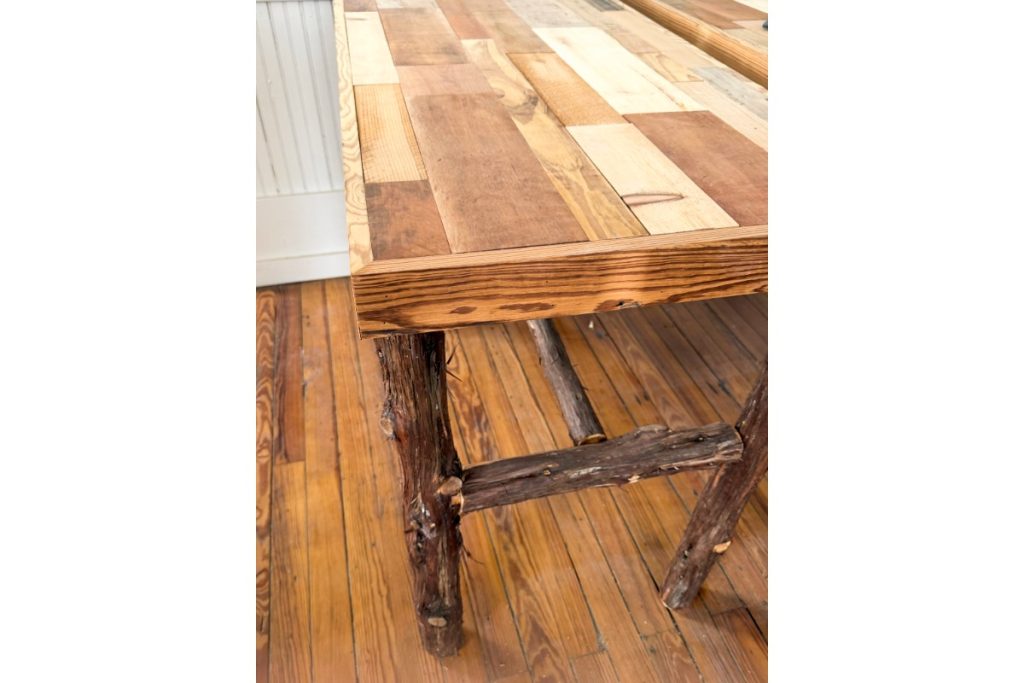
Wood for a tabletop came from the floor of the Houghton Graham Watch Repair house that sat on the edge of RR 1431, next to the Marble Falls Elementary School sports field.
The legs for that table were once cedar trees on Oberhaus’ acreage in Smithwick.
The Magerkurth pine is also being used to make shelves for a planned mining display.
“All the materials I have used, Darlene had lying around, or I had lying around,” Oberhaus said.
He and Oostermeyer each copped to being wood hoarders.
“I’ve been hoarding wood ever since I started working,” Oberhaus said. “I saved every scrap of redwood I ever had.”
Fellow hoarder and wood wizard Mike Stahr helps with the project when large pieces, like the pine tree, need to be cut down to size. When he’s not training his quarter horses to rope cattle, he can be talked into dusting off his sawmill equipment in Tobeyville and slicing up some boards. He built the new doors for the Crownover Chapel.
“I’m retired from the sawmill and mostly in the horse business,” he said. “I just cut wood for people I know. It’s my toy.”
Stahr (pronounced “Stair”) was known for his mesquite and cedar furniture and yellow pine log houses. He also used to cut wood for pallets.
“I used to run the sawmill every day,” he said. “This place was full of logs. It was all logs. I like livestock better.”
The two retired woodworkers both began their careers outside of the Highland Lakes. Stahr was a rancher in Nebraska before moving to Marble Falls. Oberhaus lived in Dallas and built redwood decks for spas and outdoor furniture.
Oberhaus opened a furniture store in Marble Falls when he moved here with his wife, Cassie, in the mid-1990s. He sold furniture at Main Street shows and Christmas by the Lake, a pre-Walkway of Lights event.
When not working on the museum, he and Cassie, who is a Master Naturalist, are xeriscaping their yard. They also volunteer at the Helping Center and Candlelight Ranch.
“We like philanthropy. We like helping people, especially since we’ve gotten older,” Oberhaus said. “I wanted something new to contribute to, and this was a perfect place for me to do it.”
He said he never had much interest in history—until moving to Marble Falls. Here, he has instinctively fitted his own history into the community and The Falls on the Colorado Museum. Almost every room on the second floor will contain pieces built by his hand, using wood from his, Oostermeyer’s, and Stahr’s hoarded stockpiles.
One room will even display a family heirloom donated by the Oberhaus couple: an intricately carved high chair that belonged to Cassie’s grandfather, who brought it from Germany. The high chair on wheels turns into a stroller with the flip of the right levers.
The second-story work isn’t the only contribution Oberhaus has made to the museum. In 2011, he built the ash-wood desk that visitors see as they walk through the door on the first floor and are greeted by a docent.
“I’ve worked with Rod for over 20 years now,” Oostermeyer said. “I asked him to think outside the box, and he started sketching things up that just blew my mind. We just gee-haw together.”
For those who don’t know the term “gee-haw,” which is said to turn draft horses in the same direction when pulling a wagon, they get along well enough to pull the historic Falls on the Colorado Museum into the future.