




Llano County now in screwworm ‘surveillance zone’
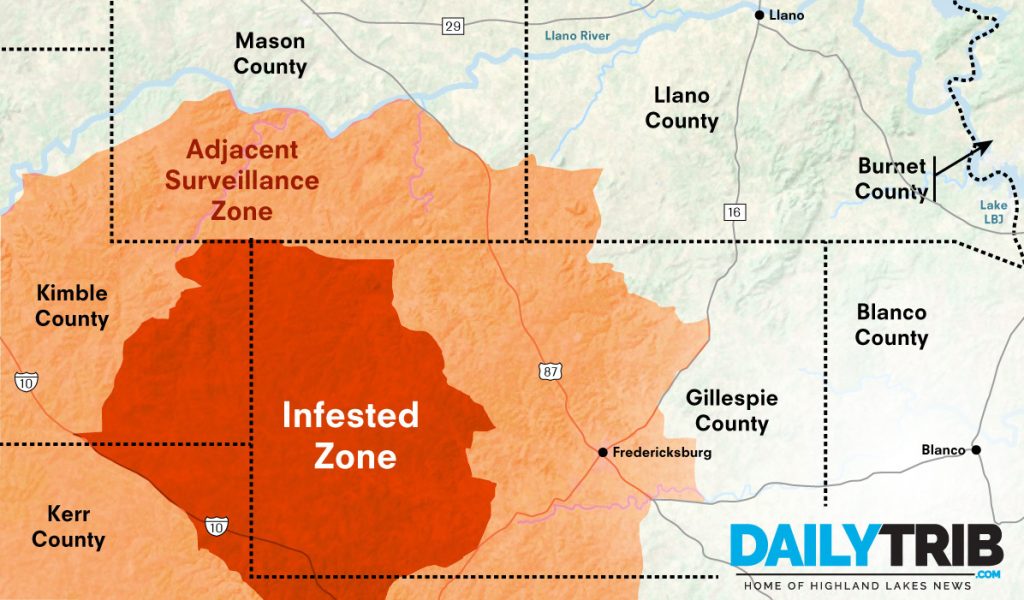
This map shows the current state of the New World screwworm outbreak in Texas, which now includes a surveillance zone in southwest Llano County. Texas Animal Health Commission map enhanced by DailyTrib staff
Editor’s note: This story has been made free by DailyTrib as a matter of public safety.
A confirmed New World screwworm case documented on Monday, June 8, in Gillespie County has put southwest Llano County within the “Adjacent Surveillance Zone” established by the Texas Animal Health Commission to monitor the outbreak.
An updated TAHC map released on Wednesday, June 10, shows southwest Llano County as within the “Adjacent Surveillance Zone” surrounding the “Infested Zone” emanating from western Gillespie County.
Residents within the Adjacent Surveillance Zone are being asked to:
- Closely monitor animals for wounds and maggot infestations
- Cover and treat open wounds quickly
- Report suspicious wounds or wounds that appear to be infested with maggots on livestock to the TAHC Incident Command Post line at 737-900-7455. Report similar symptoms in wildlife to the Texas Parks and Wildlife Department Incident Command Post at 956-755-8559
- Work with your private veterinarian on approved preventative treatment methods
The state and federal government are coordinating sterile New World screwworm fly dispersals within the surveillance zone, a method of releasing sterile male flies en masse within an area to help produce sterile eggs from females and break the insect’s breeding cycle.
Llano County is not under any animal movement restrictions as of Thursday, June 11, but any areas that are included in the Infested Zone are under strict quarantines that prohibit the movement of warm-blooded animals without prior authorization from the TAHC.
Background on the worm
The screwworm is the larval form of the New World screwworm fly. It is a flesh-eating parasite that wreaked havoc on Texas livestock, pets, and wildlife for decades before being effectively eradicated in the United States by the 1980s.
A resurgence of the bug was detected in Central America in 2023, moving steadily northward, with state and federal officials warning in 2025 of a possible U.S. outbreak.
The first confirmed infection documented in the recent wave within U.S. borders was in Zavala County, TX, on June 3.
Texas has been on high alert since the Zavala County case was detected. On Monday, June 8, Governor Greg Abbott activated the Texas State Emergency Operations Center to “Level II,” mobilizing state resources and agencies to combat the screwworm outbreak.
“I have activated the full use of all state resources to respond to the New World screwworm threat,” Governor Abbott wrote in a June 8 media release. “The protection of our ranchers, livestock producers, deer breeders, and the Texas economy from this pest is a top priority.”
Fly/worm life cycle and impacts
The concern about the worm centers on its ability to quickly harm or even kill animals if left untreated.
According to a research evaluation from the Texas A&M Agrilife Extension on the New World screwworm, female flies are attracted to fresh, open wounds on warm-blooded animals. A wound as small as a thorn scratch or a tick bite is enough to draw them in.
Of special concern are the umbilical cord attachment points on newborn livestock, castration wounds, branding wounds, shearing wounds, dehorning wounds, or other wounds caused in regular ranching or agricultural work.
Female flies lay 100-300 eggs on the perimeter of a wound and within 24 hours the eggs hatch and begin to feed on living or dead flesh in the area.
Within one to two weeks, the worms grow, feeding on their host, consuming a large amount of flesh.
“Untreated screwworm infestations can be fatal,” wrote Texas A&M Entomologist Bart Drees. “The larvae will continue to feed on the animal and will eventually eat the host alive.”
Drees wrote that treating wounds immediately was the best control measure for screwworm infestations.
“Any animal with a severe wound should not be left untreated or out in the pasture unprotected,” he said.