



Spicewood Elementary students get open heart lesson
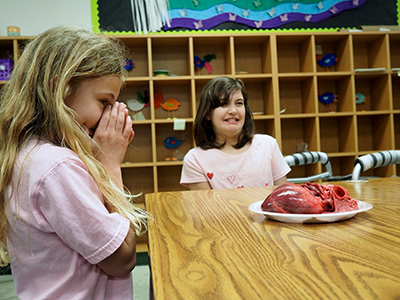
Spicewood Elementary School student Alese Martin (left) and Audra Stanfield don’t find examining a pig’s heart very enticing. Spicewood Elementary School nurse Allyson Black holds a heart lab each year during February to teach students about the heart. She talks about the makeup of the heart, how it works and how students can keep theirs healthy. It’s one of the most anticipated labs of the year — well, for some students. Staff photo by Daniel Clifton
DANIEL CLIFTON • PICAYUNE EDITOR
SPICEWOOD — Spicewood Elementary School student Audra Stanfield leaned back a bit in her chair and kept a few inches between herself and the table.
“This is very interesting, but it’s very gross,” she said during a science and health laboratory Feb. 20. She scrunched up her face a bit after campus nurse Allyson Black set a white paper plate down on the table. It wasn’t the paper plate triggering Stansfield’s reaction but the glob of red muscle sitting on it.
“We’re going to be looking at pig hearts,” Black told the class a few minutes before handing out the organs. “These look just like a human heart. Mammal hearts all have the same basic structure with two sides and four chambers.”
Black has conducted the heart lab for several years. A meat processor in Johnson City donates the hearts — in this case, pig hearts — for the program. While students can read about hearts, see them in a video or handle a model of one, there’s nothing like picking up an actual heart and examining the four chambers and other parts of the muscle.
Before passing out the hearts, Black talks about the heart and its structure. She even shows a video of the heart, which goes over the way it pumps out oxygen-rich blood to the body and brings back the oxygen-depleted blood before sending it through the lungs for more oxygen.
“It’s a cycle,” she explained.
During the lab, Black even showed a sonogram of a child’s heart. She discussed the two sides and four chambers. But then, she pointed to an open part between the two sides of this particular heart.
“The baby’s heart doesn’t have a separating wall that goes all the way down the heart,” Black said. “So the blood was mixing.”
This caused the baby’s heart to pump out less-than-fully oxygenated blood through her body, which left the child tired, weak and somewhat pale. Doctors determined the problem and recommended surgery to correct it.
“When she was a little less than a year old, they did surgery and fixed her heart,” Black said. “Now, she’s healthy and happy. But I want you to think about that. You need to think about your heart and how important it is and how you need to take care of it.”
One student asked that, since the pig heart looks so much like a human heart and functions the same basic way, could doctors implant one in a person if his or her heart wasn’t properly working.
“We haven’t come that far yet, but my father has a problem with one of his heart valves, and they did replace it with a pig’s heart valve,” Black answered.
With her lecture completed, Black handed out the hearts. Some students recoiled at first, but others, such as Lilly Otwell, picked up the heart and examined it.
“See here,” she said as she showed a part of the heart to a classmate. “It’s not that bad. It’s really pretty cool.”
daniel@thepicayune.com