




Dog’s best friend
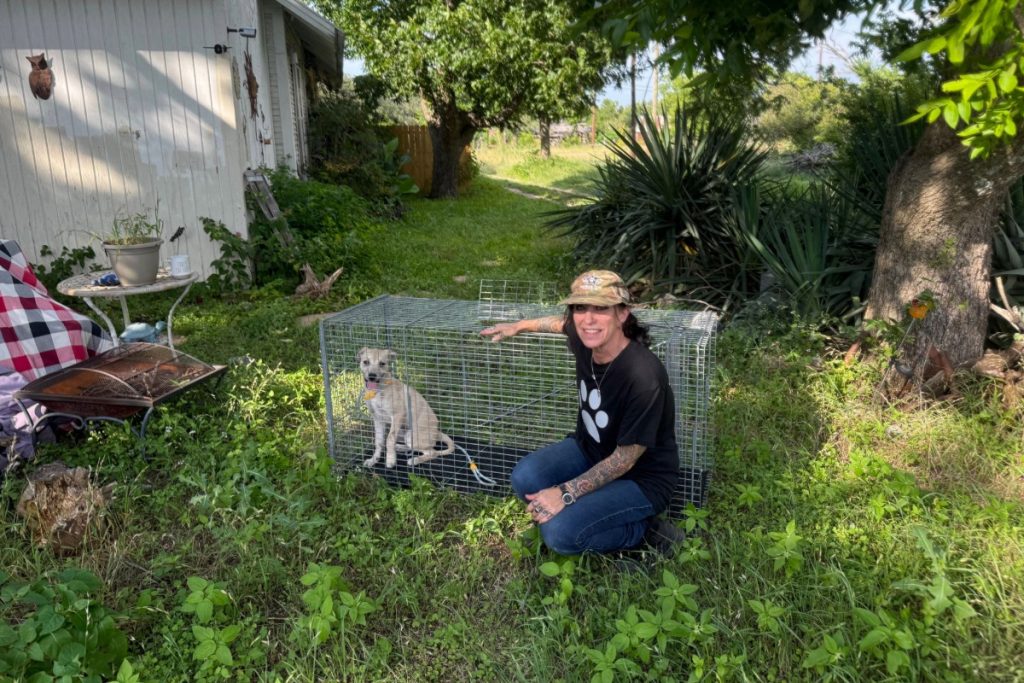
Foster dog Pandora demonstrates one of the traps that volunteer animal trapper Cori L. McCann uses to rescue lost pets and dogs dumped on the roadside. A true animal lover, McCann has six dogs and three fosters. Photo courtesy of Cori L. McCann
Volunteer Cori McCann comes to the rescue of lost and stray canines
Good training, common sense, and the right equipment—all necessities when it comes to catching lost and stray dogs. Sometimes, however, it takes a bit more than that, said volunteer dog trapper Cori L. McCann of Briggs.
“You have to have patience, so much patience,” she said. “You have to be able to sit there for 10 hours—however long it takes—and be willing to sleep in your car. Everything is a lesson in patience.”
Lost dogs go into survival mode and must be lured into well-placed, monitored, and humane wire traps, which takes planning and time, she said. Just putting food in a kennel with a trip plate won’t work.
McCann sets up live feeds and studies the animal’s behavior, sometimes for days, before setting the trap. The timing is critical. She needs to know when the dog feeds and be on hand when the cage door drops.
“I won’t leave a dog unattended in a trap,” she said. “If it’s an overnight thing, if it’s that desperate a situation, I stay overnight in my car.”
Cameras feed live images of the cage and surrounding area to McCann’s phone, which stays within reach when one or both of the two traps she uses are set. The trip mechanism isn’t activated unless McCann is on high alert near the trap.
“I make sure I’m no more than 30 seconds down the road when the trip plate is active,” she said.
The hunt for stray or missing dogs begins with a report or posting and relies on sightings, social media messages, and a relentless trapper who monitors digital media, cruises neighborhoods, and knocks on doors. Word of mouth and reported sightings are essential to the process.
“You can’t trap a dog that’s not there or one you can’t find,” McCann said. “You have to pinpoint locations, put a feeding station down, you have to put the cameras down. That’s the start of the process.”
One June rescue involved a pregnant dog dumped on the side of the road in Florence. A nearby resident secured the nine pups, but the mother hid under the house and wouldn’t come out.
McCann set up a trap, and by the time she had parked her car to monitor the momma dog’s actions, it was calmly sitting in the cage, fed and happy. The new canine family was taken to Texas Humane Heroes in Leander for care and placement.
It’s not always that easy.
Recently, McCann spent two nights in her car to trap a newly adopted dog that escaped during transport from a shelter to its forever home. The new owners stopped at a fast-food restaurant, and the dog bolted when the car doors opened.
“A drone operator flew that night and spotted her,” said McCann, who quickly set up a feeding station and trap. “It took 24 hours for the dog to find the feeding station, and another 24 hours before it worked.”
McCann assists animal control officers in Burnet and Llano counties as a volunteer. The sheriffs’ offices notify her when stray or missing dogs are hard to capture. She also gets tips through the Burnet County Lost and Found Pets Facebook page and other lost pet social media sites on Facebook and Instagram. McCann is active on all of them, working to reunite lost pets with their owners and help animals that may have been dumped.
Success stories pepper the social media sites.
“My Australian Cattle Dog, lost in the Rattan Creek Greenbelt for over two months, is now home,” one woman posted on social media. “Cori, you are a gem.”
Said another: “Cori L. McCann is such a blessing to the community! She is incredible!”
Rescued animals in the area are taken in by the Hill Country Humane Society in Buchanan Dam, a no-kill shelter that provides behavioral rehabilitation, veterinarian care, and adoption services.
HCHS Executive Director Paighton Corley singled out McCann for the way she handles the animals she rescues.
“It’s amazing what she does,” Corley said. “She not only traps strays, she can also deal with scared animals. She recently trapped a scared, escaped foster and got it back to safety. It’s now been adopted and is living its best life.”
HCHS is another step in the rescue process, all of which involves community support.
“If we ignore the stray population, it will reproduce and get bigger,” Corley continued. “That takes a community working together.”
Five years ago, only 30 percent of the animals at the Hill Country Humane Society left the shelter alive. Now, around 97 percent of the animals are saved, one of the highest save rates in the country, according to Corley.
“Our entire community should be really proud,” she said. “And we should all listen to what McCann is telling us. When she’s trapping, she asks that people not chase the animals or mess with the traps. It’s so important.”
As McCann says: “It’s a process. A very intense process, and you can’t rush the process.”
McCann works a full-time job, devoting her after-hours life to her own animals as well as to her 19-year-old daughter, Chloe Whitworth, who is a trapper-in-training, and the art of humanely rescuing dogs. She owns all the equipment but is always in need of replacements and upgrades, so she accepts donations through an online wish list.
“I post a link to an Amazon wish list, and members of the community will respond and purchase necessities,” she said. “People have been really supportive.”
Needs include flea treatments, bungee cords, carabiner clips, heavy-duty hooks, and security cables. Sometimes, bigger items are needed. Currently, McCann has two game cameras that operate on a cell network and two 6-foot-plus cages, which she lugs around mostly on her own.
“I have a 60-inch and a 72-inch trap,” she said. “They weigh about 55 pounds each. They are not that easy to move around.”
Food for traps includes Vienna sausages, tuna, salmon, raw steak, and a variety of dog foods. When trapping a missing pet, she uses whatever the owner usually feeds it.
Her love for dogs drives her passion for safe rescue, something that kicked into high gear when one of her own beloved pets escaped her yard and was shot and killed.
“It destroyed me,” McCann said. “I felt so guilty because I couldn’t save him in that moment. I have since wanted to save as many dogs as I can.”
The trauma led to action and advocacy.
“Animals don’t have a voice,” she said. “Someone needs to be their voice.”
McCann’s ultimate dream is to establish an emergency foster network for pets if their owner is hospitalized, arrested, or, for any reason, is forced to leave them behind.
“A lot of people treat their pets like family and aren’t going to leave them behind, no matter the circumstances,” she said. “Knowing their pet has a safe place to go, maybe they are more likely to go to rehab or leave a domestic violence situation.”
McCann’s animals are certainly an important part of her family, including a dog she’s had for 13 years.
“She’s my child,” she said.
Evidence of her passion for community service through rescue surfaces with each successful capture and return.
“I cry on every capture; I bawl my eyes out,” she said. “It’s a very passionate endeavor. I put my heart and soul in it. Every single one.”
WHEN YOUR PET GOES MISSING
Tips for reporting and finding lost animals are listed on McCann’s Facebook page, Central Texas Highland Lakes Area Lost and Found Pets. This is a short version of the do’s and don’ts.
- Post on all lost pet social media platforms and keep track of each. Include town/city and major roads/cross streets near where the animal went missing. Include your phone number, but do not include the pet’s name.
- Put up colorful posters around your neighborhood, also with the above information.
- Never offer a reward, as this can attract scammers.
NOTIFY LOCAL SHELTERS AND ANIMAL CONTROL
- Burnet County Sheriff’s Office, 512-756-8080
- Llano County Sheriff’s Office, 325-247-5767
- Burnet/Marble Falls police departments’ non-emergency line, 830-693-3611
- Bertram City Hall (to request the animal control officer), 512-355-2197
- Hill Country Humane Society, 512-793-5463