




In the Garden: Soil vs Dirt
Although we often interchange the words dirt and soil, they aren’t the same thing. We found a great definition from Soil Science Society of America. “Soil is alive with living organisms such as worms, fungi, insects, bacteria, and organic matter. It supports life with its naturally occurring nutrients and minerals, making it a perfect planting medium. It is a complete and self-sustaining ecosystem.” While on the other hand dirt is “displaced soil.” Once soil is displaced it breaks up the ecosystem and becomes the annoying dirt, we are washing off our gloves and out of our clothes.
Soil
You have often heard us mention to mulch, mulch, mulch. Okay so many more times than often. One of the reasons why it is important to mulch is to protect the soil ecosystem that provides a healthy habitat for our plants. The mulch protects the organisms, as well as the roots from the harsh environment whether August heat or 3rd week of January cold. For instance, after a heavy dew or rain earthworms (natures soil rototiller) will rise to the top of the soil. The mulch works as their umbrella so that they aren’t baked from the sun the next afternoon. The mulch also works as a barrier to control temperatures (as best it can in Central Texas weather). Think of the insulated bags we use to bring groceries home from the store. The insulated bag helps maintain the needed temperature for your food. Mulch will also break down into organic matter, thus the need to continuously add more mulch.
Gentle reminder: since mulch does such a great job of creating a sustainable habitat for bugs, always make sure and leave a 6” ring of un-mulched area around your trees. Some bugs we don’t want so cozy with our trees.
Our plants need nutrients in their most basic form. For instance, Nitrogen is essential for chlorophyll and cell formation of plants. Oxygen is needed for respiration and energy production. Microbes eat and digest organic matter in our gardens, flower beds, fields, and pastures. The eating and digesting results in nutrients in their basic form. Microbes, microorganisms such as fungi and bacteria, are citizens of our soil ecosystem. During certain times of the seasons, we will advise to add organic matter to your gardens. This action feeds the microbes which in turn feeds our plants. It’s a wonderful circle.
Robins
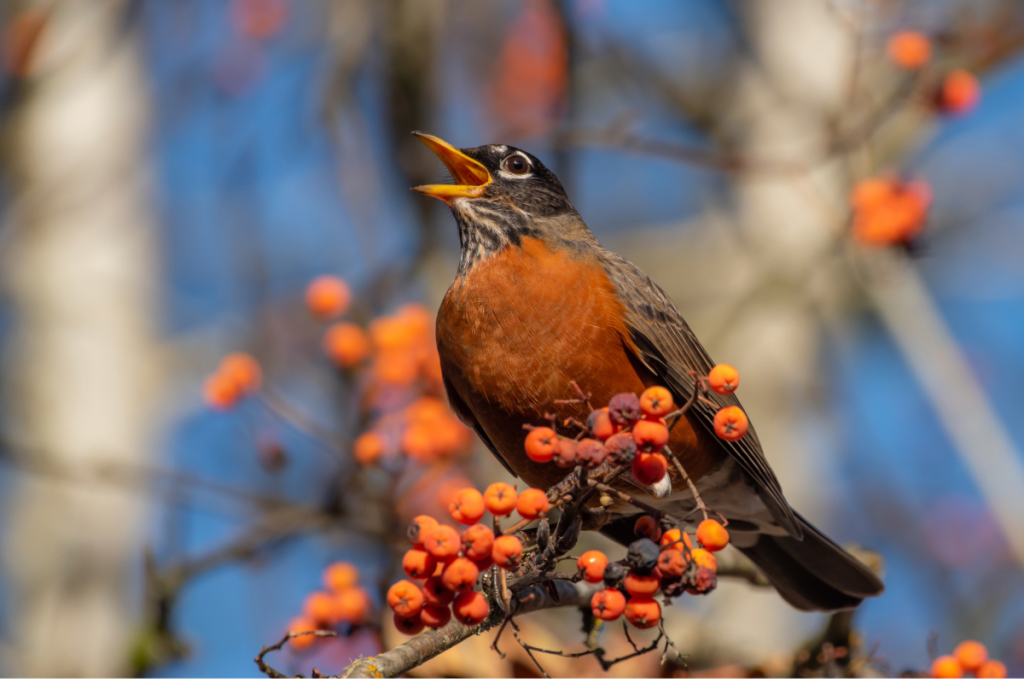
Have you seen the Robins? With the cooler weather we have a changing of our avian guard. Did you know in the Blackfoot tribe, robins are a symbol of peace? When they saw a robin, they believed their camp was safe from attack. Ever watch a robin catch a worm. They’ll stand motionless with their head cocked a little to the side. And then when the worm thinks it’s safe and pops its head above the soil, the robin is there for breakfast.
December Duties:
1.) Keep an eye on the weather. Although we have time to prepare for the Spring most of the time, we don’t know which days.
2.) Add organic material to all your beds, flower, and garden.
3.) If your bulbs (includes both tulip and hyacinth) have been in the refrigerator for the last 4-6 weeks, time to put them in the soil
4.) Please do not prune your fruit trees yet. When we prune fruit trees, we are telling them that it’s time to start new growth and bud. We’ll let you know when to prune your fruit trees.
5.) Set out those cool season plants such as pansies, violas, stock, snapdragons.
6.) Start planning your Spring Garden.
Keep your souls and soles in your garden! Till next time.
Remember the True Master Gardener: Jesus said, “I am the vine; my Father is the Gardener.” John 15:1 Contact Martelle Luedecke (512) 769-3179 at luedeckephotography@gmail.com or Bill email bill@texasland.net.