




1800s Texas Rangers at Smithwick Cemetery get their crosses

A Texas Ranger Memorial Cross was placed at the gravesite of Elias Jackson (1823-91) in Smithwick Cemetery during a March 29 ceremony. Jackson served under Capt. Christian Dorbandt Sr. in 1864. Staff photo by Suzanne Freeman
Seven Texas Rangers who served during and after the Civil War received graveside recognition at a recent ceremony at Smithwick Cemetery. Metal crosses with Texas Ranger badges were placed next to six headstones in the cemetery. A seventh ranger who served with the lawmen, but was not buried in the cemetery, was also honored.
The rangers were under the command of Capt. Christian Dorbandt Sr. in the 3rd Frontier Division, most in 1864. Two served from 1870-71.
“It wasn’t like an occupation back then; it was more like the military,” said Texas Ranger Association Foundation President Joe B. Davis, who spoke during the March 29 ceremony. “Rangers are buried everywhere, all over the state. We wanted to start marking these graves so people will know that they served.”
The Texas Rangers were founded in 1823 by Stephen F. Austin. In 1935, the law enforcement agency became the state’s Bureau of Investigation under the Texas Department of Public Safety. Only 166 rangers serve on the force today. When Davis joined 28 years ago, that number was 72.
TRAF is a nonprofit association. The foundation provides the crosses as part of its mission to mark the graves of past rangers. It also raises money for scholarships and operates the Texas Ranger Museum in the Buckhorn Saloon and Museum in downtown San Antonio. The Texas Ranger Hall of Fame and Museum in Waco is run by the city in partnership with the DPS.
“We’ve been holding these ceremonies since the late 1990s,” Davis said. “So far, we have marked over 800 graves.”
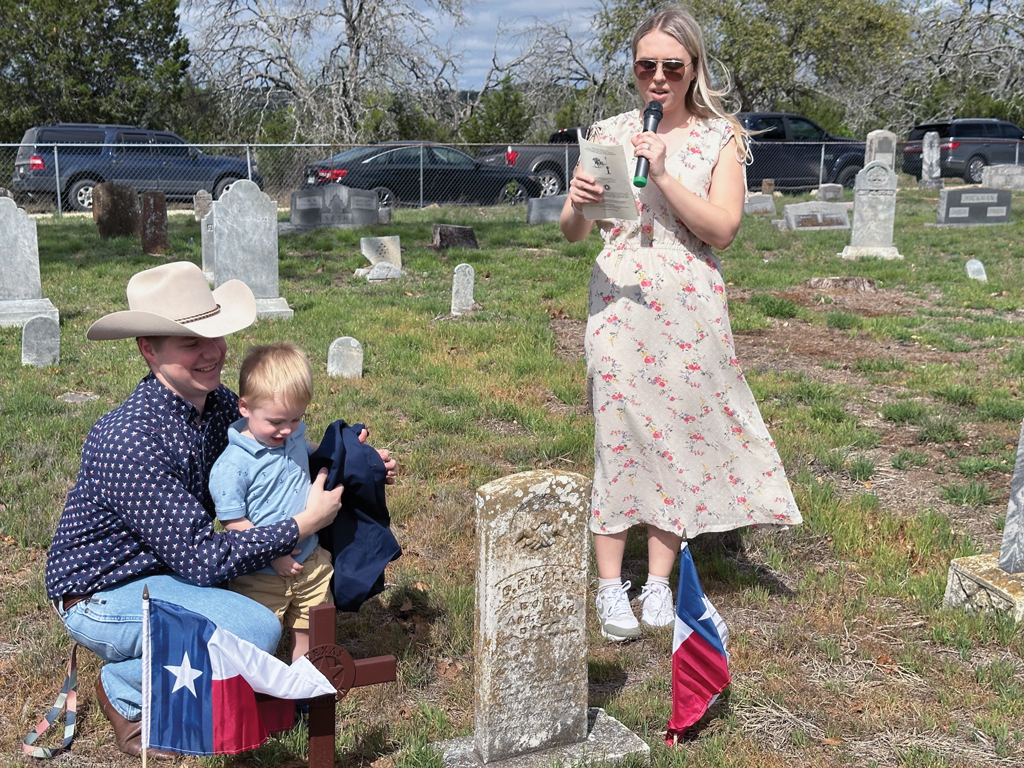
Llano Middle School history teacher Nichole Ritchie of Cottonwood Shores researched the seven Smithwick-based rangers. Ritchie and her husband, Michael, a Cottonwood Shores city councilor, are history buffs. Together, they found two lost Texas Centennial markers, one in Burnet County and the other in Llano County. The Burnet County marker has been restored and is now displayed prominently on the courthouse lawn in Burnet. Restoration of the Llano County marker is underway.
“I did the research five years ago,” said Nichole of the Texas Rangers buried in Smithwick Cemetery. “I gave all the information to the cemetery association but didn’t hear anything until recently when they called and said, ‘We are ready to move forward on this.’”
The March 29 ceremony drew around 50 people, including descendants of the recognized rangers. After a few words from Davis, the Ritchies led the crowd from headstone to headstone, and Nichole spoke about each lawmen. Her husband and 2-year-old son, Colton, uncovered the crosses. Each cross was covered by a blue velvet case.
The seven Texas Rangers honored all served under Capt. Dorbandt. Three of the six buried in Smithwick Cemetery are Elias Jackson, Benjamin Franklin Hall, and Calvin Austin Hall. Ranger Israel DeSpain also served under Dorbandt in 1864 but is not buried in the cemetery. Rangers serving from 1870-71 were Zebulon Riley Jackson and Riley V. Parker. William Carol Heffington served the longest, from 1863 until the end of the Civil War in 1865.
Smithwick Cemetery is 11 miles southeast of Marble Falls on RR 1431. A historical marker was placed at the site in 1997.
Capt. Dorbandt died in 1910 and is buried in South San Gabriel Cemetery. His gravesite received a Texas Ranger Memorial Cross in 2014.
Smithwick Cemetery historical marker
The history of Smithwick Cemetery dates to 1854, when 18-year-old Rebecca Chambers died and was buried there. Rebecca was reportedly ill while traveling through the community, just southeast of Marble Falls, with sister and brother-in-law Nancy and E.G. Evans. She asked to be buried on a flower-covered hillside where the cemetery now sits.
While the land was vacant public domain, several other burials took place on it. About 65 early graves are marked only by rocks. The cemetery site was part of a 160-acre survey by A.J. Stanford and patented in 1857. The burial grounds were used by early settlers of Hickory Creek, Elm Grove, and Smithwick’s Mill.
The Smithwick Cemetery Association formed in 1930. Land was added to the site over the years, a caretaker was hired, and improvements were made, including a tabernacle and fencing. The association continues to maintain the cemetery. Among the 600 burials there are five unknown bodies reinterred from the South San Gabriel River area in 1974 by the U.S. Army Corps of Engineers as well as veterans of the Civil War, Spanish-American War, World War I, World War II, and Korean War.